
It is not just a technology upgrade but a fundamental rethink of how you understand your customers
For years, Adobe Analytics was the gold standard for digital measurement. It answered the questions that mattered most in a web-centric world: Which campaigns drove conversions? Where are visitors dropping off? Which pages perform best?
Those are still valid questions. But they’re no longer sufficient.
Today’s customer doesn’t live in a single session. They discover your brand on Instagram, research on desktop, call your support center, walk into a store, and finally convert on mobile — often over days or weeks. If your analytics only captures what happens on your website, you’re seeing a fraction of the story and making decisions on incomplete information.
That is precisely the gap Adobe Customer Journey Analytics (CJA) was built to close.
From Session Data to Customer Understanding
Adobe Analytics is a session-based measurement tool. It is exceptionally good at what it was designed to do: track visitor behavior across your digital properties and surface patterns in that data.
But session data has inherent limits:
- It treats each visit as a standalone event, disconnected from the customer’s broader journey
- It cannot natively reconcile a logged-in desktop user with a mobile app visitor and an in-store purchase
- It reflects digital interactions only, leaving out the CRM records, call center logs, loyalty data, and offline transactions that often explain why customers behave the way they do
CJA shifts the unit of analysis from the session to the person. Rather than asking what happened on the website, it asks what did this customer experience end-to-end – and what drove their decision?
Built on Adobe Experience Platform: A Different Foundation
The reason CJA can do what Adobe Analytics cannot comes down to what it is built on: Adobe Experience Platform (AEP).
AEP acts as a unified data foundation, bringing together all customer data, online and offline, into a standardized framework called the Experience Data Model (XDM). This is not cosmetic. It fundamentally changes what analysis is possible.
With CJA on AEP, organizations can:
- Ingest any data source — web behavior, mobile events, CRM records, POS transactions, call center interactions, loyalty platforms, and more — unified into a single schema
- Stitch identities across channels, connecting anonymous browsing to known customer records to create a coherent, person-level view of every interaction
- Process data flexibly at report time, meaning teams can create new segments, dimensions, and metrics without going back to change data collection or rewrite implementation code
That last point is easy to underestimate. Traditional analytics architectures lock you into whatever questions you anticipated when you built them. CJA lets your analytics evolve as fast as your business questions do — without requiring an engineering sprint every time.
Seeing the Full Journey, Not Just a Chapter of It
One of the most practical shifts CJA enables is the ability to build cross-channel journey views that actually reflect how customers behave.
With Adobe Analytics, you might have separate dashboards for your website, your app, and your contact center — each telling a partial story, with no easy way to connect them. CJA allows analysts to:
- Build end-to-end funnel and journey visualizations that span web, mobile, CRM, and offline touchpoints in a single analysis
- Identify where customers fall through the cracks between channels — the moments where a great web experience hands off to a frustrating call center interaction, for example
- Apply flexible attribution models that reflect the complexity of multi-touch, multi-day journeys rather than forcing last-click logic on non-linear behavior
The insight shift is significant: instead of optimizing individual channels in isolation, teams can start optimizing the overall experience customers have as they move between them.
Analytics That Grow with Your Business
Legacy analytics architectures can become a constraint over time. As business questions evolve, teams often find themselves limited by the dimensions and metrics baked into their original implementation.
CJA removes that constraint:
- Unlimited dimensions and metrics — build the views your business needs today, not just the ones you anticipated when you went live
- Flexible schema design — adapt your data model as new sources, channels, or product lines come online
- Report-time processing — re-analyze historical data with new logic without re-collecting it, which is invaluable when business definitions change or new questions emerge retroactively
For analytics teams, this means less time waiting on implementation changes and more time generating actual insight.
This Is a Migration — Plan It That Way
It would be a disservice to suggest that moving to CJA is straightforward. Because it uses a different data processing model, identity framework, and analytical structure than Adobe Analytics, organizations that approach it as a simple swap typically run into friction.
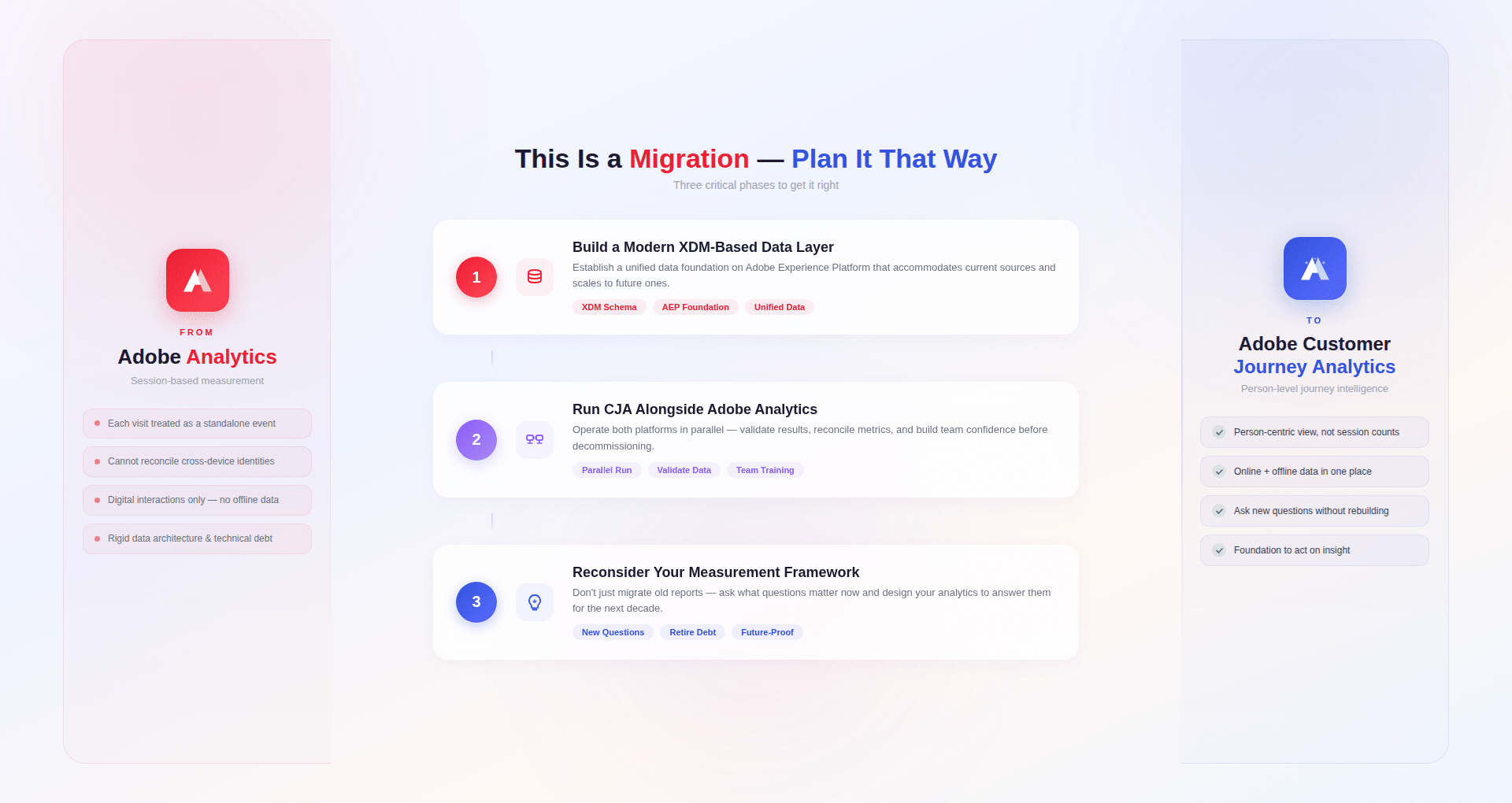
A well-planned migration involves:
- Building a modern XDM-based data layer that can accommodate your current sources and scale to future ones
- Running CJA alongside Adobe Analytics during the transition period to validate results, reconcile metric differences, and build team confidence before decommissioning
- Reconsidering your measurement framework — not just migrating old reports into a new tool, but asking what questions matter now and designing your analytics to answer them
Done well, this transition is an opportunity to retire years of accumulated technical debt, consolidate fragmented analytics investments, and build a foundation that actually serves the business for the next decade.
The Bottom Line
The case for moving to Adobe Customer Journey Analytics is not primarily about features. It’s about the kind of organization you want to be.
If your analytics are still session-centric, channel-siloed, and tied to a rigid data architecture, you’re not just missing insight — you’re making decisions about customer experience with information that doesn’t reflect how your customers actually behave.
CJA gives you:
- A person-centric view, not a session count
- Online and offline data in one place, not three separate dashboards
- The flexibility to ask new questions without rebuilding your implementation
- The foundation to act on insight, not just report it
The shift from Adobe Analytics to CJA is a shift from measurement to understanding — and for organizations competing on customer experience, that distinction increasingly determines who wins.
Considering a move to Adobe Customer Journey Analytics? InfoVision’s Adobe practice has helped organizations design and execute this transition. Contact our expert to talk through what it would mean for your data environment.