

AI has stopped being a future conversation. It is showing up in how teams actually work right now — in how decisions get made, how reports get built, and whether a manager spends Tuesday morning reviewing data or acting on it.
Moderating this conversation for AICoreSpot, an AI-focused community for leaders and technology experts, I kept coming back to one uncomfortable idea: this debate is almost never really about the technology. It is about understanding where it can support people, where human judgment must stay central, and how organizations can build a workplace where both actually work together.
The webinar, The Future of Work: Empowering People Through AI and Intelligent Automation, brought together Russ Felker, Chief Technology Officer at MegaCorp Logistics; Mu Qiao, Senior Director of Software Engineering at Hertz; and Pratyoosh Patel, Emerging Technology Practice Leader at InfoVision. What struck me listening to all three was that their starting points were completely different – logistics, consumer mobility, emerging tech consulting — but they kept landing in the same place: the organizations that will actually benefit from AI are the ones investing in their people, not just their tools.
AI Is Already Taking Over Pieces of Work
AI is not replacing entire roles – not yet, and probably not in the way most people fear. What it is doing is chewing through the parts of a job that nobody enjoys: reading through dashboards before a meeting, chasing status updates, moving information from one system to another.
That changes something fundamental about what a job is actually for. If the task-completion part is increasingly automated, what you are left responsible for is the thinking — knowing what to push back on, what to trust, and when a result that looks right is actually wrong.
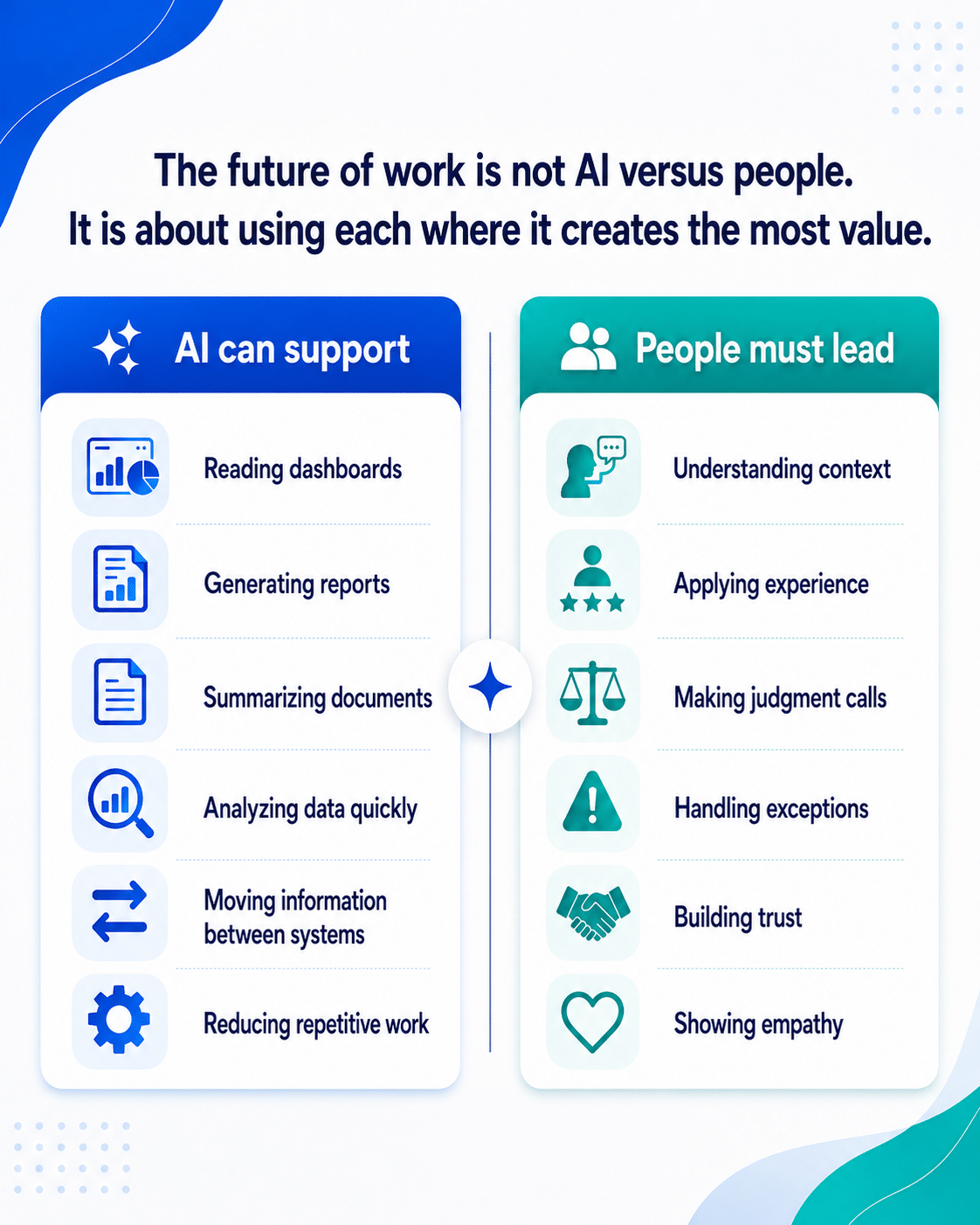
That is why the future of work is not AI versus people. It is people working with AI, with more clarity about where each actually creates value.
Will AI replace jobs, or will it change the way people work?
The Real Shift Is From Doing Everything to Deciding Better
One of the most important changes AI brings is the movement of information work away from people.
AI can read dashboards, scan repositories, generate reports, summarize documents, analyze data, and bring useful inputs together much faster than traditional manual methods. This is already changing how teams prepare for decisions.
But that does not mean AI should own every decision.
Business decisions are rarely made from visible data alone. They also depend on context, experience, customer realities, operational constraints, relationships, risk appetite, and timing. Much of that knowledge still lives with people.
That is where human value becomes even more important.
AI can process information at speed. People still need to convert that information into judgment.
Every Employee May Need to Learn How to Manage AI
As AI becomes part of everyday work, employees will need more than familiarity with the tools, they will need a genuinely different operating mindset. Many people will have to manage not only their own time and priorities, but also how AI contributes to their work: giving it direction, checking its outputs, spotting the gaps it misses, and knowing when to step in.
The skills that made someone great at their job five years ago still matter. But there is a new layer now: knowing how to work alongside AI without either over-trusting it or ignoring it.
What Should Organizations Automate First?
The strongest AI use cases do not always begin with the most exciting ideas, they often begin with the most repetitive work. Every organization has predictable tasks where people spend time collecting information, checking status, moving data, or completing steps that do not require deep judgment. That is where AI can create early value.
For retail organizations, these opportunities may exist across store operations, inventory follow-ups, order status checks, workforce scheduling support, customer service triage, product availability checks, and back-office reporting.
The better question for leaders is not, where can we use AI? It is, where are our teams spending too much time on work that does not need deep human judgment?
Human-in-the-Loop Will Remain Critical
Human-in-the-loop is often treated as a technical safeguard, but in business, it is also a trust mechanism. Routine tasks like status checks or standard updates can be handled well through automation. But when the situation involves empathy, exception handling, or real accountability, people still expect a human.
This matters deeply in retail. A customer checking delivery status may accept an automated response. But a customer dealing with a failed delivery, a refund problem, or an urgent service issue needs someone who understands the situation beyond a policy. Automation can handle the transaction. It cannot handle the moment when a customer is frustrated enough to leave.
When should AI handle customer or employee interactions, and when should a human step in?
Scaling AI Needs More Than Experiments
AI adoption cannot stay trapped in experiments that never move forward. Organizations need to start small, learn quickly, and scale with purpose, but a small start is only useful when it is connected to a larger direction.
For some teams, moving slowly makes sense because customer impact or operational risk is high. For others, especially in internal or low-risk environments, moving faster is possible and sensible. Either way, scaling AI needs real structure: guardrails, adoption tracking, outcome measurement, and clear evidence of business value.
Too many AI pilots get approved because the demo looks good. What gets forgotten is whether it is actually solving a problem that matters.
Workforce Readiness Begins With Showing What Is Possible
AI adoption is not only a technology rollout – it is a people transition. Teams need access to tools, but they also need confidence: to see what good usage actually looks like, to understand where AI helps and where it fails, and to know that their own role becomes more valuable, not less.
There is a big difference between a leader who says “we are adopting AI” and one who shows up to a team meeting and says “I tried this last week – here is what worked and what did not.” Teams respond to the second version. It gives them permission to experiment without looking foolish.
Many employees may have tried AI once, got a poor result, and decided it was not useful. That is one of the most common adoption blockers, and the answer is not more hype – it is better examples, better playbooks, and better support. People trust outcomes more than theory.
How can leaders help teams become more confident in using AI?
The Fear Around AI Should Be Acknowledged, Not Ignored
There is something we do not say often enough in these conversations: a lot of people are genuinely scared. Organizations have spent years hiring and rewarding people for working in a certain way and now AI is asking those same people to change how they work, how they think, and how they prove their value.
Some employees will adapt quickly, some will be skeptical, and some will struggle. Leaders cannot dismiss this with motivational language. The future-ready workforce will need both willingness and capability, but organizations must also create the right environment for people to learn, experiment, and grow into this change. AI transformation cannot succeed if people feel left behind.
AI Should Scale People, Not Simply Shrink Teams
One of the most important risks in the AI conversation is treating productivity gains only as a headcount reduction opportunity. That is too narrow, and frankly short-sighted. The better use of AI productivity gains is not smaller teams – it is better teams. Teams that can handle more complexity, respond faster, and spend less time on the administrative weight that wears people down.
There is also a practical risk in removing human capability too aggressively. Every technology can fail, and when it does, organizations still need people who understand the process, the exceptions, and the customer impact. The stronger approach is to use AI to scale people.
For retail, this matters even more. Demand shifts quickly, customer expectations are high, and store and digital operations are tightly connected. If AI is used only to cut effort, businesses may end up weakening the very human capability that protects the experience.
What is the real opportunity for companies when AI makes teams more productive?
What This Means for Retail Leaders
For retail leaders, this is not a distant strategy topic. Store teams need faster support. Customer service teams need better context. Supply chain teams need stronger visibility. Digital teams need more personalization. Back-office teams need fewer manual delays. Leaders need better inputs for faster decisions.
AI and intelligent automation can support all of this – but only when applied thoughtfully. The opportunity is not to automate everything. It is to remove friction where it slows people down, improve decision-making where teams need better information, and protect human judgment where customer trust depends on it.
Retail runs on both efficiency and empathy.
AI can improve the first. People must continue to carry the second.
The Human Advantage in an AI-Enabled Workplace
As I reflected on the conversation, one idea stayed with me: the future of work is not about choosing between people and AI, it is about designing work more thoughtfully.
AI can automate repetitive tasks, surface patterns, and help teams move faster. But it does not know what a customer actually meant when they said they were “fine” with the service. It cannot sense that a team is burning out even though the output numbers look good. And it cannot take responsibility when something goes wrong. Those things still belong to people.
The future of work will not be less human. If anything, it will demand more of us — not more hours, but more judgment, more honesty, and more willingness to own the outcomes that automation cannot.
Watch the full webinar here:
The Future of Work: Empowering People Through AI and Intelligent Automation