

Healthcare may finally be moving past the AI demo phase.
For the last two years, ambient AI in healthcare has mostly been sold as a documentation fix: less typing, fewer clicks, faster notes, reduced burnout, and more face time with patients.
That story helped drive adoption. It just is not the whole story anymore.
The bigger shift is operational.
Ambient AI is starting to change how work moves through the healthcare enterprise. The note is becoming less of a static record and more of a trigger for downstream action: coding review, referrals, follow-up instructions, prior authorization preparation, quality reporting, and revenue cycle workflows.
The organizations getting the most value out of ambient AI are not simply deploying digital scribes. They are redesigning workflows around continuously captured clinical context.
In Brief
Q: What is ambient AI in healthcare?
A: Ambient AI uses voice, natural language processing, and clinical context to capture conversations during care encounters and convert them into documentation or workflow inputs. Its broader value appears when that context supports downstream work such as coding, referrals, authorization, and follow-up.
The Early Results Are Promising, But They Need Context
The strongest evidence today supports documentation burden reduction and improved clinician experience. But the results are not uniform across every setting.
Some health systems are reporting meaningful improvements in after-hours work, note closure, and clinician focus. Others are seeing more modest gains at enterprise scale.
What the Early Data Shows
Ambient AI is showing clear promise in documentation and clinician experience, but wider impact depends on adoption depth, specialty fit, and workflow redesign.
93%
More attention during visits
Physicians said ambient AI helped them give patients their full attention. [1,2]
41%
Less after-hours work
Reduction in after-hours documentation work reported by Mass General Brigham. [3]
66%
Fewer delayed notes
Reduction in delayed note closures through a hybrid ambient documentation model. [3]
13–16
Minutes saved
More modest time savings found across five academic health systems. [4]
The emerging pattern is simple: ambient AI can improve documentation workflows, but broader operational gains depend on how deeply it is adopted and how well the surrounding workflow is redesigned.
In Brief
Q: Why do ambient AI results vary across health systems?
A: Outcomes depend on adoption depth, specialty fit, clinician trust, training, EHR integration, and whether the surrounding workflow is redesigned. Light or inconsistent usage may reduce documentation effort but is unlikely to create wider operational gains.
The Real Opportunity Starts After the Note
Historically, the clinical note functioned mainly as documentation of what already happened.
Ambient AI changes that dynamic because clinical intent becomes structured and available much earlier in the process.
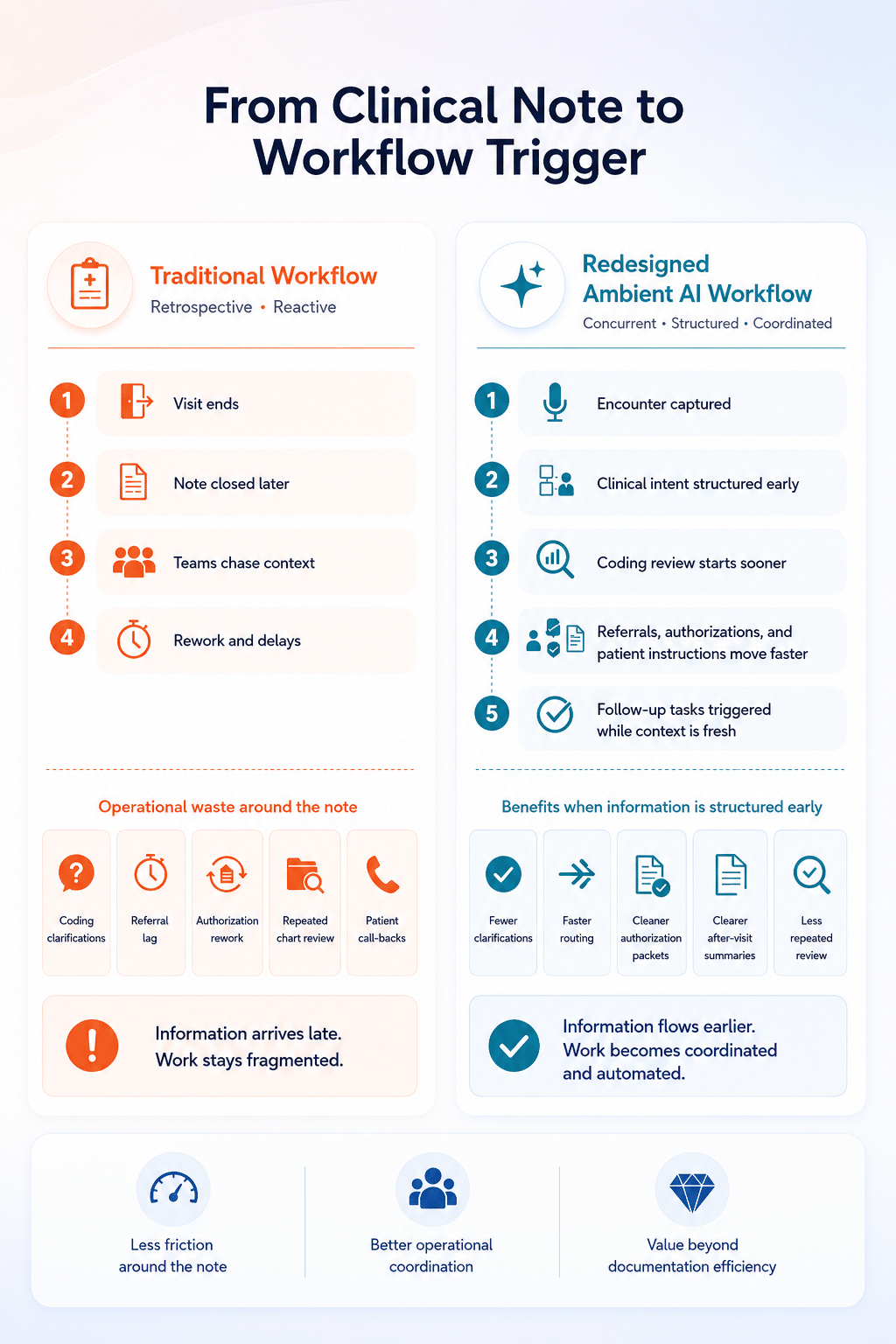
The old workflow was retrospective. The visit ended, the note was closed later, and downstream teams often had to chase missing context.
With ambient AI, the workflow becomes more concurrent. The encounter can begin producing structured inputs for coding, referrals, authorization, patient instructions, and follow-up while clinical intent is still fresh.
That is a much bigger shift than faster transcription.
Much of the operational waste sits around the note: delayed signatures, coding clarifications, incomplete documentation, referral lag, authorization rework, repeated chart reviews, and avoidable patient call-backs.
Ambient AI changes the economics of clinical context availability. When information becomes structured earlier, workflows that were previously fragmented and reactive can start becoming more coordinated and automated.
In many organizations, the operational coordination enabled by ambient AI could become more valuable than the documentation efficiency gains that initially drove adoption.
In Brief
Q: Where does ambient AI create the strongest ROI?
A: The strongest opportunity often sits after the note: fewer coding clarifications, faster referral routing, cleaner authorization packets, clearer after-visit summaries, and less repeated manual chart review across teams.
Ambient AI Is Moving Beyond the Scribe Market
The ambient AI market has become crowded quickly, with Microsoft/Nuance, Abridge, Suki, Nabla, DeepScribe, Ambience, and others competing for health system adoption.
But the real buying decision is shifting.
What Will Matter More in Vendor Selection
As AI-generated notes become easier to deliver, health systems will likely evaluate ambient AI on workflow depth, not documentation alone.
Specialty Fit
Does the solution understand the documentation and workflow needs of different specialties?
Workflow Integration
Can it connect with coding, referrals, authorization, patient communication, and revenue cycle workflows?
Governance Readiness
Does it support consent, auditability, human review, attribution, privacy, and liability controls?
Operating Fit
Can it work across EHRs, specialty systems, payer portals, call centers, and analytics environments?
As AI-generated notes become more common, healthcare organizations will need to look beyond transcription quality alone. The next layer of differentiation will come from workflow integration, specialty depth, deployment speed, analytics, governance, and how well the solution connects with the broader operating environment.
Epic’s move into native ambient capabilities may accelerate that shift, especially for Epic-heavy organizations.[5] Third-party vendors will likely need to prove value beyond note generation by supporting downstream workflows across coding, referrals, prior authorization, patient communication, and revenue cycle operations.
In Brief
Q: Why is workflow depth becoming important in ambient AI vendor selection?
A: As AI-generated notes become more common, differentiation will depend on how well ambient AI connects with specialty workflows, EHRs, revenue cycle tools, payer processes, analytics, and governance models.
Governance Is Becoming a Strategic Requirement
As ambient AI moves from note generation into downstream workflow support, governance moves from checkbox to strategic enabler.
Governance cannot be treated as a side conversation anymore.
As ambient AI moves beyond documentation and starts influencing operational workflows, the risks become more consequential.
Governance Areas That Need Clear Ownership
Healthcare organizations now have to think through patient consent, audio retention policies, HIPAA and third-party processing requirements, state recording laws, hallucination monitoring, auditability, attribution accuracy, human review expectations, and liability boundaries.
This is not simply a compliance issue. It is an operational scaling issue.
If healthcare organizations cannot trust AI-assisted downstream workflows, the broader workflow redesign vision stalls.
Workflow redesign also does not mean handing clinical operations to an autonomous black box. The scalable model is AI-prepared work with clear human review points, especially for clinical decisions, coding, orders, patient instructions, and anything tied to liability or reimbursement.
No governance, no scalable orchestration.
In Brief
Q: What governance is needed for ambient AI?
A: Governance should cover patient consent, audio retention, HIPAA and third-party processing, state recording laws, hallucination monitoring, auditability, attribution accuracy, human review points, and liability boundaries.
Where Healthcare Leaders Should Focus
The better strategic question is not, “Where can we deploy ambient AI?”
It is, “Where does documentation friction create the most downstream operational waste?”
For many organizations, that means focusing first on high-friction environments like primary care, specialty referrals, oncology, chronic disease management, surgical documentation, discharge planning, and prior authorization workflows.
Metrics That Show Real Value
Clinician Impact
Note closure time, documentation lag, and after-hours EHR usage.
Operational and Financial Impact
Coding clarification volume, denial patterns, referral turnaround, and days in AR.
Patient Impact
Clearer after-visit summaries, fewer avoidable call-backs, and improved follow-up adherence.
That is the real shift happening underneath the surface.
Ambient AI is becoming less of a productivity tool and more of an operational redesign initiative.
In Brief
Q: What metrics prove ambient AI is creating value?
A: Useful metrics should cover clinician, operational, financial, and patient impact, including note closure time, documentation lag, coding clarification volume, denial patterns, referral turnaround, days in AR, avoidable call-backs, and follow-up adherence.
The Scribe Is the Wedge
Ambient AI will not transform healthcare simply because it writes cleaner notes.
Its long-term value is that the clinical conversation itself becomes usable operational data.
A clinician finishes the visit. The note is drafted. Coding review starts earlier. The referral already contains better context. Patient instructions and after-visit summaries are generated faster and at a more understandable reading level. An authorization packet requires less manual cleanup. Another downstream team avoids yet another chart review cycle.
None of that feels particularly futuristic.
That is probably the point.
The most valuable healthcare AI may not be the flashiest. It may simply remove the friction healthcare organizations had quietly learned to tolerate.
References
[1] Stults CD, et al. An Ambient Artificial Intelligence Documentation Platform for Clinicians. JAMA Network Open. Published May 2, 2025.
View source
[2] American Medical Association. With ambient AI, 93% of doctors can give patients “full attention.” Published Nov. 5, 2025.
View source
[3] Mass General Brigham. Hybrid Ambient Documentation Decreases After-Hours Work, Note Delays for Physicians. Published Nov. 25, 2025.
View source
[4] Rotenstein LS, et al. Changes in Clinician Time Expenditure and Visit Quantity Associated With AI Scribes. JAMA. Published 2026. DOI: 10.1001/jama.2026.2253.
View source
[5] KLAS Research. Epic’s Ambient Speech Announcement 2025: How Epic’s Move into Ambient Speech May Shape Customer Strategies. Published September 26, 2025.
View source