

With AI dominating and reshaping every industry conversation, it is natural to wonder: is this technology mere hype, or is it truly here to stay? Are we still experimenting, or have we crossed into implementations that genuinely bolster AI’s game-changing claims?
The Future of AI-Driven Retail Supply Chain & Transportation Management
Moderated by: Monica Umesh, Director of Retail, InfoVision
Panelists:
-
Ravi Thatavarthy, CISO, Empiric Health
-
Sameer Bhavanibhatla, Data & AI Leader
Retail has made real strides in AI adoption, with measurable impact for both workers and customers. This article focuses on a critical piece of that journey: supply chain and transportation management.
Most supply chain systems were built for a predictable world, steady rhythms of demand forecasting and inventory management. That world no longer exists. Margin pressure, global disruption, sustainability goals, and rising customer expectations are reshaping how retailers plan, move goods, and respond to change.
What’s needed now isn’t isolated automation but a layer of intelligence powering smarter, more resilient supply chains. The retailers who win the next decade won’t just have the best products, they’ll have the smartest supply chains behind them.
This blog shares insights from a webinar on The Future of AI-Driven Retail Supply Chain & Transportation Management, where the consensus was clear: start now, don’t wait for a perfect AI strategy.
How is AI changing the way you think about demand forecasting day to day?
The industry is moving from traditional demand forecasting based on historical patterns to always-on predictions. Instead of relying on static history and fixed daily updates, AI enables real-time rerouting and dynamic carrier selection.
For example, if the East Coast sees lower store traffic because of a regional holiday, AI can help teams reroute inventory to the Midwest instead of continuing to follow last month’s plan.
Challenges in AI Adoption
As against periodic forecasting, continuous prediction is the need of the hour for retailers. Traditional supply chains looked backwards. AI-powered ones do not. They scan in every direction at once – picking up signals from traffic patterns, local events, weather disruptions, and live browsing behavior. The result: decisions that are near-real-time, not days or weeks after the fact. The engine behind all of this? Clean, well-structured data.
This is why the panellists emphasize thinking through the lens of data first. The fundamental question to answer is: how clean is your data?
Both Ravi Thatavarthy and Sameer Bhavanibhatla make this point emphatically: AI is only as intelligent as the data feeding it. Organizations that have built well-structured, accessible data lakehouses are certainly leading the way, both for now and the future. Those still working with fragmented, siloed, or inconsistently maintained data will find that AI amplifies their problems rather than solving them.
Legacy infrastructure is also a formidable challenge. Many of these systems, while still functional, are not scalable and simply not built for the demands of the new world. “This is a definite pain point that we need to look at”, says Sameer. Many warehouse management and transportation systems in use today were not designed to integrate with modern AI platforms. Addressing that technical debt, in small progressive steps is critical to steering the organization in the right direction.
What do organizations get wrong when they try to adopt AI without the right data foundation?
Many organizations treat data as something to solve later, when in reality data is a byproduct of process. If the process itself is not coherent, the data it generates will not be reliable enough to support meaningful AI outcomes.
The better approach is to evaluate processes from the beginning and make sure each step generates the right data. When the process is sound, the data becomes usable, and AI can deliver more reliable insights on top of it.
Too often, organizations try to layer AI onto broken or poorly designed workflows and then wonder why the results fall short.
The Business Case: Communicating the AI Value
“I don’t see supply chain as a logistics problem. It’s more about customer experience”, emphasizes Sameer.
The moment a customer places an order, a promise is made. Every link in the supply chain, from warehouse to last-mile delivery, either honors that promise or erodes it. When retailers frame AI investment through this lens, the ROI conversation with the board becomes significantly more convincing. The question shifts from “what does this technology cost?” to “what does a broken customer promise cost us in lifetime value, repeat purchase, and brand trust?” Logistics is therefore not about moving inventory, it is about delivering on a commitment, and the organic customer loyalty that follow when that commitment is consistently kept.
For executives building the internal case for AI investment, the most effective approach is to let business owners and not IT, champion the use cases. Survey your teams to identify the highest friction, most repetitive workflows. Build targeted, high-ROI pilots such as automating contract reviews, enabling intelligent inventory replenishment, or deploying Microsoft Copilot across back-office functions. Let the results speak and let the business leaders who benefit present those results to the board.
How do you actually get Board buy-in for AI investment in supply chain?
One practical way to build support is to form an AI innovation group and start by identifying real pain points from across the business. From there, organizations can develop use cases with clear ROI and tie them directly to measurable business outcomes.
For example, contract review work that once required significant manual effort can be completed in under an hour using an AI agent. That kind of efficiency is easier for leadership to understand when the impact is clearly demonstrated.
The most important part is who presents the value. When business unit leaders speak about the benefits, the case for investment becomes much stronger than when it is framed only as a technical initiative.
Addressing Concerns About Trust & Governance
Trust and governance are non-negotiable, particularly given the prevalence of legacy infrastructure and understandable organizational fear around AI. The good news: both are solvable with the right architecture and the right mindset.
Education about ‘what AI is and what AI is not’, is the most powerful tool for overcoming resistance. Much of the fear around AI stems from misunderstanding: the assumption that AI bypasses access controls or exposes data that should be protected. In reality, as Ravi explains, “AI is a technology that impersonates the access of the user, meaning it surfaces only what the user is already authorized to see, nothing more.”
Role-based access control is therefore the cornerstone of trustworthy AI architecture. Any AI system deployed across supply chain operations must respect and enforce the same permission boundaries that govern human access. Beyond that, guardrails around token consumption, particularly for generative AI tools, prevent accidental cost overruns and ensure accountability across the organization.
Sameer introduced an architecture principle worth adopting broadly: micro-agent orchestration. Rather than building large, monolithic AI systems, the most resilient architectures break intelligence into small, focused agents, each responsible for a discrete task, that hand off to one another in sequence. This reduces hallucination risk, improves decision accuracy, and makes systems far easier to audit and govern.
How do you build trust in AI systems, especially when legacy infrastructure and compliance concerns are in the mix?
Trust in AI starts with security-first design. Architecture decisions need to account for role-based access, permissions, and guardrails before features are considered.
Without those controls, AI systems can access information they should not, creating both compliance and operational risk. Clear boundaries are essential to make these systems dependable.
Trust also improves when AI is designed as a set of smaller, focused agents that hand tasks off cleanly to one another. The more targeted each agent is, the lower the risk of hallucination and the stronger the overall system becomes.
Where to Start: A Practical Roadmap
Moving from discussion to action requires more than a technology decision. The panel is united in the belief that change management is the most critical factor, and how you approach it will determine the outcome. Getting buy-in from people at every level is integral to AI adoption. With that foundation in place, the panellists recommend the following roadmap:
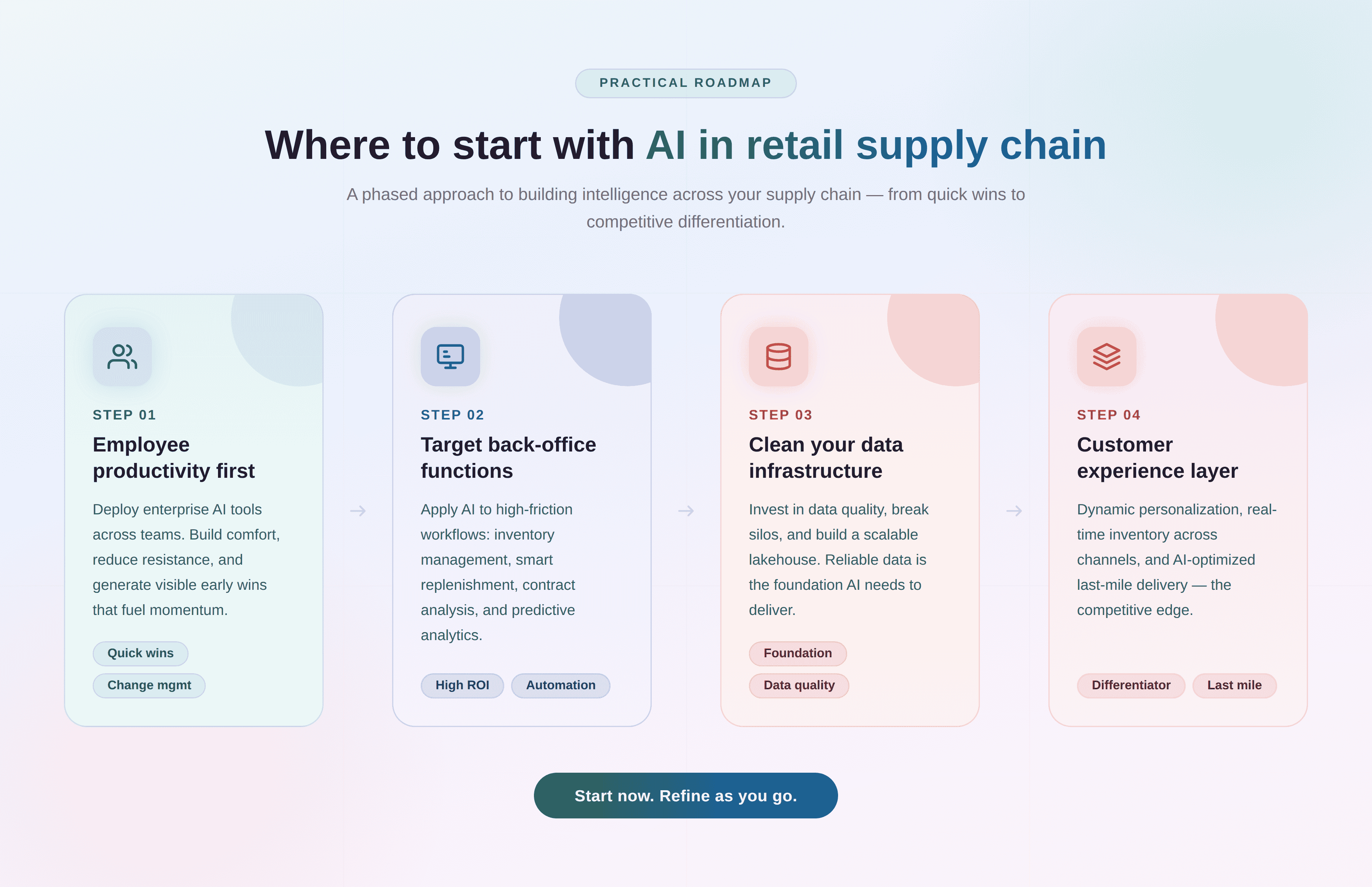
- Employee productivity first. Deploy enterprise AI tools across your organization. Build familiarity, reduce fear, and generate early wins.
- Target back-office functions. Inventory management, smart replenishments, contract analysis, adding intelligent dimensions to predictive analytics are good starting points.
- Clean your data infrastructure. As AI matures across your back-end operations, simultaneously invest in the data quality and scalability that will eventually support customer-facing intelligence.
- Move to the customer experience layer. Dynamic personalization, real-time inventory alignment across online and in-store channels, and AI-optimized last-mile delivery are the competitive differentiators.
Emerging Capabilities to Watch
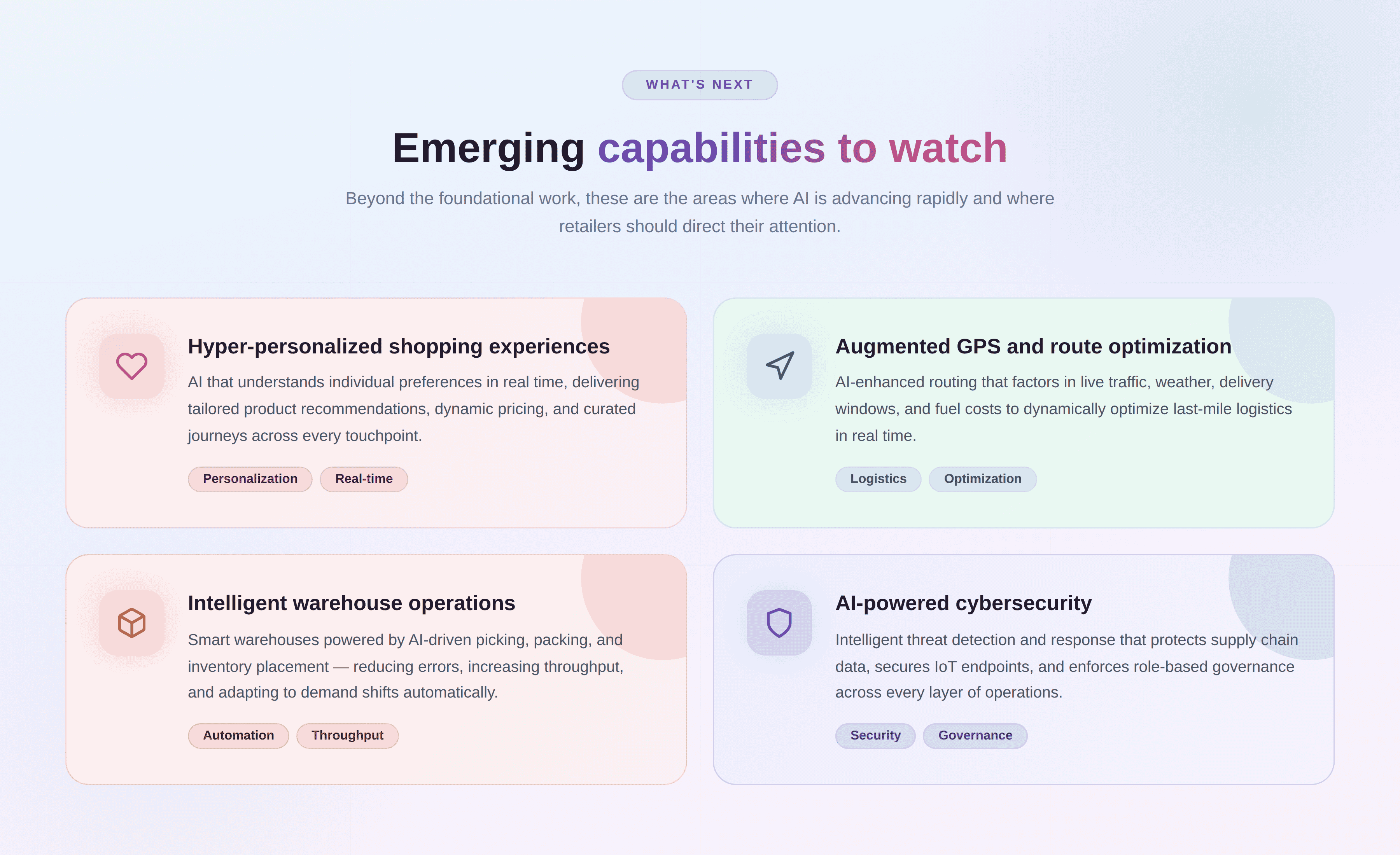
Beyond the foundational work, the panel highlighted several areas where AI is advancing rapidly and where retailers should direct their attention:
The conversation is just beginning. Watch the full webinar for a deeper dive.