

India has firmly established itself as a preferred destination in the Global Capability Center (GCC) landscape. The numbers tell this story clearly.
The country today accounts for more than half of the global GCC footprint, with over 1,700 centers operating across the country and a workforce exceeding 1.9 million professionals supporting this ecosystem. The scale continues to expand, with the sector projected to grow at 12–14% CAGR towards a $110 billion market by 2030.
Yet the most important shift underway is not numerical. It is structural. Close observers of the ecosystem are noticing the emergence of a new model: the Specialist GCC.
India is no longer just a location where enterprises extend operational capacity. It is increasingly where they build and concentrate strategic capability. This steady transition from cost-led delivery centers to capability-led innovation hubs is reshaping how organizations design their global operating models.
The narrative is shifting from extending operational capacity to building strategic capability, and from cost arbitrage to innovation-led value creation as the primary drivers behind choosing India as a GCC destination.
This evolution, particularly the rise of more specialized, capability-driven GCC models, is explored in greater depth in our eBook on the future of GCCs. This blog distils some of the key insights driving that shift.
Moving Beyond the Scale Paradigm
The GCC model began with a clear enterprise need: optimize supply chains, digitize core systems, and consolidate shared services. The early generation of GCCs was therefore built with a defined intent: to centralize operations, standardize processes, improve control, and drive cost efficiency through scale.
These centers often scaled rapidly, supported by structured service lines, layered governance, and well-defined operational maturity frameworks. For that phase of enterprise transformation, the model worked well.

Over time, however, the enterprise environment became far more dynamic and demanding. Innovation cycles shortened. Platform modernization became continuous. Cloud-native architectures required tighter integration. Artificial intelligence initiatives began cutting across functions. And product engineering teams increasingly operated in distributed environments.
In such a landscape, the primary challenge was no longer scale. It was coherence.
When capabilities are fragmented across geographies and vendors, architectural continuity begins to weaken. When decision-making is spread across multiple layers, responsiveness slows. And when knowledge is not retained within a stable ecosystem, innovation becomes reactive rather than intentional.
Scale without alignment introduces complexity.
Specialist GCCs are a response to that complexity
What is a Specialist GCC?
A Specialist GCC in India is a focused, capability-led Global Capability Center, typically structured with 25–200 experts and designed to own engineering, product, data, or AI domains rather than operate as a large-scale delivery extension.
Unlike traditional GCCs built primarily for cost efficiency and workforce scale, Specialist GCCs prioritize architectural ownership, innovation velocity, and long-term capability retention within India’s mature GCC ecosystem.
A Specialist GCC is defined not by its size, but by its architectural discipline. These centers are built around concentrated expertise and clear ownership of capability domains, enabling continuity in design, product thinking, and decision-making.
They operate less as distributed execution arms and more as embedded capability hubs within the enterprise ecosystem.
Why Mid-Sized Enterprises Are Leading This Model
A significant portion of new GCC setups now originate from mid-sized enterprises. These organizations typically operate with leaner structures and closer alignment between strategy and execution, allowing them to move with greater speed and clarity.
Unlike large enterprises that often replicate scale, mid-sized organizations are more deliberate in how they build global capability. Their focus is not on workforce volume, but on creating tightly aligned hubs that can own product stacks, advance data and AI capabilities, and lead platform, cloud, and cybersecurity initiatives.
For such enterprises, control and depth matter more than workforce volume. Specialist GCCs offer a mechanism to build capability without inheriting bureaucratic weight of traditional models.
As the shift becomes more visible, a natural question emerges:
Why are mid-sized enterprises building Specialist GCCs in India?
Mid-sized enterprises are building Specialist GCCs in India to create concentrated innovation hubs without inheriting the complexity of large-scale operations.
India offers access to a deep and growing talent pool, strong digital infrastructure, and a mature GCC ecosystem, enabling organizations to build and scale high-value capabilities efficiently.
Purpose as the Primary Structural Lever
The durability of any GCC begins with absolute clarity on mandate. A sharply articulated charter ensures structural alignment.
A Specialist GCC typically begins with a clear articulation of its role within the enterprise operating model. It may be tasked with owning a specific product line, leading AI deployment across platforms, consolidating cloud engineering expertise, or strengthening data governance architecture.
The eBook underscores that the early phase of a GCC’s journey determines its long-term trajectory . Purpose clarity at inception prevents mid-phase fragility.
Structural coherence is not accidental. It is designed.
Expertise Density as a Competitive Advantage
While traditional GCCs often scaled through headcount growth, Specialist GCCs are built around concentrated expertise. This difference may appear subtle, but its impact is significant.
Higher expertise density leads to faster decision cycles, reduced architectural rework, clearer accountability, and stronger cross-functional integration.
In distributed enterprise environments, where time zones and digital collaboration introduce friction, this concentration of expertise helps reduce coordination overhead and improve alignment. This becomes especially critical in AI-driven transformations, where data engineers, machine learning specialists, cloud architects, and product teams must work in close sync.
The mandate for Specialist GCCs therefore goes beyond efficiency or cost advantage. Their primary goal is to drive product development, strengthen data engineering capabilities, lead platform and digital transformation, and apply artificial intelligence in meaningful business contexts.
As organizations evaluate this shift, another important question emerges:
What is the difference between a traditional GCC and a capability-led GCC?
A traditional GCC is typically scale-driven and process-oriented, focusing on operational efficiency and throughput.
A capability-led GCC, often structured as a Specialist GCC, emphasizes expertise density, architectural continuity, and ownership of high-value domains such as AI, cloud, cybersecurity, and data engineering.

AI Integration and Architectural Ownership
Specialist GCCs are structurally well-suited to embed AI into core systems because of their concentrated expertise model. Rather than layering AI experiments onto fragmented systems, they can integrate machine learning capabilities directly within architectural frameworks.
AI adoption introduces new structural demands. It requires integrated data pipelines, scalable cloud infrastructure, secure architecture, and cross-functional collaboration.
This approach reduces duplication and enhances long-term maintainability, making AI adoption more systematic rather than opportunistic.
As enterprises accelerate their AI journeys, a key question arises:
How do Specialist GCCs support AI-led digital transformation in India?
Specialist GCCs support AI-led transformation by embedding data engineering, cloud architecture, and machine learning expertise within tightly aligned teams.
India’s mature GCC ecosystem enables enterprises to integrate AI directly into core platforms, improving innovation velocity and long-term architectural stability.
India’s Ecosystem Maturity
India’s appeal as a GCC destination extends beyond cost differentials.
Major hubs such as Bengaluru, Hyderabad, Chennai, Pune, and NCR host mature ecosystems supported by academia, startups, and industry networks. In 2024 alone, GCCs leased 77.2 million square feet of workspace, reflecting infrastructure readiness at scale.
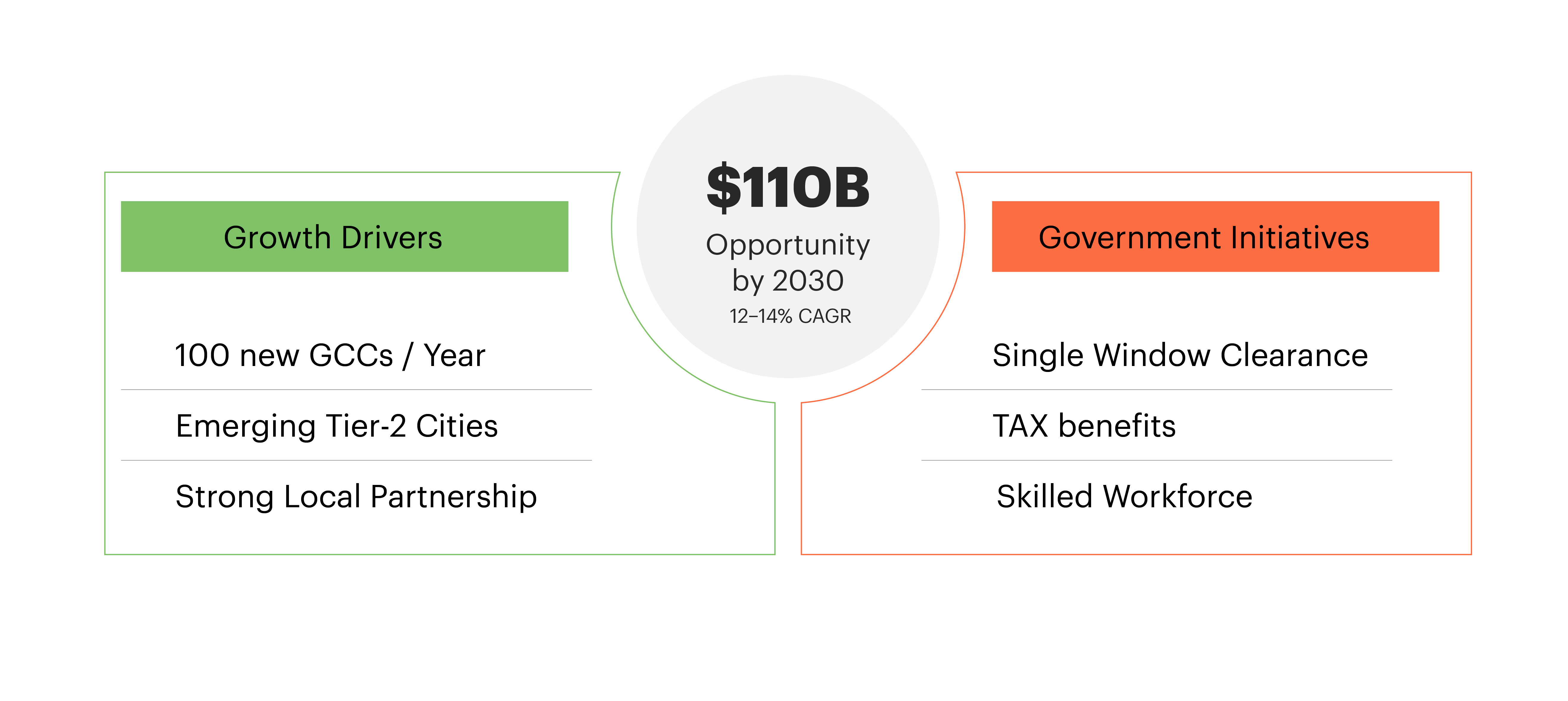
State governments including Telangana, Karnataka, and Tamil Nadu have implemented structured policy initiatives offering streamlined approvals and skill development support.
The workforce exceeds 1.9 million professionals and continues to grow. The ecosystem is not nascent. It is institutionalized.
The evolution of GCCs in India reflects a deeper shift in how enterprises think about capability, ownership, and innovation. The move from scale-driven models to capability-led structures is not incremental, it is foundational.
Specialist GCCs represent this next phase. They are not extensions of global operations, but integral nodes of enterprise capability designed to deliver coherence, speed, and long-term strategic value.
For organizations evaluating how to design or evolve their GCC strategy, understanding this shift is critical.
Our eBook explores the Specialist GCC model in detail, covering structural design, operating principles, and real-world application of capability-led centers.