
Best practices to integrate Salesforce and SAP

The integration between Salesforce and SAP will help achieve better brand value and profits for any organization. Successful integration of these two powerful enterprise platforms creates the potential to strike an equilibrium between business operations and customer relations, which is integral for the success of any product a company launches.

Salesforce is a leading cloud-based customer relationship management platform that provides customized applications and software solutions for sales, service, marketing and analytics. It unites multiple functions of an organization from anywhere with Customer 360, a Salesforce-integrated CRM platform, that powers the entire suite of connected apps.

On the other hand, SAP stands for systems, applications and products in data processing. It is a leading producer of software used for the management of business processes, developing solutions that facilitate effective data processing and information flow across organizations. SAP assists enterprise software to manage both their business operations and customer relations.

A Salesforce SAP integration brings in the possibility of better customer service and enhances business profits. The integration helps organizations across industries, irrespective of its size, run their businesses profitably, adapt continuously and grow sustainably.

Businesses that undergo the Salesforce SAP integration have a unique advantage in managing and tracking customer relationships. While Salesforce manages front-end information about its customers, SAP manages back-end tasks. Organizations that integrate the two, benefit from additional business functions through enhanced productivity and value-added insights. This, in turn, improves customer interaction and experience.

Benefits of Salesforce SAP Integration

Organizations can gain numerous advantages by leveraging the integration of Salesforce and SAP. Some of the benefits that this integration provides, include:

  • Effective data management with business intelligence capabilities
  • Improved invoice creation
  • Real-time error management with troubleshooting services
  • Processing of orders in real-time for optimal outcomes
  • Accelerated cash flow, thereby maximizing return on investment (ROI)

The Salesforce and SAP integration is crucial to bring in a 360-degree view of customer data, which enables a seamless customer journey. However, despite its prevalence, getting the integration right is a challenge that many organizations face. The implementation of the integration might not be very straightforward as both, Salesforce and SAP, are complex solutions built to be proprietary and standalone offerings. Neither of the platforms is designed to work with other software, and here’s why.

SAP is built as a back-end solution and many of its offerings were created much before the age of cloud computing. On the other hand, Salesforce is a cloud pioneer and created for front-end use. Therefore, a seamless integration requires a planned approach to account for the technological differences between SAP’s on-premises solutions and Salesforce’s cloud-based solutions.

When an organization plans for Salesforce and SAP integration, mapping out its process in advance will be the best place to start. Approaching the integration through the lens of a process rather than a simple data mapping or end-to-end connectivity will make the business more scalable and efficient. The rapid adoption of cloud technology is impacting how enterprise application support is developed and implemented to assist in the same.

Challenges of integrating Salesforce and SAP

Although the Salesforce SAP integration could translate into multiple benefits for organizations, its implementation could come with its own set of limitations and challenges. Any successful integration requires the right approach and the right set of enabling technologies. Apart from the core approach, other technical issues could include adapters and interfaces, communications, semantic mediation, format conversion and security.

Below are some of the most common challenges encountered during the integration:

  • Technical disparities as SAP is an on-premise software whereas Salesforce is a cloud solution
  • Difficulty in synchronizing data from SAP to Salesforce
  • Salesforce users generate quotes using products and price book information that need to be linked with corresponding opportunities in SAP. Whereas, product and pricing information in SAP needs to be synchronized with Salesforce.
  • The need to process data in Salesforce before reaching the order and execution phase in SAP also needs to be considered.
  • Relevant data such as related order history and current financial status need to be accessible in real-time for the Salesforce user.

The idea is to leverage the best approach that is consistent with the organization’s integration requirements. Of course, there are several options to achieve optimal integration according to those requirements. The importance of managed IT infrastructure grows manifold during such important operations, a point that every organization must take note of.

Design solution in cloud integration

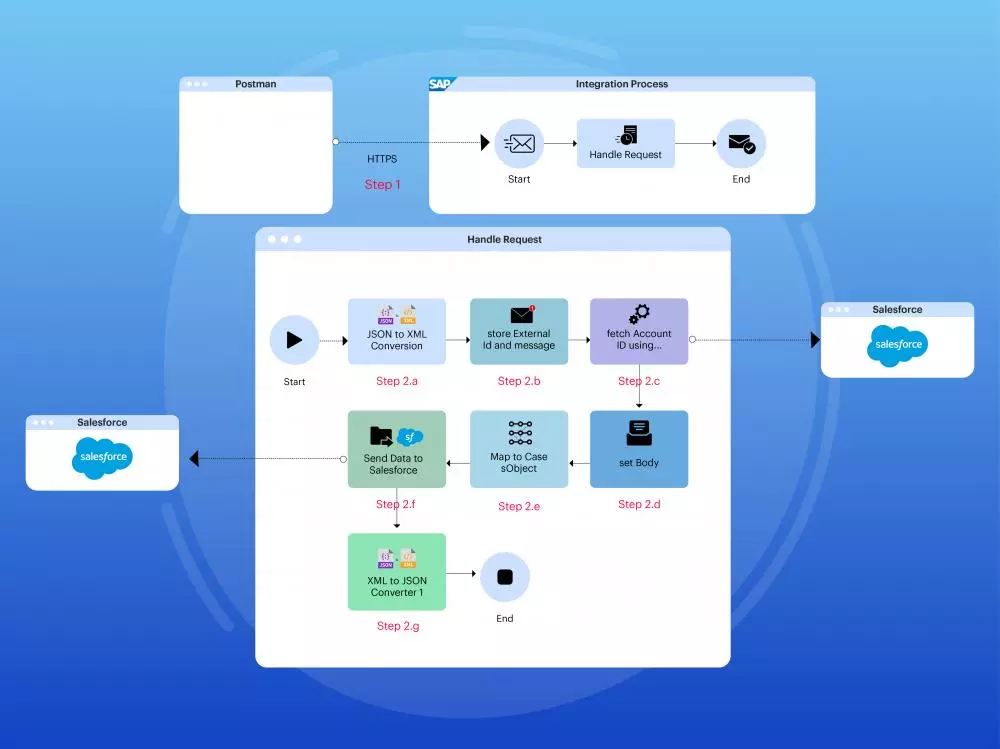
Below is a graphical representation of the technical workflow, showing the different steps involved during the integration of Salesforce and SAP.

salesforce-sap-integration

Step-by-step process of SAP and Salesforce integration

The main steps for integration of SAP and Salesforce are as below:

  • Log in to the Salesforce development account
  • Go to the setup option and type API in the Quick Find box
  • Download the required WSDL file
  • Use the Salesforce WSDL to create the required SOAP project
  • Create WSDL/XSD with the help of the following steps
  • Create an upsert request using SOAPui
  • Subsequently, create XSD for that request using external tools
  • By importing the external definition, that was created in the previous step, create another ESR object
  • Message map by creating SOAP requests
  • Next, an API lookup code is needed for the session ID and server URL
  • Thereafter an ID configuration is needed
  • In order to do that, first create 2 ICOs by getting data from ECC and then sending it to Salesforce

Conclusion

As one of the most widely used enterprise resource planning solutions in the market, SAP plays a key role in the most critical aspects of business processes for many companies. To fully automate and optimize these business processes, companies need to integrate SAP with other applications within their organization. Integrating Salesforce and SAP is an essential step since there is a central need to bring these frameworks together to meet the prerequisites of the business.

The individual benefits of both Salesforce and SAP when combined during their integration empower organizations with the ability to turn vital customer data into meaningful and actionable insights. This will allow decision-makers to make crucial business decisions faster, streamline business processes, boost productivity and therefore gain a competitive advantage in the market.

Infovision with its cloud migration expertise and as a managed service provider with its technical staffing services is a trusted partner for achieving Salesforce SAP integration.

Planning Poker: A Proven Technique to Enhance Business Agility

The famous adage: “the whole is greater than the sum of its parts” fits so well in the context of how teams function. The same goes well in the context of an organization. Teams are the building blocks of an organization and have a significant role to play in fostering business agility.

In a team the overall performance of the unit is critical to achieving shared objectives and agility is a big accelerator that helps accomplish this goal. Most of the organizations are adopting agile or scaled agile frameworks in their digital transformation journeys to achieve business agility. As already mentioned, team agility is an essential ingredient if one has to achieve business agility.

In any routine project, given that different teams work on different types of user stories or tasks, a proven practice for planning and estimation that is used by agile teams is the Planning Poker technique. Based on the team requirement this technique can be used in a variety of team settings. This blog focuses on the ‘what’ and ‘how’ of this popular consensus-based estimating approach.

How Does the Planning Poker Technique Work?

The Planning poker technique is used during sprint or iteration planning by the team to estimate the story points for user stories. The Scrum master facilitates this event and the product owner and the team members are the active participants. It uses modified Fibonacci series 0, ½, 1, 2, 3, 5, 8, 13, 20, 40, 100 to estimate the size of the user story. The modified Fibonacci series has the numbers in increasing order from 0 to n to capture any uncertainty. The set of poker cards is placed in centre of the table. There are multiple cards, i.e. ten cards for number 5, ten cards for number 8 and so on which represents the numbers from the Fibonacci series. When the product owner shares the user story, all the team members go through it and pick one poker card from the table, based on the best number which fits their estimate.  They are not supposed to reveal the estimated number card immediately.  They then place their card upside down on the table. On the instruction of the scrum master all the members then reverse their respective cards at the same time.  The number/estimate that the card reveals is then discussed for variations along with the thought process on why the team member chose the given number. Shared understanding is created through thought-provoking discussions, and the scrum master repeats the planning poker technique until the team members reach suitable consensus on the estimate.

This process of estimation by each team member and the discussions that follow, help the team members understand different aspects involved in the user story. In this way planning poker technique helps in getting a better or accurate estimate for the team backlog and smooth execution of the sprint or iteration. It has been observed that over a period the team members become capable of good estimation and the team is able to handle and accommodate in between additions of the user stories by the product owner. This leads to increase in the confidence of the team members and overall improved functioning of the team. In a way planning poker technique is designed such that it enhances self-organizing characteristics of the team. So, the planning poker technique is used for agile estimations within the team for better and healthier sprint delivery.

Common Challenges

Here’s why it is important to have a consensus-based estimation technique.

  • In most of the teams, a majority of members have familiarity with the waterfall way of working, where complete scope is defined and the team members work on the tasks assigned to them.  In such a scenario they don’t know the scope of overall tasks and how much time it would take to complete the tasks. When the same team members start working in agile teams, the approach is contrary so they face difficulty in estimating and meeting sprint goals.
  • Teams are dynamic.  There is always a situation where some team members leave and new ones join. The scope of work also keeps changing, new additions are uncertain. In Agile teams one should always take the right decision and move forward.
  • Wrong estimates by the scrum master or the product owner or the team leader – the people who usually estimate on behalf of team – can lead to dissatisfaction which in turn impacts delivery.

When is Planning Poker Required?

This technique is very helpful as it brings clarity and helps in faster delivery for teams working in
sprints or iterations. This is true especially when,

  • The scope of the work is new or complex to address the unknowns,
  • The team is consistently not able to meet the sprint goals, 
  • the requirements are changing, and customer priority is changing,
  • when the team is newly formed and starting on execution,
  • when teams are transforming from waterfall to agile,
  • when overall performance of a team needs improvement,
  • when the root cause is problem in estimations.

Driving Scrum Values

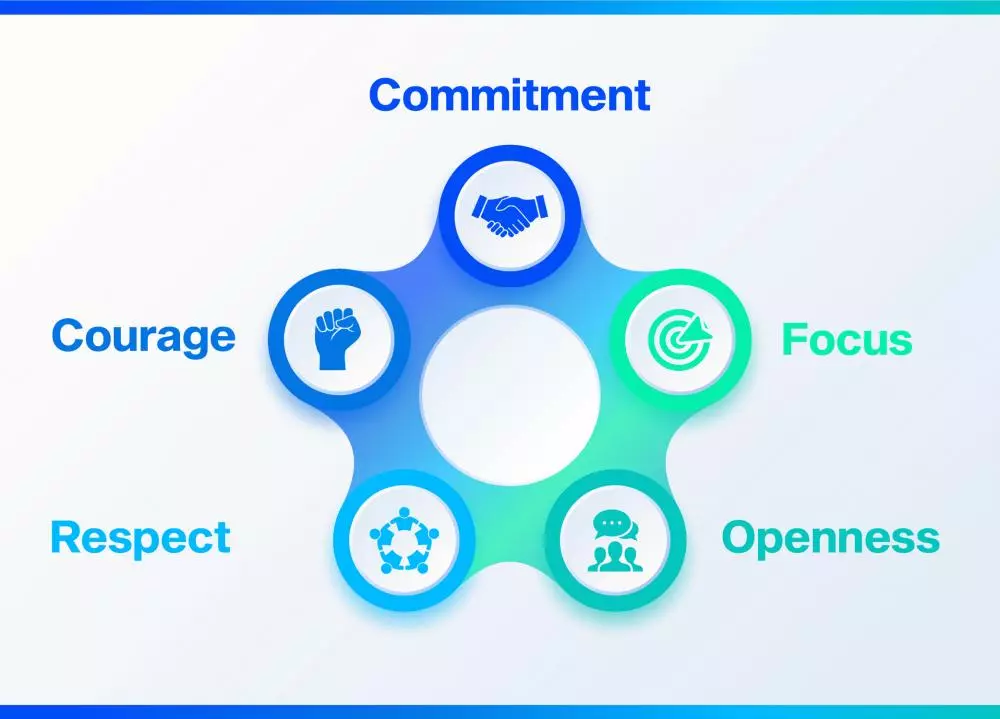
Scrum values create strong and resilient teams. Planning Poker drives the following scrum values within the teams.

  • Commitment: By using Planning Poker for estimation, all the team members commit to the sprint goal.
  • Focus: Since the team members discuss about the different aspects of the user stories, the team members are equipped with the required information to start focusing on the task.
  • Openness: The team is encouraged to openly discuss about the user stories. This helps in bringing out the unknowns.
  • Respect:Since all the team members discuss and mutually participate in the estimation it creates a mutual respect for all team members as this is a way of learning and understanding each other.
  • Courage: In a majority of situations, a lot of the team members do not speak and tend to follow the leader blindly. The Planning Poker practice encourages all the team members to participate and be courageous.

Due to the many benefits, agile teams like Scrum, Scaled Agile Framework, Kanban and hybrid agile
teams practice planning poker.

This technique increases the predictability of team sprint goal leading to higher levels of collaboration, performance and team agility. Team agility leads to increased predictability in program level and enhances business agility thus leading to win-win for the team members, organization and customers.

Why Salesforce flow is the new beginning for administrators

Simplifying business automation processes without coding has been one of the many remarkable features of the Salesforce platform. Coming from a .Net background, I was amazed to see the capabilities that Salesforce’s Workflow Rule brought in. Then came the Process Builder in 2015, enabling us to not just update parent records but also create new records and update related records. Process Builder became a tool for system administrators that could reasonably compete with Apex.

When Salesforce introduced Flow, I considered it an over-complicated and heavy version of Process Builder and Workflow Rules. I saw no compelling reason to adopt it as my business automation tool. If the work gets done through Process Builder, that is what I would do.

Why then did I board the Flow-train?

Initially, Flow was built on the Cloud Flow Designer. In its spring 2019 release, Salesforce introduced Flow Builder, a declarative interface that provides faster and more intuitive front-end for creating individual flows. I started experimenting with Flow about years ago to explore the new features and my perception about it changed for good. I boarded the Flow-train and decided to not look back, and here is why:

  • Records are created and updated quickly using Flow as compared to Process Builder and Workflow Rules.
  • Salesforce expanded the Flow’s capabilities to include both record-triggered and schedule-triggered Flow.
  • Salesforce announced that Process Builder and Workflow Rules would no longer receive product updates. Salesforce Flow will be the new tool for declarative process automation.
     

What else did Salesforce say?

In June 2020, Salesforce published a blog on what will be considered the best practices for any business process automation. The blog had three main takeaways:

  1. Use a ‘BeforeSave’ Flow to update a Salesforce record as it’s faster than Process Builder (it could possibly outperform Process Builder by 10x).
  2. Use an ‘AfterSave’ Flow to create records or send emails. This will increase the performance for end users as compared to Process Builder.
  3. If the logic of a Flow gets very complex then it’s probably best to use Apex coding.

Salesforce is planning to invest and enhance heavily on Flow. Therefore, it’s only advisable to start
leveraging Flow and considerably reduce the dependency on Process Builder or Workflow Rules.

But is Flow the only tool? I have asked this question myself every time I read Salesforce release notes. Undeniably, Flow is evolving at an incredible pace. With the Winter 21 release, it can be scheduled, triggered on record updates, called by platform events and even be visible or invisible to the users. With Flow, you can reuse without rebuilding; you can build incredible complex business logic and reuse across multiple Flows. It can do what Workflow Rules, Process builder and Approval process can do.

Therefore, to answer the question, I think Flow will soon become the most go-to tool for administrators to automate all business process in a declarative way.

Adios, Process Builder and Workflow Rules?

Well, not yet.

Salesforce will continue to allow system administrators to maintain the existing, as well as create new Workflow Rules and Process Builders, but it’s not going to be enhanced any more for sure.

Salesforce, in Dreamforce 21 announced the retirement of Workflow and Process Builder. Patrick Stokes, the product manager responsible for the retirement, has reassured that there will be a formal roadmap that is governed by an end-of-life council. In the spirit of transparency, here are the stages they have planned:

  • Spring’ 22 release: Launch migration tool for Workflow Rules
  • Summer’ 22 release: Launch migration tool for Process Builder
  • Winter’ 23 release: Will no longer be able to create new Process Builders or Workflow Rules

My Recommendations

  • Don’t create new Process Builders or Work Flow Rules in your organization. Instead,
    transition to Flow and get comfortable with it.
  • Never forget the complexities: if the existing Process Builder or Workflow Rules are causing
    problems, then move to Flow instead.
  • If the existing Process Builder or Workflow are working fine, then let them be.

The Relevance of Simulated Phishing Campaign in Today’s World

To understand the relevance of simulated phishing campaigns, especially in today’s times, one needs to learn all about phishing and how it is weaponized to target employees of an organization. In this blog, I explain how phishing attacks work.   The objective is to enumerate the importance and impact of proven preventive strategies such as simulated phishing campaigns, in organizations.

What is phishing?

Phishing is an organized multibillion-dollar cybercrime business. The attackers pose as a legitimate organization or individual and contact their targets (employees), through email, telephone, or text message. The attackers then lure employees to give away the organization’s sensitive data and compromise the critical infrastructure.

Phishing is done to gain a foothold in corporate or government networks. Almost 80% of phishing attacks are done through emails. The email recipients are tricked into clicking malicious links or downloading executable files, which leads to the installation of malware for data exfiltration and ransomware attacks.

There are different types of phishing attacks including email phishing, vishing, whaling, smishing & spear phishing. 

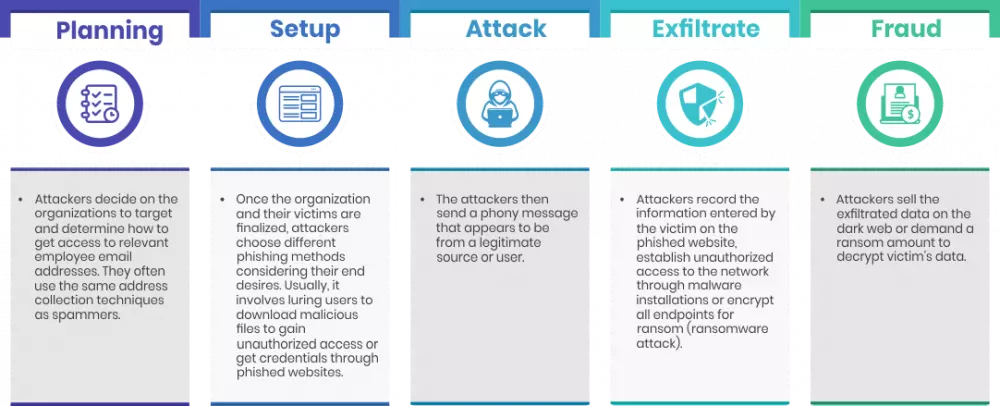
How is phishing weaponized?

The attack follows a phase-wise approach as described below:

Why Simulated Campaigns?

When it comes to securing an organization, employees are the weakest links because they are often the prime targets for cybercrimes. Phishing attacks are the easiest and most effective means to target employees. Today, phishing attacks are increasing despite having all anti-phishing measures in place. Therefore, employees need practical training to defend and keep these phishing attacks at bay.

One of the best ways to increase awareness about phishing is through simulated targeted phishing campaigns designed for all internal and contract employees. These campaigns should be run at regular intervals so that employees not only start becoming aware but also develop appropriate reflexes to differentiate between genuine emails and spam.  Our research confirms that a simulated phishing campaign is more effective in educating employees than any other method or strategy.  This is reinforced by the data that revealed a marked improvement in scores when retests were performed.

As per our previous simulated phishing campaigns delivered to our customers, we observed that on average, 25% of the phishing emails were opened, and at least 15% of them ended up giving away sensitive information or downloaded executable files. One of every three customers’ existing anti-phishing solutions was ineffective in stopping the phishing campaign. Note, the above statistics were recorded despite the customers delivering in-person awareness training.

InfoVision’s Enterprise Cybersecurity & Risk Services (ECRS) practice offers simulated phishing campaign services and various anti-phishing technology controls to customers. The customized simulated phishing campaigns are effective not only in educating employees but also evaluating the existing anti-phishing control’s effectiveness in preventing these attacks.

For further details about paid and free phishing campaign services contact us at digital@infovision.com.

6 Changes in Consumer Behavior Due to Digital Transformation In Retail

The traditional brick and mortar model of retail has been under siege by digitally enabled online and mobile channels. Consumer behavior in digital retail has undergone immense change due to digital technologies which are at the core of this transformation. However its successful implementation requires careful planning and cross collaboration across various retail functions.

The rise of the internet and proliferation of digital transformation has had some profound and unexpected effects on 21st century life. While the term digital transformation may seem like a vast and hazy concept it is fairly easy to understand it, when one sees the constantly evolving changes in the retail sector.

A careful analysis of the trends and consumer behavior driving this transformation can help retailers maintain their focus and achieve tangible benefits.  The new generation of customers is more informed and prepared to move through this environment.  Research mobility has increased with the technology available such as computers, mobile phones, tablets and so on.

The baseline is that consumer buying behavior is evolving in digital retail which in turn is pushing for continuous transformation.

What drives consumer behavior?

Business houses such as Uber and Amazon, have demonstrated to the world what digital transformation can do to an organization.  They have taken traditional business concepts such as retail sales and transit and applied innovative digital technology that has left their competitors far behind. A new consumer-brand relationship has risen with the emergence of the internet. Customers expect relevant content in relation to what they are doing anytime, anywhere, in the format they desire and on a device of their choice. By having access to this information, the consumer can then collate and analyze the information slowly and arrive at an informed choice. This educated consumer then crosses several digital platforms to make a purchase which could be online or offline. It is undeniable that users now prefer applications which are more agile, provide responsive and convenient navigation making the choosing process as pleasant an experience as the actual buying of the product.

How is digital transformation keeping pace with changing consumer behavior

The disruption of digital technology and its impact on the consumer behavior in digital retail has very real implications. How brand owners need to adapt their communication strategies in order to build successful and meaningful relationships with consumers today will be their formula to stay in the race.

Here are the top trends that retailers need to focus on with respect to consumer behavior, in order to surge ahead of competition

1. Use of mobile apps

Mobile based purchases are outpacing the growth of even online retail. Apart from the fact that bigger and powerful smartphones are enabling better shopping experiences, the mobile is also emerging as a strong connector across all retail channels, linking in- store and online modes of shopping. In addition to basic information, consumers also have access to loyalty programs, real time check on store inventory and improved customer engagement.  This convenience in the mind of the consumer is irreplaceable and influences consumer buying behavior.

2. Mobile based payment applications

Mobile based retail payments can be made either in person at the point of sale or can be done remotely via mobile apps or browsers. Mobile payments provide a seamless experience to consumers from their smartphones. The consumers today opt for such payments because of convenience and ease of use, the rewards and discounts such payments provide and it also has the necessary compliance and security features in place.

3. Social media

Social media has made giant leaps in today’s world be it for staying in touch or for access to the latest information or to keep up with the current trends. Many of today’s consumers tend to frequent social media sites such Instagram, Facebook, Twitter, Pinterest and YouTube. The consumers have an opportunity to familiarize themselves with the product as well as compare and contrast products with reference to design, color, prices and so on through these sites.  They have realized that the content marketing on these social media sites is organic, relevant, and adds value. The additional benefit of product recommendation/purchase coupled with social mixing is a trend that consumers are making the order of the day.

4. Voice recognition and virtual reality

Voice Enabled Search such as Apple’s Siri, Amazon’s Alexa and Google’s Assist are changing the way consumers look for retail products. Searching for products and services using natural speech makes the entire process frictionless and faster. The convenience of such voice recognition systems is driving today’s consumer buying behavior towards a comfortable experience. They are looking for more and more services and products to be channelized through this mode. Another important aspect of changing consumer behavior in digital retail is virtual reality which allows  for consumers to experience the reality of the product in the virtual world. This gives the customer a more realistic picture about the product they intend to purchase.

5. Customer insights

Earlier an individual approach was associated with luxury brand shopping albeit in real time. Today with digital transformation, consumers find that customization is available for several more products and at affordable prices. The ability to customize based on individual needs engages the customer in a better way since it makes the customer feel the product was tailor made for him/her.  Customization gives consumers better value of money and better access to all products which were previously unavailable due to size difference or color variations or such.

6. Reverse showrooming

Reverse showrooming occurs when a customer browses and researches products online but purchases the product at an actual store. Apparel and furniture benefit from this kind of retailing. This is extremely beneficial for consumers since they enter a store armed with all the information they need before purchase of a product. Their online browsing would have given them all there is to know about a certain product such as origin, material used, colors available, availability at store. The last step to have an actual feel of the product is completed at the store thereby hastening the process of a purchase.

Conclusion

The retail industry is one of the most rapidly evolving verticals across the worlds. A change in consumer buying behavior is due to this digital transformation which empowers today’s consumer with deeper knowledge that l assists them in making the best choice based on their needs.