
Ambient AI Is Not the ROI. The Redesigned Clinical Workflow Is.

Healthcare may finally be moving past the AI demo phase.

For the last two years, ambient AI in healthcare has mostly been sold as a documentation fix: less typing, fewer clicks, faster notes, reduced burnout, and more face time with patients.

That story helped drive adoption. It just is not the whole story anymore.

The bigger shift is operational.

Ambient AI is starting to change how work moves through the healthcare enterprise. The note is becoming less of a static record and more of a trigger for downstream action: coding review, referrals, follow-up instructions, prior authorization preparation, quality reporting, and revenue cycle workflows.

The organizations getting the most value out of ambient AI are not simply deploying digital scribes. They are redesigning workflows around continuously captured clinical context.

In Brief

Q: What is ambient AI in healthcare?

A: Ambient AI uses voice, natural language processing, and clinical context to capture conversations during care encounters and convert them into documentation or workflow inputs. Its broader value appears when that context supports downstream work such as coding, referrals, authorization, and follow-up.

The Early Results Are Promising, But They Need Context

The strongest evidence today supports documentation burden reduction and improved clinician experience. But the results are not uniform across every setting.

Some health systems are reporting meaningful improvements in after-hours work, note closure, and clinician focus. Others are seeing more modest gains at enterprise scale.

Early Data

What the Early Data Shows

Ambient AI is showing clear promise in documentation and clinician experience, but wider impact depends on adoption depth, specialty fit, and workflow redesign.

93%

More attention during visits

Physicians said ambient AI helped them give patients their full attention. [1,2]

41%

Less after-hours work

Reduction in after-hours documentation work reported by Mass General Brigham. [3]

66%

Fewer delayed notes

Reduction in delayed note closures through a hybrid ambient documentation model. [3]

13–16

Minutes saved

More modest time savings found across five academic health systems. [4]

The emerging pattern is simple: ambient AI can improve documentation workflows, but broader operational gains depend on how deeply it is adopted and how well the surrounding workflow is redesigned.

In Brief

Q: Why do ambient AI results vary across health systems?

A: Outcomes depend on adoption depth, specialty fit, clinician trust, training, EHR integration, and whether the surrounding workflow is redesigned. Light or inconsistent usage may reduce documentation effort but is unlikely to create wider operational gains.

The Real Opportunity Starts After the Note

Historically, the clinical note functioned mainly as documentation of what already happened.

Ambient AI changes that dynamic because clinical intent becomes structured and available much earlier in the process.

Ambient

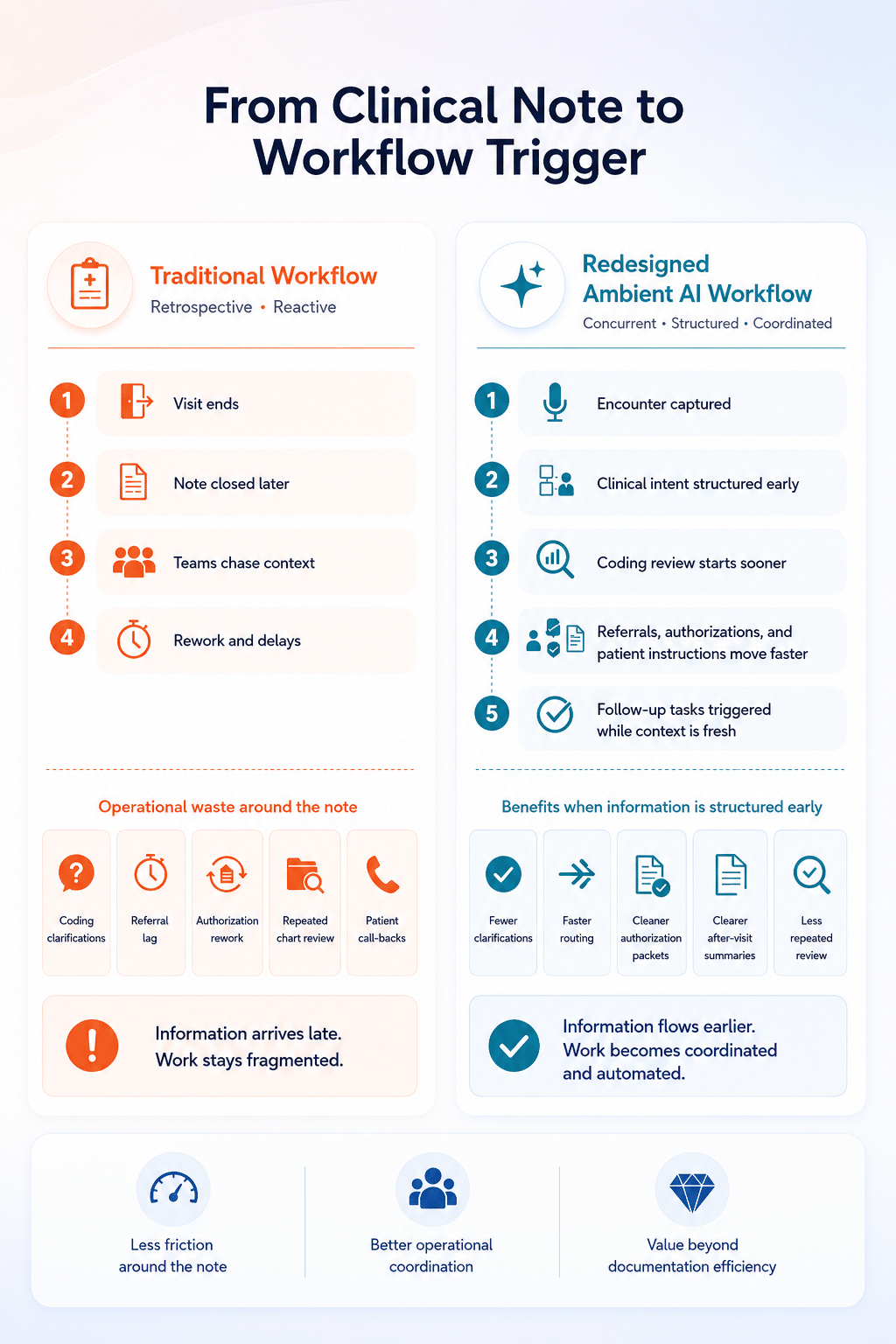
The old workflow was retrospective. The visit ended, the note was closed later, and downstream teams often had to chase missing context.

With ambient AI, the workflow becomes more concurrent. The encounter can begin producing structured inputs for coding, referrals, authorization, patient instructions, and follow-up while clinical intent is still fresh.

That is a much bigger shift than faster transcription.

Much of the operational waste sits around the note: delayed signatures, coding clarifications, incomplete documentation, referral lag, authorization rework, repeated chart reviews, and avoidable patient call-backs.

Ambient AI changes the economics of clinical context availability. When information becomes structured earlier, workflows that were previously fragmented and reactive can start becoming more coordinated and automated.

In many organizations, the operational coordination enabled by ambient AI could become more valuable than the documentation efficiency gains that initially drove adoption.

In Brief

Q: Where does ambient AI create the strongest ROI?

A: The strongest opportunity often sits after the note: fewer coding clarifications, faster referral routing, cleaner authorization packets, clearer after-visit summaries, and less repeated manual chart review across teams.

Ambient AI Is Moving Beyond the Scribe Market

The ambient AI market has become crowded quickly, with Microsoft/Nuance, Abridge, Suki, Nabla, DeepScribe, Ambience, and others competing for health system adoption.

But the real buying decision is shifting.

What Will Matter More in Vendor Selection

As AI-generated notes become easier to deliver, health systems will likely evaluate ambient AI on workflow depth, not documentation alone.

Specialty Fit

Does the solution understand the documentation and workflow needs of different specialties?

Workflow Integration

Can it connect with coding, referrals, authorization, patient communication, and revenue cycle workflows?

Governance Readiness

Does it support consent, auditability, human review, attribution, privacy, and liability controls?

Operating Fit

Can it work across EHRs, specialty systems, payer portals, call centers, and analytics environments?

Bottom line: AI-generated notes are becoming table stakes. Workflow depth is becoming the real differentiator.

As AI-generated notes become more common, healthcare organizations will need to look beyond transcription quality alone. The next layer of differentiation will come from workflow integration, specialty depth, deployment speed, analytics, governance, and how well the solution connects with the broader operating environment.

Epic’s move into native ambient capabilities may accelerate that shift, especially for Epic-heavy organizations.[5] Third-party vendors will likely need to prove value beyond note generation by supporting downstream workflows across coding, referrals, prior authorization, patient communication, and revenue cycle operations.

In Brief

Q: Why is workflow depth becoming important in ambient AI vendor selection?

A: As AI-generated notes become more common, differentiation will depend on how well ambient AI connects with specialty workflows, EHRs, revenue cycle tools, payer processes, analytics, and governance models.

Governance Is Becoming a Strategic Requirement

As ambient AI moves from note generation into downstream workflow support, governance moves from checkbox to strategic enabler.

Governance cannot be treated as a side conversation anymore.

As ambient AI moves beyond documentation and starts influencing operational workflows, the risks become more consequential.

Governance Areas That Need Clear Ownership

Patient consent
Audio retention
HIPAA and third-party processing
State recording laws
Hallucination monitoring
Auditability and attribution
Human review points
Liability boundaries

Healthcare organizations now have to think through patient consent, audio retention policies, HIPAA and third-party processing requirements, state recording laws, hallucination monitoring, auditability, attribution accuracy, human review expectations, and liability boundaries.

This is not simply a compliance issue. It is an operational scaling issue.

If healthcare organizations cannot trust AI-assisted downstream workflows, the broader workflow redesign vision stalls.

Workflow redesign also does not mean handing clinical operations to an autonomous black box. The scalable model is AI-prepared work with clear human review points, especially for clinical decisions, coding, orders, patient instructions, and anything tied to liability or reimbursement.

No governance, no scalable orchestration.

In Brief

Q: What governance is needed for ambient AI?

A: Governance should cover patient consent, audio retention, HIPAA and third-party processing, state recording laws, hallucination monitoring, auditability, attribution accuracy, human review points, and liability boundaries.

Where Healthcare Leaders Should Focus

The better strategic question is not, “Where can we deploy ambient AI?”

It is, “Where does documentation friction create the most downstream operational waste?”

For many organizations, that means focusing first on high-friction environments like primary care, specialty referrals, oncology, chronic disease management, surgical documentation, discharge planning, and prior authorization workflows.

Metrics That Show Real Value

Clinician Impact

Note closure time, documentation lag, and after-hours EHR usage.

Operational and Financial Impact

Coding clarification volume, denial patterns, referral turnaround, and days in AR.

Patient Impact

Clearer after-visit summaries, fewer avoidable call-backs, and improved follow-up adherence.

That is the real shift happening underneath the surface.

Ambient AI is becoming less of a productivity tool and more of an operational redesign initiative.

In Brief

Q: What metrics prove ambient AI is creating value?

A: Useful metrics should cover clinician, operational, financial, and patient impact, including note closure time, documentation lag, coding clarification volume, denial patterns, referral turnaround, days in AR, avoidable call-backs, and follow-up adherence.

The Scribe Is the Wedge

Ambient AI will not transform healthcare simply because it writes cleaner notes.

Its long-term value is that the clinical conversation itself becomes usable operational data.

A clinician finishes the visit. The note is drafted. Coding review starts earlier. The referral already contains better context. Patient instructions and after-visit summaries are generated faster and at a more understandable reading level. An authorization packet requires less manual cleanup. Another downstream team avoids yet another chart review cycle.

None of that feels particularly futuristic.

That is probably the point.

The most valuable healthcare AI may not be the flashiest. It may simply remove the friction healthcare organizations had quietly learned to tolerate.

References

[1] Stults CD, et al. An Ambient Artificial Intelligence Documentation Platform for Clinicians. JAMA Network Open. Published May 2, 2025.
View source

[2] American Medical Association. With ambient AI, 93% of doctors can give patients “full attention.” Published Nov. 5, 2025.
View source

[3] Mass General Brigham. Hybrid Ambient Documentation Decreases After-Hours Work, Note Delays for Physicians. Published Nov. 25, 2025.
View source

[4] Rotenstein LS, et al. Changes in Clinician Time Expenditure and Visit Quantity Associated With AI Scribes. JAMA. Published 2026. DOI: 10.1001/jama.2026.2253.
View source

[5] KLAS Research. Epic’s Ambient Speech Announcement 2025: How Epic’s Move into Ambient Speech May Shape Customer Strategies. Published September 26, 2025.
View source

Azure SRE Agent Vs. AWS DevOps Agent – A Technical Deep Dive

The Hardest Part of Enterprise AI Isn’t Technology, It’s the Operating Model

“Most enterprises are not failing at AI because of technology; they’re failing because of operating model gaps.”

That thought stayed with me after a recent NASSCOM roundtable on accelerating enterprise AI adoption. I had walked in expecting a conversation around models, tools, and benchmarks. I walked out with a very different observation.

Across industries, across scales, and across maturity levels, the pattern seems to be consistent. The gap between an impressive pilot and durable business value isn’t a technology problem. It’s an operating model problem.

At InfoVision, we see this every day in our conversations with clients. That is the lens I want to share here – not as theory, but on the basis of what we’ve learned building and delivering AI at scale for enterprises across Retail, BFSI, healthcare and technology.

Beyond the Pilot

Almost every enterprise AI program I encounter starts the same way: excitement, experimentation, a handful of promising POCs. Very few cross the chasm to scaled, measurable value.

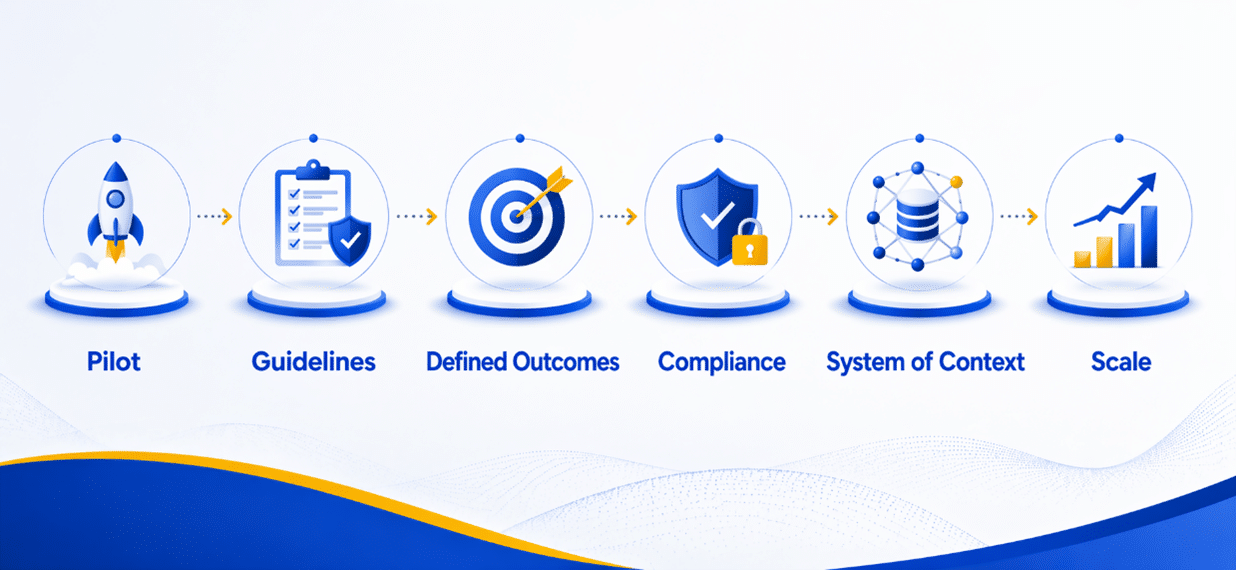
The maturity curve, as I’ve come to see it, runs something like this:

Beyond the Pilot

The most important shift in that journey is the move from a System of Work, where AI simply executes tasks, to a System of Context, where AI understands the business nuance in which it operates: the processes, the policies, the customer, the risk posture, the institutional memory. A chatbot that can answer questions is a capability. An AI that knows how your organization actually works is a strategic asset.

In Brief
What is ‘System of Context’ in enterprise AI?

A System of Context is an AI implementation that understands the business it operates in rather than simply executing generic tasks. A couple of parameters to understand the business would be the processes, policies, customers, risk posture, and institutional memory. Moving to a System of Context is what separates enterprise AI programs that stay stuck in pilot from those that scale into durable business value.

Why do 95% of AI Initiatives Never Scale?

The most common failure mode I see is deceptively simple: there is no clear end goal. Teams jump into AI without first defining what success looks like, how ROI will be measured, or what “scale” actually means for the problem they are solving.

Without that clarity, even the best pilots remain pilots. Budget gets spent, demos get built, and the organization learns a lot; however, nothing meaningful ends up in production. Clarity of outcomes is the single highest-leverage input to an AI program, and it is almost always the cheapest to get right.

The Seven Pillars of Enterprise AI Adoption

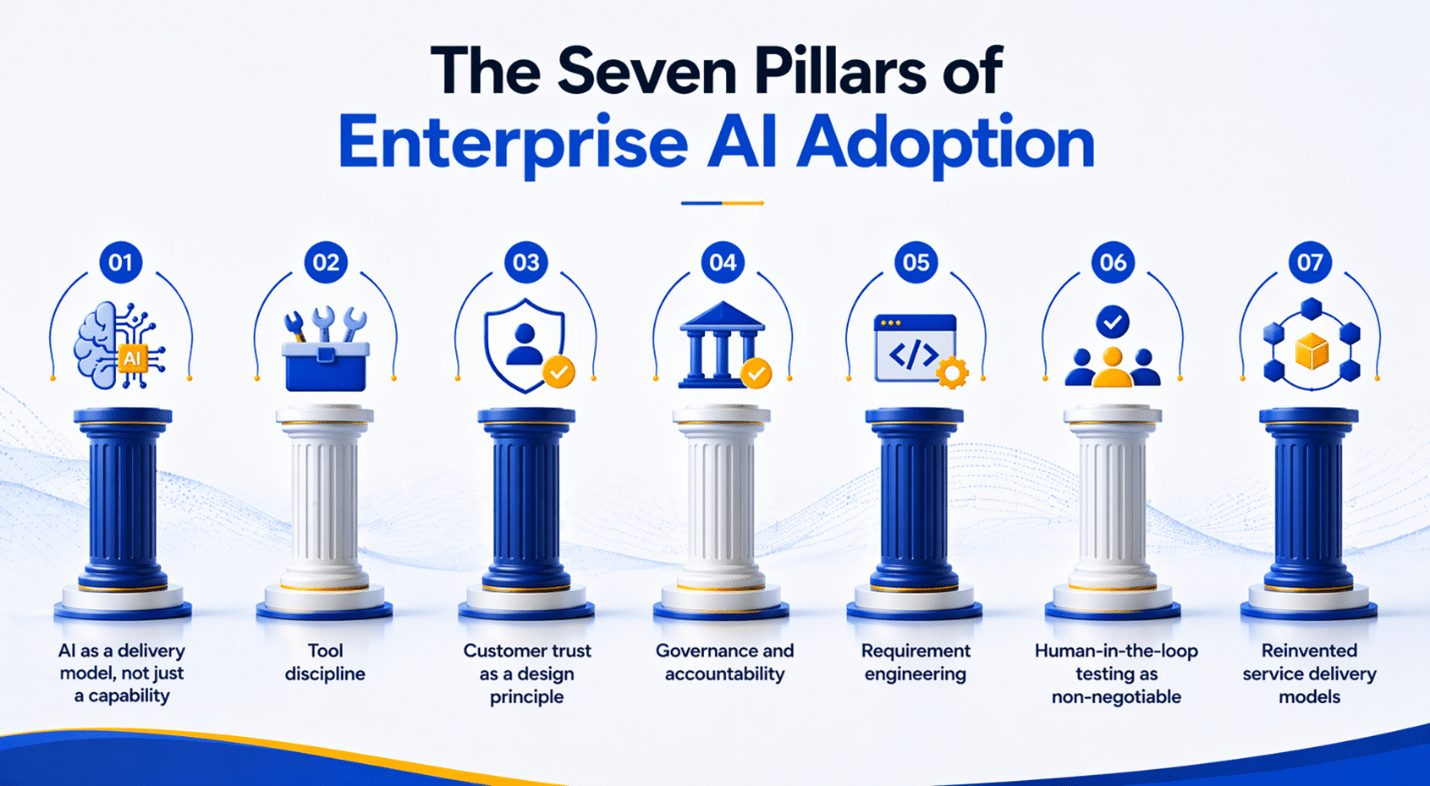
From the hundreds of conversations our delivery and consulting teams have had with enterprise leaders, a consistent set of foundations has emerged. I think of them as the seven pillars of serious AI adoption:

  • AI as a delivery model, not just a capability. AI must reshape how work gets done, not sit alongside it as a feature.
  • Tool discipline. Fewer tools, used exceptionally well, beat a sprawling toolchain every time.
  • Customer trust as a design principle. Trust is not a compliance checkbox but an architectural decision.
  • Governance and accountability. Clear ownership of models, data, and outcomes across the lifecycle.
  • Requirement engineering. Prompting, context design, and automation are the new SDLC skills.
  • Human-in-the-loop testing as non-negotiable. Oversight is not friction; it is the thing that lets you scale responsibly.
  • Reinvented service delivery models. Pods, pricing, and SLAs all have to change. Otherwise, AI just subsidises old ways of working.

In short, this is the point: enterprise AI is not a technology transformation. It is an operating model transformation.

The Seven Pillars of Enterprise AI Adoption

Where AI Actually Creates Value

For all the discussion around AI, the business conversation is surprisingly limited. The value almost always shows up in four places: engineering productivity, revenue differentiation & customer retention, outcome-based delivery improvements, and clearer trade-offs between traditional and AI-driven ways of working.

At InfoVision, one of the practical ways we de-risk this for clients is through what we call the Parallel Pod Model — roughly 30% AI-first delivery running alongside 70% traditional delivery for the same program. The split is not dogma; it is a structure. It lets our clients compare apples to apples, generate real performance data, and scale what works. We’ve seen this model cut through months of “will it work in our context” debates by producing evidence inside a single release cycle.

Underpinning this is our AI Center of Excellence and a growing library of platform accelerators – reusable assets for document intelligence, RAG-based knowledge systems, OCR-driven data extraction, and domain-specific evaluation harnesses. These accelerators exist for one reason: to compress the distance between a promising idea and a production-grade outcome. The enterprises that win with AI are the ones that don’t rebuild the same plumbing on every engagement.

Data extraction, retrieval-augmented generation, and OCR are no longer novelties – they are the competitive differentiators of the next five years.

Seven Checks Before You Go to Production

Before any AI workload moves from pilot to production, we ask our delivery teams and clients to stress-test against seven checks. None of them are glamorous. All of them are non-negotiable:

  • Security embedded early — not bolted after launch.
  • Regulatory alignment from day one, especially in regulated industries.
  • Clear ownership between pilot teams and production teams.
  • An MVP tied to a specific business outcome, not to a technology demo.
  • A deliberate integration strategy with existing systems and data.
  • Defined KPIs, agreed with the business before the build starts.
  • Clarity on the end goal — what “done” looks like, and how we’ll know.

And sitting above all seven: human-in-the-loop governance. That is how you scale AI in an enterprise context without scaling risk at the same rate.

In Brief
What should enterprises check before moving AI workloads into production?

At InfoVision, we stress-test every AI workload against seven checks before it goes live: security embedded from day one, regulatory alignment, clear ownership between pilot and production teams, an MVP tied to a specific business outcome, a deliberate integration strategy with existing systems and data, agreed KPIs, and unambiguous clarity on the end goal. Sitting above all seven is human-in-the-loop governance, a mechanism that lets enterprises scale AI without scaling risk at the same rate.

The Real Transformation

If I had to distil what I’ve learned, from our own AI CoE, from our Parallel Pod engagements, and from conversations like the Nasscom roundtable, it would be this:

AI transformation is not about doing more with AI. It is about redefining how value is created and delivered.

Trust, governance, and clarity of outcomes are the three inputs that compound. Human oversight is the enabler of scale, not the thing slowing you down. And tool overload, left unchecked, will quietly eat your productivity gains before you ever see them.

At InfoVision, we are choosing to build that discipline into our delivery model, our accelerators, and the way we engage with our clients. It is, in every sense, how we are adopting AI ourselves – by changing how we deliver, not just what we deliver.

The most honest conversations I’ve had about AI aren’t about what’s possible, they’re about what’s actually working, and what quietly isn’t.

Why Organizations Are Moving from Adobe Analytics to Adobe Customer Journey Analytics

It is not just a technology upgrade but a fundamental rethink of how you understand your customers

For years, Adobe Analytics was the gold standard for digital measurement. It answered the questions that mattered most in a web-centric world: Which campaigns drove conversions? Where are visitors dropping off? Which pages perform best?

Those are still valid questions. But they’re no longer sufficient.

Today’s customer doesn’t live in a single session. They discover your brand on Instagram, research on desktop, call your support center, walk into a store, and finally convert on mobile — often over days or weeks. If your analytics only captures what happens on your website, you’re seeing a fraction of the story and making decisions on incomplete information.

That is precisely the gap Adobe Customer Journey Analytics (CJA) was built to close.

From Session Data to Customer Understanding

Adobe Analytics is a session-based measurement tool. It is exceptionally good at what it was designed to do: track visitor behavior across your digital properties and surface patterns in that data.

But session data has inherent limits:

  • It treats each visit as a standalone event, disconnected from the customer’s broader journey
  • It cannot natively reconcile a logged-in desktop user with a mobile app visitor and an in-store purchase
  • It reflects digital interactions only, leaving out the CRM records, call center logs, loyalty data, and offline transactions that often explain why customers behave the way they do

CJA shifts the unit of analysis from the session to the person. Rather than asking what happened on the website, it asks what did this customer experience end-to-end – and what drove their decision?

Built on Adobe Experience Platform: A Different Foundation

The reason CJA can do what Adobe Analytics cannot comes down to what it is built on: Adobe Experience Platform (AEP).

AEP acts as a unified data foundation, bringing together all customer data, online and offline, into a standardized framework called the Experience Data Model (XDM). This is not cosmetic. It fundamentally changes what analysis is possible.

With CJA on AEP, organizations can:

  • Ingest any data source — web behavior, mobile events, CRM records, POS transactions, call center interactions, loyalty platforms, and more — unified into a single schema
  • Stitch identities across channels, connecting anonymous browsing to known customer records to create a coherent, person-level view of every interaction
  • Process data flexibly at report time, meaning teams can create new segments, dimensions, and metrics without going back to change data collection or rewrite implementation code

That last point is easy to underestimate. Traditional analytics architectures lock you into whatever questions you anticipated when you built them. CJA lets your analytics evolve as fast as your business questions do — without requiring an engineering sprint every time.

Seeing the Full Journey, Not Just a Chapter of It

One of the most practical shifts CJA enables is the ability to build cross-channel journey views that actually reflect how customers behave.

With Adobe Analytics, you might have separate dashboards for your website, your app, and your contact center — each telling a partial story, with no easy way to connect them. CJA allows analysts to:

  • Build end-to-end funnel and journey visualizations that span web, mobile, CRM, and offline touchpoints in a single analysis
  • Identify where customers fall through the cracks between channels — the moments where a great web experience hands off to a frustrating call center interaction, for example
  • Apply flexible attribution models that reflect the complexity of multi-touch, multi-day journeys rather than forcing last-click logic on non-linear behavior

The insight shift is significant: instead of optimizing individual channels in isolation, teams can start optimizing the overall experience customers have as they move between them.

Analytics That Grow with Your Business

Legacy analytics architectures can become a constraint over time. As business questions evolve, teams often find themselves limited by the dimensions and metrics baked into their original implementation.

CJA removes that constraint:

  • Unlimited dimensions and metrics — build the views your business needs today, not just the ones you anticipated when you went live
  • Flexible schema design — adapt your data model as new sources, channels, or product lines come online
  • Report-time processing — re-analyze historical data with new logic without re-collecting it, which is invaluable when business definitions change or new questions emerge retroactively

For analytics teams, this means less time waiting on implementation changes and more time generating actual insight.

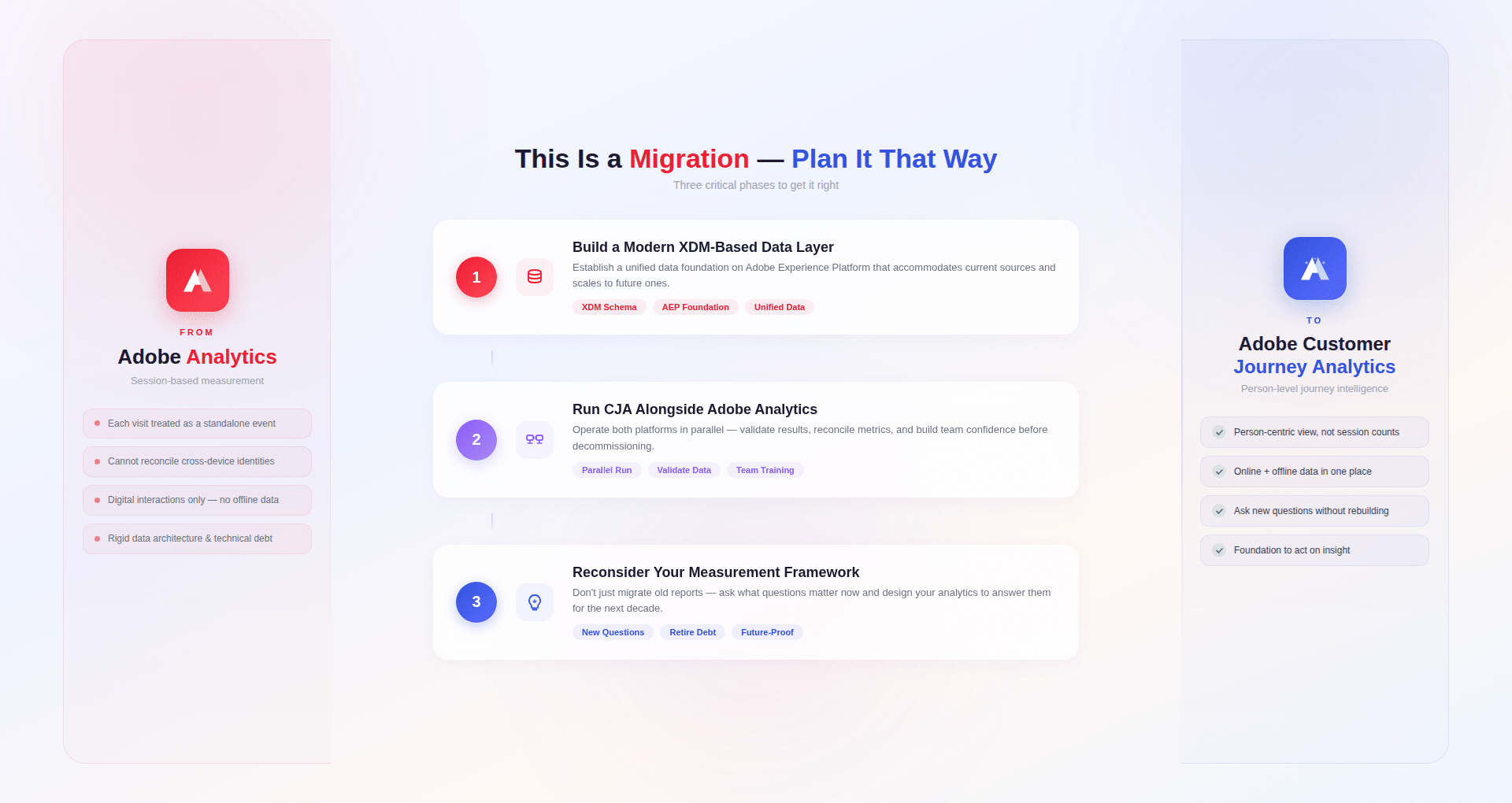
This Is a Migration — Plan It That Way

It would be a disservice to suggest that moving to CJA is straightforward. Because it uses a different data processing model, identity framework, and analytical structure than Adobe Analytics, organizations that approach it as a simple swap typically run into friction.

Migration Plan It That Way

A well-planned migration involves:

  • Building a modern XDM-based data layer that can accommodate your current sources and scale to future ones
  • Running CJA alongside Adobe Analytics during the transition period to validate results, reconcile metric differences, and build team confidence before decommissioning
  • Reconsidering your measurement framework — not just migrating old reports into a new tool, but asking what questions matter now and designing your analytics to answer them

Done well, this transition is an opportunity to retire years of accumulated technical debt, consolidate fragmented analytics investments, and build a foundation that actually serves the business for the next decade.

The Bottom Line

The case for moving to Adobe Customer Journey Analytics is not primarily about features. It’s about the kind of organization you want to be.

If your analytics are still session-centric, channel-siloed, and tied to a rigid data architecture, you’re not just missing insight — you’re making decisions about customer experience with information that doesn’t reflect how your customers actually behave.

CJA gives you:

  • A person-centric view, not a session count
  • Online and offline data in one place, not three separate dashboards
  • The flexibility to ask new questions without rebuilding your implementation
  • The foundation to act on insight, not just report it

The shift from Adobe Analytics to CJA is a shift from measurement to understanding — and for organizations competing on customer experience, that distinction increasingly determines who wins.

Considering a move to Adobe Customer Journey Analytics?  InfoVision’s Adobe practice has helped organizations design and execute this transition. Contact our expert to talk through what it would mean for your data environment.

The CMS Prior Auth Rule Explained: Scorecards, APIs, and What Comes Next

For years, prior authorization lived inside the payer’s walls. Providers felt it. Patients waited through it. Executives managed it as a cost center. But the market could not really compare it. That changed on March 31, 2026, when impacted payers under CMS-0057-F had to begin publicly posting certain prior authorization metrics for the previous calendar year. The first scorecard reflects calendar year 2025 – meaning the market is judging payers on pre-rule performance, not on how they are operating today.1

That timing nuance matters. The first public scorecard is being judged under a new transparency regime, but it reflects a period before the rule’s new process requirements were fully in force. Beginning in 2026, impacted payers other than Qualified Health Plan issuers on the federally facilitated exchanges must send prior authorization decisions within 72 hours for expedited requests and 7 calendar days for standard requests. Beginning in 2026, payers also have to provide a specific reason for denial for medical items and services, regardless of how the request was submitted.2

That is why this rule is bigger than compliance. CMS did not just add another reporting obligation. It made prior authorization more legible. Once CMS forces the numbers into public view, prior auth stops being just an internal process problem and starts becoming a market signal. That is an inference, but it follows directly from CMS requiring impacted payers to publicly post comparable prior authorization metrics on a recurring basis.1

The first scorecard is real, but it is still blurry

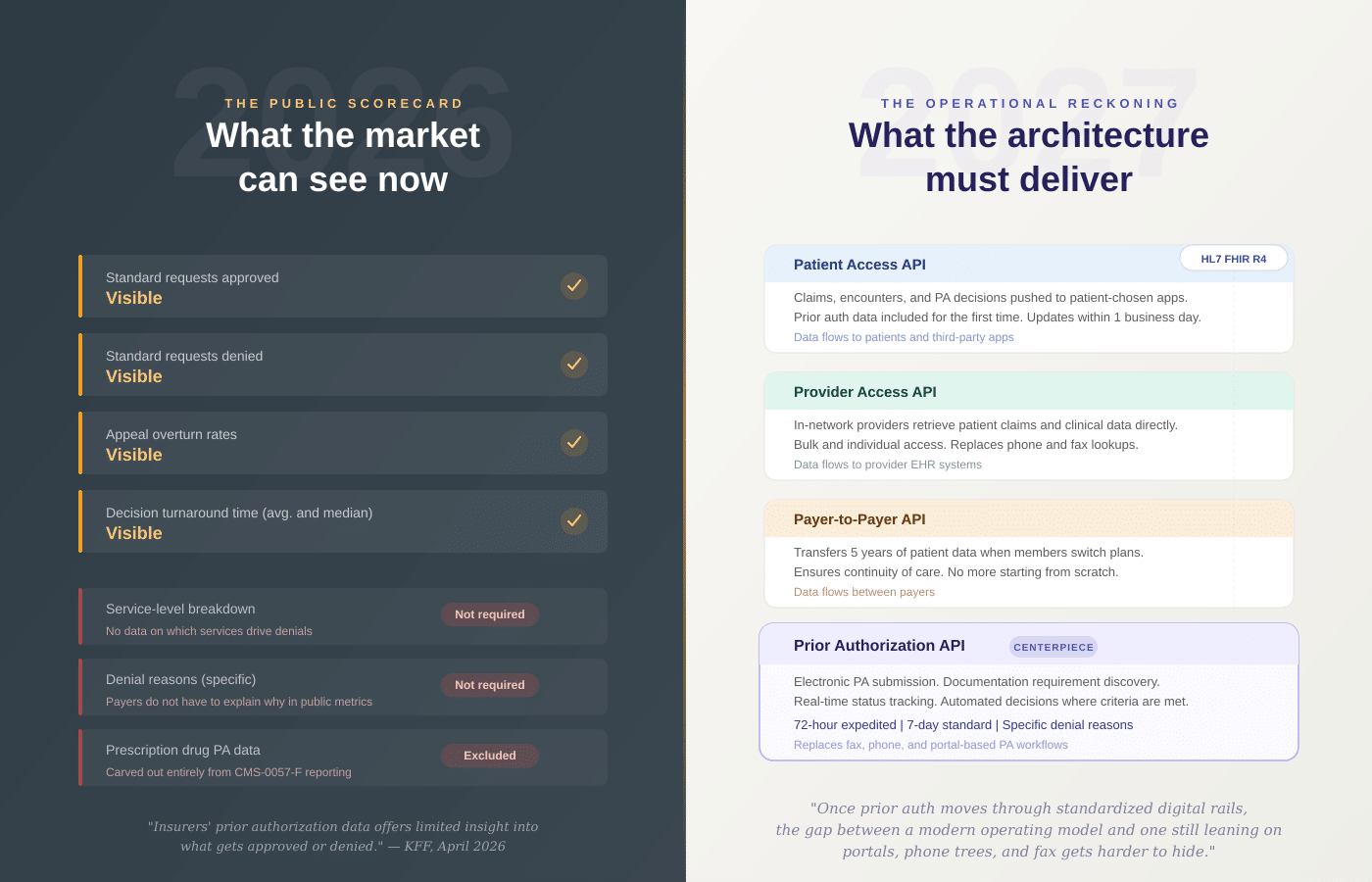
CMS is specific about what must now be posted publicly for medical items and services subject to prior authorization, excluding drugs. Impacted payers must publish approval and denial percentages, appeal outcomes, extended-review approvals, and average and median decision times for both standard and expedited requests.1

But the first year of public reporting is still pretty blunt. KFF says the new data offers limited insight, there is no breakdown by service type, no explanation of why denials happened, and prescription drugs are excluded entirely. You can compare payers at a high level, but you cannot yet cleanly separate clinical value from administrative noise. The last point is inference from KFF’s description of the data limits.3

That is the first year. It gets sharper from here.

At a Glance

What prior authorization metrics must health insurers publicly report under CMS-0057-F?

Under CMS-0057-F, impacted payers must annually publish key prior authorization metrics on their websites. These include the list of services requiring prior authorization (excluding drugs), approval and denial rates for both standard and expedited requests, appeal overturn rates, instances where review timelines were extended, and the average and median time taken to reach decisions.

The first reports, covering 2025 data, were due by March 31, 2026. However, the data is aggregated across all services, without breakdowns by service type, denial reasons, or prescription drugs, which limits its usefulness for deeper performance comparisons.

The smarter executive question is not “How often do you deny?”

The sharper question is this: How much friction do you create per clinically useful intervention?

Call it a Utilization Friction Index if you want shorthand. The point is simple: a process can approve a very high share of requests and still impose major operational drag through documentation churn, status checking, appeals, and wait time. The public reporting requirement does not calculate that index for you, but it does create the raw ingredients for the market to start asking the question. That conclusion is an inference from the metrics CMS requires payers to publish.1

How often do you deny

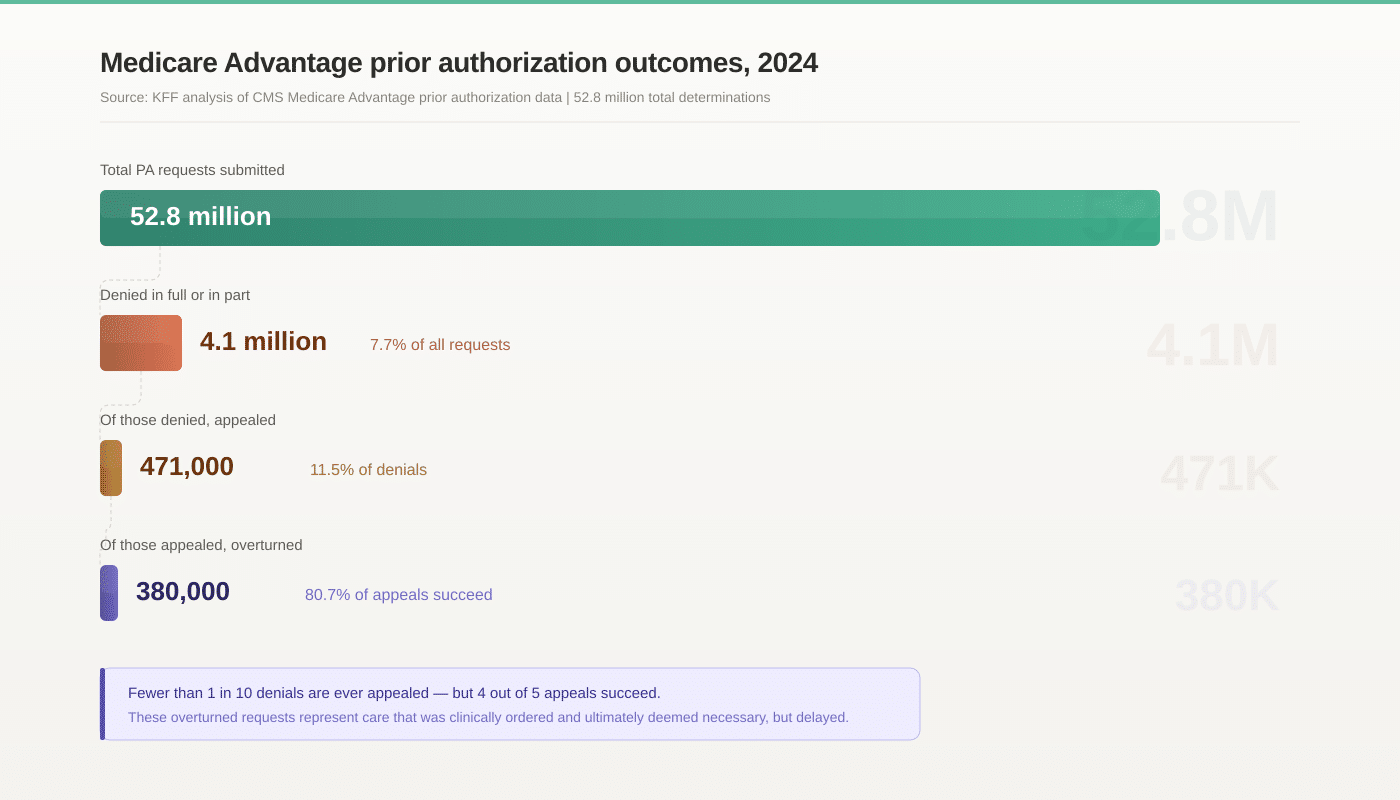
KFF’s Medicare Advantage analysis shows why this matters. In 2024, Medicare Advantage insurers made 52.8 million prior authorization determinations and 4.1 million were denied in full or in part. Only 11.5% of denials were appealed, but 80.7% of appealed denials were partially or fully overturned. Those overturned requests represent medical care that was ordered by a clinician and ultimately deemed necessary, but potentially delayed because of the extra step of appealing the initial decision.4

A high approval rate and a high-friction process are not mutually exclusive. That is the paradox the new transparency regime starts to expose.

2026 is the public scorecard. 2027 is the operational reckoning

CMS’s timeline makes the next inflection point clear. Impacted payers generally had to implement certain provisions by January 1, 2026, but have until primarily January 1, 2027 to meet the API development and enhancement requirements in the final rule. Those API-related requirements include the Patient Access API, Provider Access API, Payer-to-Payer API, and Prior Authorization API.5 The Prior Authorization API specifically must be populated with the list of items and services requiring prior auth, the payer’s documentation requirements for those items and services, and must support the creation and exchange of prior authorization requests from providers and responses from payers.

2026 is the public scorecard. 2027 is the operational reckoning

CMS also separately finalized the 2026 process requirements for denial specificity and faster turnaround times.6 That is why 2027 is the real operational test. In 2026, a payer can still argue that the public numbers reflect a transition-year baseline. In 2027, the architecture itself starts getting exposed. Once prior auth has to move through more standardized digital rails, the gap between a payer with a modern operating model and one still leaning on portals, phone trees, faxes, and exception queues gets harder to hide. That is inference, but it is grounded in the rule’s shift from public reporting to API-enabled exchange.5

At a Glance

What is the Prior Authorization API required by CMS in 2027, and how does it change the process?

Starting January 1, 2027, CMS-0057-F mandates a Prior Authorization API built on the HL7 FHIR R4 standard. This API enables providers to identify services requiring prior authorization, access documentation requirements, submit requests electronically, and receive decisions digitally.

This is CMS’s push to move prior auth off fragmented manual channels and onto more standardized digital exchange. While real-time decisions are not required, the automation introduced by the API is expected to significantly reduce turnaround times and streamline prior authorization processes.

Compliance is the mandate. PAS is the path.

There is one technical distinction worth keeping clean. CMS mandates the Prior Authorization API. CMS does not separately mandate PAS as a standalone fifth requirement. But it  strongly recommends that impacted payers develop their APIs to conform with certain implementation guides, and its own overview deck lists the Da Vinci CRD, DTR, and PAS implementation guides as recommended for the Prior Authorization API. That is the difference between compliance and architecture.6

From static scorecard to more liquid data

The transparency story also does not stop at a web page. The Patient Access API allows a third-party software application of the enrollee’s choosing to access the data made available through the API. CMS also requires reporting on how many unique patients had their data transferred through the Patient Access API to a health app selected by the patient, including how many had data transferred more than once.7

CMS’s 2024 overview deck further says that, beginning in 2027, impacted payers must include certain information about patients’ prior authorization requests and decisions, excluding drugs, in the Patient Access API. That does not create a consumer-grade comparison app overnight. But it does move prior auth away from static website disclosure and closer to app-accessible data in the patient’s hands. The second and third sentences are inference from CMS’s API requirements.6

Transparency creates pressure for exemption

The gold-carding angle is real, but it has to be stated carefully. KFF notes that some insurers waive prior authorization requirements for certain providers, including through gold-carding programs, and points to UnitedHealth Group’s decision to launch a national gold-card program that exempts certain providers from prior authorization requirements. KFF also notes that some insurers exempt providers through risk-based contracts.4

Separately, the American Medical Association says the federal GOLD CARD Act would exempt physicians from Medicare Advantage prior authorization requirements so long as 90% of their requests were approved in the preceding 12 months, and says the legislation was based on a similar Texas law.9

CMS-0057-F does not create gold-carding. But once payers are forced to publish aggregate prior auth performance, the pressure grows to explain why predictably approved care is still being pushed through the same tollbooth.

At a Glance

How does public reporting of prior authorization data affect health plan competition?

Public reporting under CMS-0057-F transforms prior authorization performance into a visible competitive factor. Metrics such as denial rates, turnaround times, and appeal outcomes are now accessible to providers, employers, and policymakers.

This transparency allows providers to use PA data in negotiations, employers to evaluate plans beyond premiums, and researchers to benchmark payer performance. It also increases scrutiny, especially when high appeal overturn rates highlight potential issues in initial decision-making.

CMS-0057-F does not itself create gold-carding. But transparency makes the logic behind gold-carding harder to ignore. If a provider or service line is predictably approved over time, the market has more reason to ask why the tollbooth is still there. That is inference based on KFF’s description of gold-carding programs and the public reporting regime CMS now requires.1,4

What this means for health plans and their technology partners

The cleanest way to read CMS-0057-F is not as a narrow compliance story. It is a market-structure story. The first public posting in 2026 reflects calendar year 2025 performance. The API build-out lands primarily in 2027. In between, prior authorization is shifting from a hidden workflow to a more visible, more measurable signal of operational maturity.

Payers that treat this as a documentation exercise will find themselves on the wrong side of that comparison. The ones that use the 2026 window to modernize their prior auth architecture — standardizing decision logic, reducing manual touchpoints, building toward API-ready infrastructure — will be better positioned when 2027 makes the operational gaps legible to the entire market.

2026 is the setup year. By 2027, excuses get a lot thinner.

References

  1. Centers for Medicare & Medicaid Services. Prior Authorization API. Accessed April 8, 2026.
    Source
  2. Centers for Medicare & Medicaid Services. CMS Interoperability and Prior Authorization Final Rule (CMS-0057-F) Fact Sheet. Accessed April 8, 2026.
    Source
  3. KFF. Insurers’ Prior Authorization Data Offers Little Insight Into What Gets Approved or Denied. Accessed April 8, 2026.
    Source
  4. KFF. Medicare Advantage Insurers Made Nearly 53 Million Prior Authorization Determinations in 2024. Accessed April 8, 2026.
    Source
  5. Centers for Medicare & Medicaid Services. CMS Interoperability and Prior Authorization Final Rule (CMS-0057-F). Accessed April 8, 2026.
    Source
  6. Centers for Medicare & Medicaid Services. CMS Interoperability and Prior Authorization Final Rule Presentation. Accessed April 8, 2026.
    Source
  7. Centers for Medicare & Medicaid Services. Patient Access API. Accessed April 8, 2026.
    Source
  8. Centers for Medicare & Medicaid Services. General Interoperability / Prior Authorization FAQs. Accessed April 8, 2026.
    Source
  9. American Medical Association. “Gold card” approach to prior authorization introduced in Congress. Accessed April 8, 2026.
    Source

Is AI Rewriting the Rules of Retail Supply Chain?

With AI dominating and reshaping every industry conversation, it is natural to wonder: is this technology mere hype, or is it truly here to stay? Are we still experimenting, or have we crossed into implementations that genuinely bolster AI’s game-changing claims?

Insights from the Webinar

The Future of AI-Driven Retail Supply Chain & Transportation Management

Moderated by: Monica Umesh, Director of Retail, InfoVision

Panelists:

  • Ravi Thatavarthy, CISO, Empiric Health

  • Sameer Bhavanibhatla, Data & AI Leader


Watch the full webinar →

Retail has made real strides in AI adoption, with measurable impact for both workers and customers. This article focuses on a critical piece of that journey: supply chain and transportation management.

Most supply chain systems were built for a predictable world, steady rhythms of demand forecasting and inventory management. That world no longer exists. Margin pressure, global disruption, sustainability goals, and rising customer expectations are reshaping how retailers plan, move goods, and respond to change.

What’s needed now isn’t isolated automation but a layer of intelligence powering smarter, more resilient supply chains. The retailers who win the next decade won’t just have the best products, they’ll have the smartest supply chains behind them.

This blog shares insights from a webinar on The Future of AI-Driven Retail Supply Chain & Transportation Management, where the consensus was clear: start now, don’t wait for a perfect AI strategy.

At a Glance

How is AI changing the way you think about demand forecasting day to day?

The industry is moving from traditional demand forecasting based on historical patterns to always-on predictions. Instead of relying on static history and fixed daily updates, AI enables real-time rerouting and dynamic carrier selection.

For example, if the East Coast sees lower store traffic because of a regional holiday, AI can help teams reroute inventory to the Midwest instead of continuing to follow last month’s plan.

Ravi Thatavarthy

Challenges in AI Adoption

As against periodic forecasting, continuous prediction is the need of the hour for retailers.  Traditional supply chains looked backwards. AI-powered ones do not. They scan in every direction at once – picking up signals from traffic patterns, local events, weather disruptions, and live browsing behavior. The result: decisions that are near-real-time, not days or weeks after the fact.  The engine behind all of this? Clean, well-structured data.

This is why the panellists emphasize thinking through the lens of data first. The fundamental question to answer is: how clean is your data?

Both Ravi Thatavarthy and Sameer Bhavanibhatla make this point emphatically: AI is only as intelligent as the data feeding it. Organizations that have built well-structured, accessible data lakehouses are certainly leading the way, both for now and the future. Those still working with fragmented, siloed, or inconsistently maintained data will find that AI amplifies their problems rather than solving them.

Legacy infrastructure is also a formidable challenge. Many of these systems, while still functional, are not scalable and simply not built for the demands of the new world.  “This is a definite pain point that we need to look at”, says Sameer.  Many warehouse management and transportation systems in use today were not designed to integrate with modern AI platforms. Addressing that technical debt, in small progressive steps is critical to steering the organization in the right direction.

At a Glance

What do organizations get wrong when they try to adopt AI without the right data foundation?

Many organizations treat data as something to solve later, when in reality data is a byproduct of process. If the process itself is not coherent, the data it generates will not be reliable enough to support meaningful AI outcomes.

The better approach is to evaluate processes from the beginning and make sure each step generates the right data. When the process is sound, the data becomes usable, and AI can deliver more reliable insights on top of it.

Too often, organizations try to layer AI onto broken or poorly designed workflows and then wonder why the results fall short.

Sameer Bhavanibhatla

The Business Case: Communicating the AI Value

“I don’t see supply chain as a logistics problem. It’s more about customer experience”, emphasizes Sameer.

The moment a customer places an order, a promise is made. Every link in the supply chain, from warehouse to last-mile delivery, either honors that promise or erodes it. When retailers frame AI investment through this lens, the ROI conversation with the board becomes significantly more convincing. The question shifts from “what does this technology cost?” to “what does a broken customer promise cost us in lifetime value, repeat purchase, and brand trust?” Logistics is therefore not about moving inventory, it is about delivering on a commitment, and the organic customer loyalty that follow when that commitment is consistently kept.

For executives building the internal case for AI investment, the most effective approach is to let business owners and not IT, champion the use cases. Survey your teams to identify the highest friction, most repetitive workflows. Build targeted, high-ROI pilots such as automating contract reviews, enabling intelligent inventory replenishment, or deploying Microsoft Copilot across back-office functions. Let the results speak and let the business leaders who benefit present those results to the board.

At a Glance

How do you actually get Board buy-in for AI investment in supply chain?

One practical way to build support is to form an AI innovation group and start by identifying real pain points from across the business. From there, organizations can develop use cases with clear ROI and tie them directly to measurable business outcomes.

For example, contract review work that once required significant manual effort can be completed in under an hour using an AI agent. That kind of efficiency is easier for leadership to understand when the impact is clearly demonstrated.

The most important part is who presents the value. When business unit leaders speak about the benefits, the case for investment becomes much stronger than when it is framed only as a technical initiative.

Ravi Thatavarthy

Addressing Concerns About Trust & Governance

Trust and governance are non-negotiable, particularly given the prevalence of legacy infrastructure and understandable organizational fear around AI. The good news: both are solvable with the right architecture and the right mindset.

Education about ‘what AI is and what AI is not’, is the most powerful tool for overcoming resistance. Much of the fear around AI stems from misunderstanding: the assumption that AI bypasses access controls or exposes data that should be protected. In reality, as Ravi explains, “AI is a technology that impersonates the access of the user, meaning it surfaces only what the user is already authorized to see, nothing more.”

Role-based access control is therefore the cornerstone of trustworthy AI architecture. Any AI system deployed across supply chain operations must respect and enforce the same permission boundaries that govern human access. Beyond that, guardrails around token consumption, particularly for generative AI tools, prevent accidental cost overruns and ensure accountability across the organization.

Sameer introduced an architecture principle worth adopting broadly: micro-agent orchestration. Rather than building large, monolithic AI systems, the most resilient architectures break intelligence into small, focused agents, each responsible for a discrete task, that hand off to one another in sequence. This reduces hallucination risk, improves decision accuracy, and makes systems far easier to audit and govern.

At a Glance

How do you build trust in AI systems, especially when legacy infrastructure and compliance concerns are in the mix?

Trust in AI starts with security-first design. Architecture decisions need to account for role-based access, permissions, and guardrails before features are considered.

Without those controls, AI systems can access information they should not, creating both compliance and operational risk. Clear boundaries are essential to make these systems dependable.

Trust also improves when AI is designed as a set of smaller, focused agents that hand tasks off cleanly to one another. The more targeted each agent is, the lower the risk of hallucination and the stronger the overall system becomes.

Sameer Bhavanibhatla

Where to Start: A Practical Roadmap

Moving from discussion to action requires more than a technology decision.  The panel is united in the belief that change management is the most critical factor, and how you approach it will determine the outcome.  Getting buy-in from people at every level is integral to AI adoption. With that foundation in place, the panellists recommend the following roadmap:
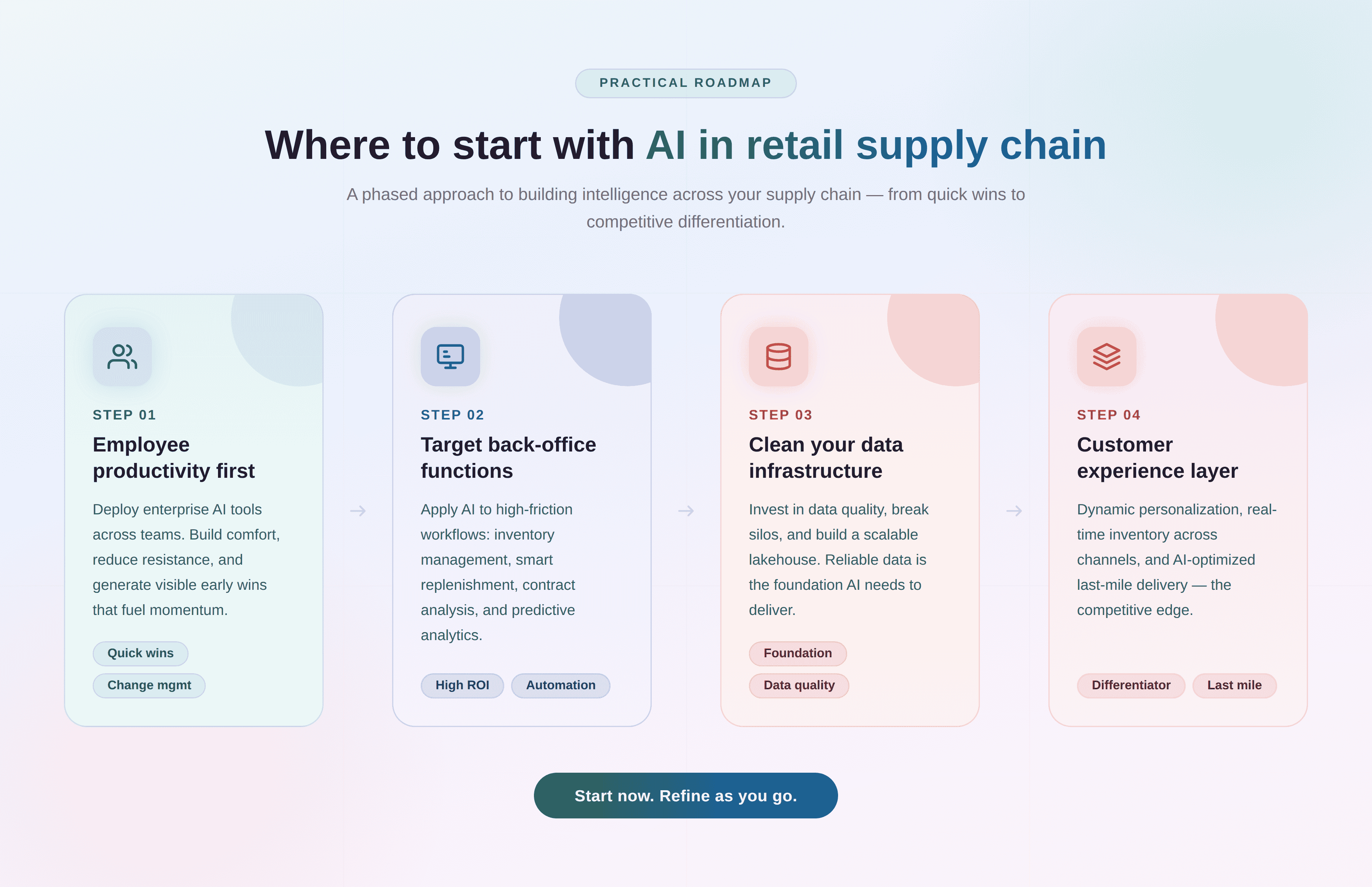
ai-retail-roadmap-infographic

  1. Employee productivity first. Deploy enterprise AI tools across your organization. Build familiarity, reduce fear, and generate early wins.
  2. Target back-office functions. Inventory management, smart replenishments, contract analysis, adding intelligent dimensions to predictive analytics are good starting points.
  3. Clean your data infrastructure. As AI matures across your back-end operations, simultaneously invest in the data quality and scalability that will eventually support customer-facing intelligence.
  4. Move to the customer experience layer. Dynamic personalization, real-time inventory alignment across online and in-store channels, and AI-optimized last-mile delivery are the competitive differentiators.

Emerging Capabilities to Watch

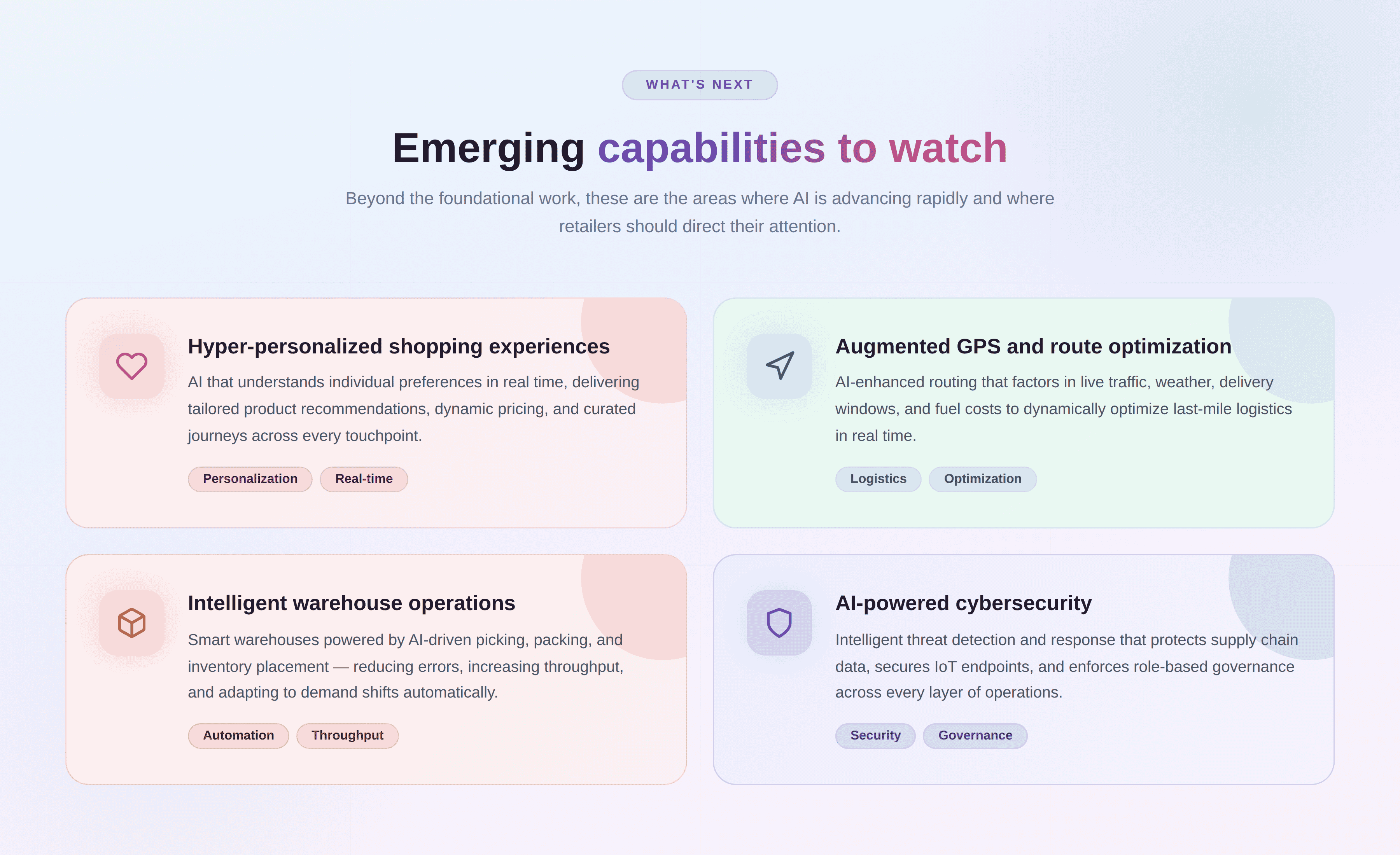
Beyond the foundational work, the panel highlighted several areas where AI is advancing rapidly and where retailers should direct their attention:
emerging-capabilities-infographic
The conversation is just beginning. Watch the full webinar for a deeper dive.

The Rise of Specialist GCC: Rethinking Capability, Not Scale

India has firmly established itself as a preferred destination in the Global Capability Center (GCC) landscape. The numbers tell this story clearly.

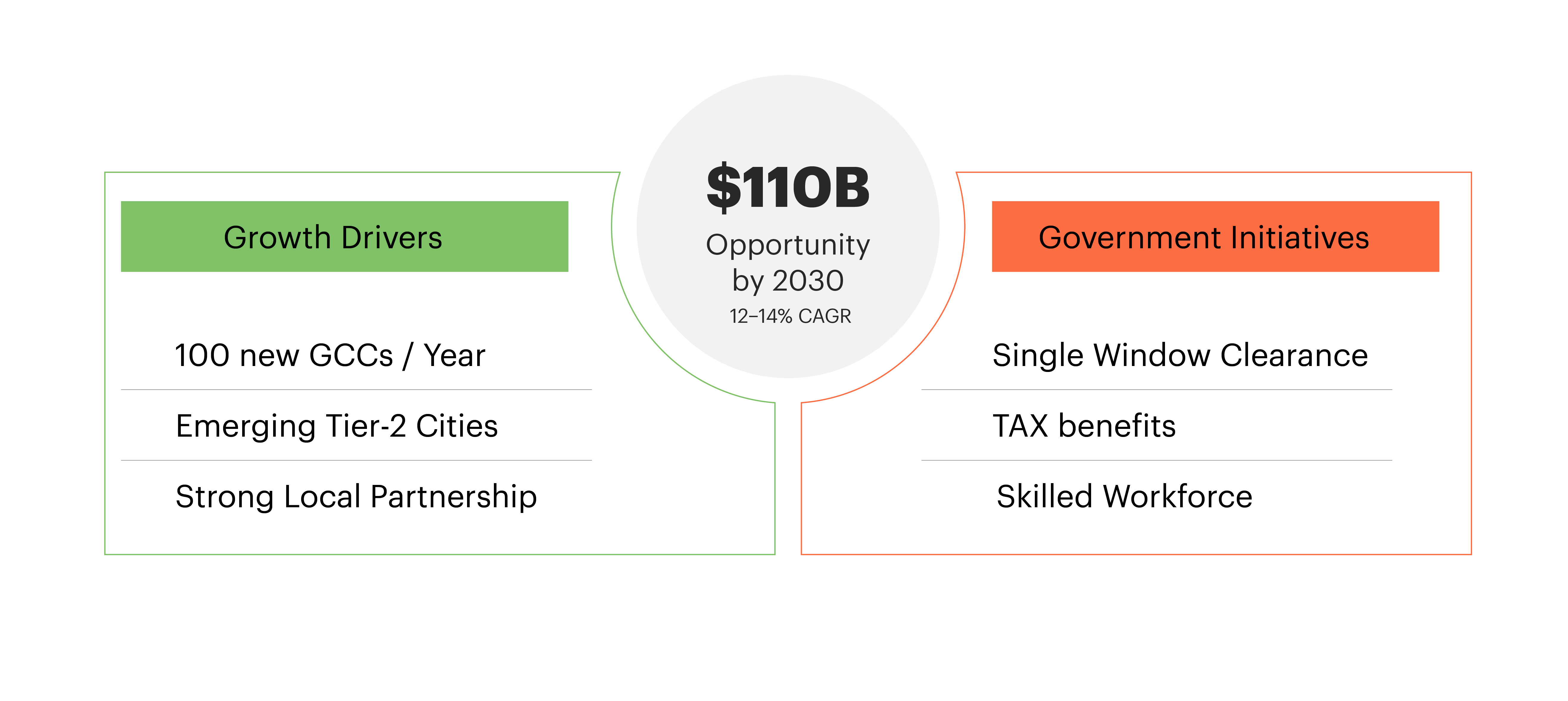
The country today accounts for more than half of the global GCC footprint, with over 1,700 centers operating across the country and a workforce exceeding 1.9 million professionals supporting this ecosystem. The scale continues to expand, with the sector projected to grow at 12–14% CAGR towards a $110 billion market by 2030.

Yet the most important shift underway is not numerical. It is structural.  Close observers of the ecosystem are noticing the emergence of a new model: the Specialist GCC.

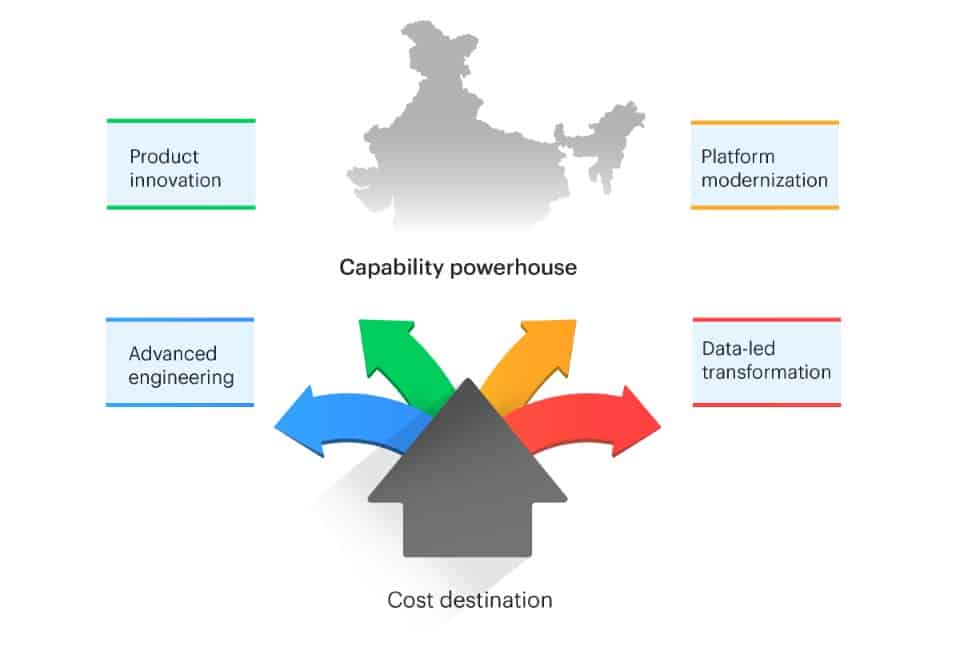
India is no longer just a location where enterprises extend operational capacity. It is increasingly where they build and concentrate strategic capability. This steady transition from cost-led delivery centers to capability-led innovation hubs is reshaping how organizations design their global operating models.

The narrative is shifting from extending operational capacity to building strategic capability, and from cost arbitrage to innovation-led value creation as the primary drivers behind choosing India as a GCC destination.

This evolution, particularly the rise of more specialized, capability-driven GCC models, is explored in greater depth in our eBook on the future of GCCs.  This blog distils some of the key insights driving that shift.

Moving Beyond the Scale Paradigm

The GCC model began with a clear enterprise need: optimize supply chains, digitize core systems, and consolidate shared services. The early generation of GCCs was therefore built with a defined intent: to centralize operations, standardize processes, improve control, and drive cost efficiency through scale.

These centers often scaled rapidly, supported by structured service lines, layered governance, and well-defined operational maturity frameworks. For that phase of enterprise transformation, the model worked well.

Moving Beyond the Scale Paradigm

Over time, however, the enterprise environment became far more dynamic and demanding. Innovation cycles shortened. Platform modernization became continuous. Cloud-native architectures required tighter integration. Artificial intelligence initiatives began cutting across functions. And product engineering teams increasingly operated in distributed environments.

In such a landscape, the primary challenge was no longer scale. It was coherence.

When capabilities are fragmented across geographies and vendors, architectural continuity begins to weaken. When decision-making is spread across multiple layers, responsiveness slows. And when knowledge is not retained within a stable ecosystem, innovation becomes reactive rather than intentional.

Scale without alignment introduces complexity.

Specialist GCCs are a response to that complexity

At a Glance

What is a Specialist GCC?

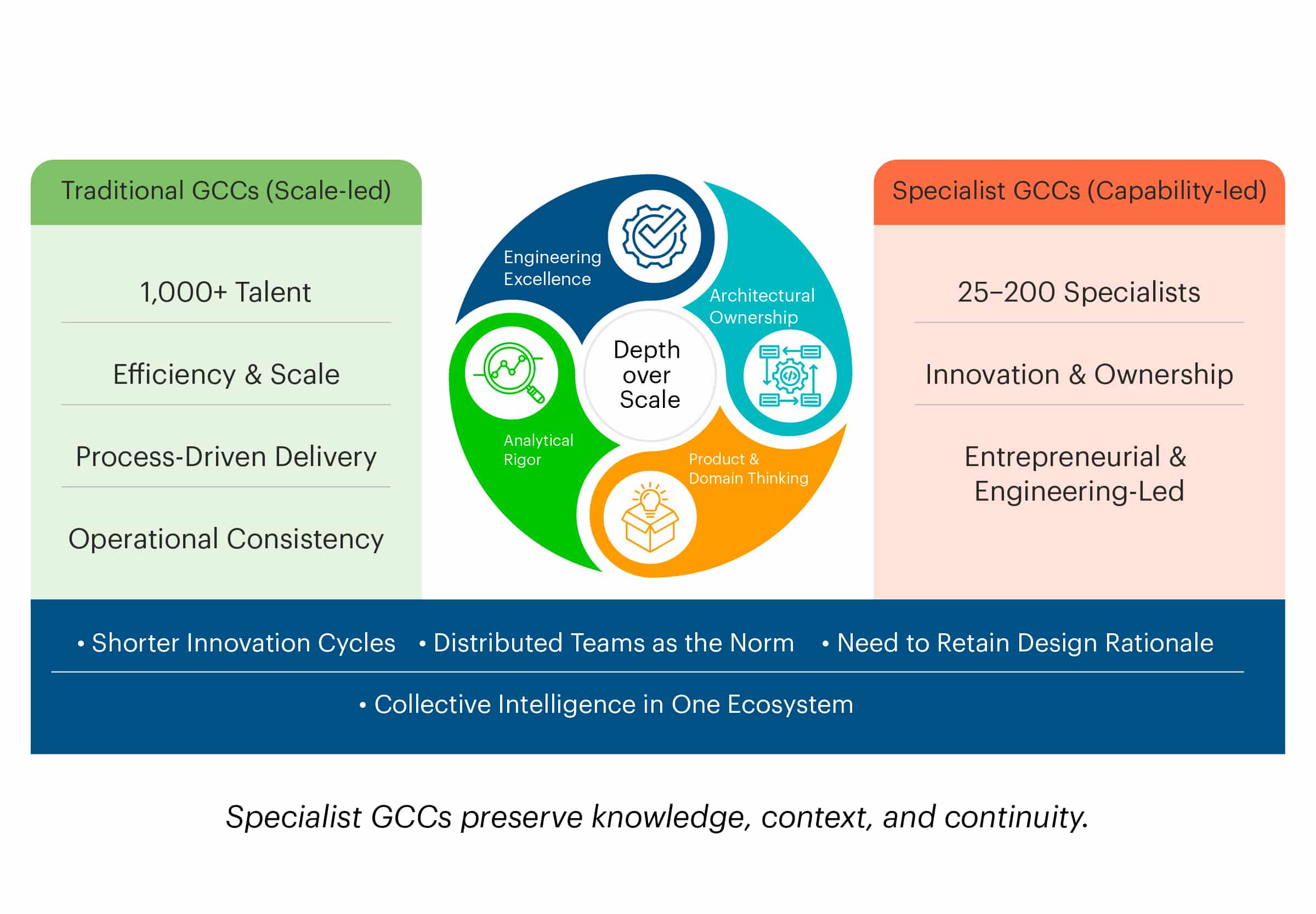
A Specialist GCC in India is a focused, capability-led Global Capability Center, typically structured with 25–200 experts and designed to own engineering, product, data, or AI domains rather than operate as a large-scale delivery extension.

Unlike traditional GCCs built primarily for cost efficiency and workforce scale, Specialist GCCs prioritize architectural ownership, innovation velocity, and long-term capability retention within India’s mature GCC ecosystem.

A Specialist GCC is defined not by its size, but by its architectural discipline. These centers are built around concentrated expertise and clear ownership of capability domains, enabling continuity in design, product thinking, and decision-making.

They operate less as distributed execution arms and more as embedded capability hubs within the enterprise ecosystem.

Why Mid-Sized Enterprises Are Leading This Model

A significant portion of new GCC setups now originate from mid-sized enterprises. These organizations typically operate with leaner structures and closer alignment between strategy and execution, allowing them to move with greater speed and clarity.

Unlike large enterprises that often replicate scale, mid-sized organizations are more deliberate in how they build global capability. Their focus is not on workforce volume, but on creating tightly aligned hubs that can own product stacks, advance data and AI capabilities, and lead platform, cloud, and cybersecurity initiatives.

For such enterprises, control and depth matter more than workforce volume.  Specialist GCCs offer a mechanism to build capability without inheriting bureaucratic weight of traditional models.

As the shift becomes more visible, a natural question emerges:

At a Glance

Why are mid-sized enterprises building Specialist GCCs in India?

Mid-sized enterprises are building Specialist GCCs in India to create concentrated innovation hubs without inheriting the complexity of large-scale operations.

India offers access to a deep and growing talent pool, strong digital infrastructure, and a mature GCC ecosystem, enabling organizations to build and scale high-value capabilities efficiently.

Purpose as the Primary Structural Lever

The durability of any GCC begins with absolute clarity on mandate.  A sharply articulated charter ensures structural alignment.

A Specialist GCC typically begins with a clear articulation of its role within the enterprise operating model. It may be tasked with owning a specific product line, leading AI deployment across platforms, consolidating cloud engineering expertise, or strengthening data governance architecture.

The eBook underscores that the early phase of a GCC’s journey determines its long-term trajectory . Purpose clarity at inception prevents mid-phase fragility.

Structural coherence is not accidental. It is designed.

Expertise Density as a Competitive Advantage

While traditional GCCs often scaled through headcount growth, Specialist GCCs are built around concentrated expertise. This difference may appear subtle, but its impact is significant.

Higher expertise density leads to faster decision cycles, reduced architectural rework, clearer accountability, and stronger cross-functional integration.

In distributed enterprise environments, where time zones and digital collaboration introduce friction, this concentration of expertise helps reduce coordination overhead and improve alignment. This becomes especially critical in AI-driven transformations, where data engineers, machine learning specialists, cloud architects, and product teams must work in close sync.

The mandate for Specialist GCCs therefore goes beyond efficiency or cost advantage. Their primary goal is to drive product development, strengthen data engineering capabilities, lead platform and digital transformation, and apply artificial intelligence in meaningful business contexts.

As organizations evaluate this shift, another important question emerges:

At a Glance

What is the difference between a traditional GCC and a capability-led GCC?

A traditional GCC is typically scale-driven and process-oriented, focusing on operational efficiency and throughput.

A capability-led GCC, often structured as a Specialist GCC, emphasizes expertise density, architectural continuity, and ownership of high-value domains such as AI, cloud, cybersecurity, and data engineering.

What is the difference between a traditional GCC and a capability-led GCC

AI Integration and Architectural Ownership

Specialist GCCs are structurally well-suited to embed AI into core systems because of their concentrated expertise model. Rather than layering AI experiments onto fragmented systems, they can integrate machine learning capabilities directly within architectural frameworks.

AI adoption introduces new structural demands. It requires integrated data pipelines, scalable cloud infrastructure, secure architecture, and cross-functional collaboration.

This approach reduces duplication and enhances long-term maintainability, making AI adoption more systematic rather than opportunistic.

As enterprises accelerate their AI journeys, a key question arises:

At a Glance

How do Specialist GCCs support AI-led digital transformation in India?

Specialist GCCs support AI-led transformation by embedding data engineering, cloud architecture, and machine learning expertise within tightly aligned teams.

India’s mature GCC ecosystem enables enterprises to integrate AI directly into core platforms, improving innovation velocity and long-term architectural stability.

India’s Ecosystem Maturity

India’s appeal as a GCC destination extends beyond cost differentials.

Major hubs such as Bengaluru, Hyderabad, Chennai, Pune, and NCR host mature ecosystems supported by academia, startups, and industry networks. In 2024 alone, GCCs leased 77.2 million square feet of workspace, reflecting infrastructure readiness at scale.

India’s Ecosystem Maturity

State governments including Telangana, Karnataka, and Tamil Nadu have implemented structured policy initiatives offering streamlined approvals and skill development support.

The workforce exceeds 1.9 million professionals and continues to grow.  The ecosystem is not nascent. It is institutionalized.

The evolution of GCCs in India reflects a deeper shift in how enterprises think about capability, ownership, and innovation. The move from scale-driven models to capability-led structures is not incremental, it is foundational.

Specialist GCCs represent this next phase. They are not extensions of global operations, but integral nodes of enterprise capability designed to deliver coherence, speed, and long-term strategic value.

For organizations evaluating how to design or evolve their GCC strategy, understanding this shift is critical.

Our eBook explores the Specialist GCC model in detail, covering structural design, operating principles, and real-world application of capability-led centers.

SAP Disaster Recovery: Why Resilience Is a Boardroom Conversation Now

How Agentic AI Is Transforming Modern Banking

Banks are under pressure to move faster while staying secure and compliant. Traditional AI has helped, but the next leap requires systems that can adapt on their own. Agentic AI brings that capability. It analyzes behavior in real time, makes decisions without waiting for human intervention, and continuously learns from new patterns. For financial institutions, this means stronger protection, faster lending, and more proactive risk management.

Agentic AI is now shaping the way financial institutions and fintechs operate.  Deloitte forecasts that by 2027, half of Gen AI adopters will shift to Agentic AI, which signals a decisive move toward systems that can sense, decide, and act with limited human intervention.

Banks are exploring this shift not simply to automate tasks, but to strengthen decision-making, minimize fraud, accelerate credit access, and improve resilience in a landscape where risks evolve by the hour. Seen through a strategic lens, agentic AI is becoming the foundation of intelligent banking ecosystems.

Agentic AI in Banking

Rethinking Banking Resilience

Let’s face it. Fraud has become one of the biggest threats to financial stability. Credential stuffing, synthetic identities, deepfake impersonations, and crime as a service have made legacy fraud controls inadequate. Traditional engines rely heavily on rule-based checks and siloed scoring models. They often delay detection, escalate false positives, and frustrate both teams and customers.

Industry numbers convey the urgency.  Banking fraud losses are projected to exceed $45 billion in 2024–2025, fueled by increasingly sophisticated attacks. The Alloy 2025 State of Fraud Report found that 60% of financial institutions and fintechs reported an increase in fraud attacks year on year. A report by SEON Ltd. places worldwide fraud costs at around US $5.13 trillion annually, showing a steep rise of around 56 % over the past decade.  This reality demands a different approach, one that moves from reactive protection to proactive intelligence.

Agentic AI introduces that shift by combining autonomous analysis, context awareness, and continuous learning.

With fraud mitigation becoming more complex, banks are recognizing that they cannot protect customers with yesterday’s tools. This is where the agentic model creates meaningful impact.

Agentic AI Reinvents Fraud Detection

Agentic AI applies advanced pattern recognition, behavior modelling, and real-time analytics to detect anomalies in seconds. At a strategic level, this matters for three reasons.

First, it closes the reaction gap.

Fraudsters adapt faster than traditional risk models. Agentic systems learn from live behavior, not just historical data. This allows them to act before a suspicious pattern becomes an actual loss.

Second, it reduces operational friction.

Banks often suffer from high false positives, which strain investigation teams and disrupt customers. With contextual intelligence, agentic models filter out noise and highlight the most critical threats.

Third, it enhances customer trust.

A bank that protects its customers in real time secures long-term loyalty. Faster detection reduces incident severity and the average cost per breach.

Many banks that implemented agentic fraud engines have reported close to 28 percent fewer successful scams and identity fraud attempts. This demonstrates a measurable business case, not just a technical upgrade.

Fraud detection may be the most visible use case, but the same intelligence applies across the credit lifecycle. The next leap is in how banks approve and process loans.

Fast-Tracking Loan Approvals

Loan approvals have traditionally been paperwork-heavy and time-consuming. Manual document checks scattered income proofs, inconsistent scoring, and dependency on credit officers often result in delayed decisions. For borrowers seeking immediate liquidity, especially small businesses and underserved segments, this delay becomes a barrier.

Automated document intelligence.

AI agents extract and verify data from bank statements, payslips, GST records, and business documents with higher accuracy than manual review.

Instant risk scoring.

Agentic systems evaluate repayment capacity using behavioural signals and contextual insights rather than relying on limited bureau data.

Higher inclusion.

Because agentic AI interprets non-traditional data more effectively, it expands credit access for customers who were earlier deemed “thin-file”.

The outcomes speak for themselves. Some lenders have brought down loan processing from two days to less than an hour. Others have improved decision accuracy and extended credit to nearly  22% more underserved borrowers.

Key benefits of Agentic Al in loan approvals

While speed matters, sustainable lending also requires continuous risk visibility. This brings us to the third strategic advantage of agentic AI.

Real-Time Risk Management

Banks operate in an increasingly unpredictable financial climate, and this calls for continuous risk assessment to stay afloat. Market shifts, cyber threats, liquidity risks, and compliance events can emerge faster than manual reviews can respond. Traditional risk models were never designed for real-time recalibration.

Agentic AI supports a more predictive risk posture.

Continuous monitoring.

AI systems track millions of data points across transactions, customer behavior, credit exposure, and operational triggers. This reduces the reliance on periodic reviews.

Dynamic risk scoring.

Models adjust exposure based on new inputs rather than waiting for quarterly cycles. Banks respond to anomalies within seconds.

Operational efficiency.

Studies show that AI-enabled risk dashboards reduce manual effort by nearly half and accelerate suspicious activity reviews by up to eighty percent.

From a strategic standpoint, this shifts risk management from a reporting function to a real-time control tower. It improves audit readiness, strengthens compliance, and equips banks to make faster, informed decisions.

As powerful as these outcomes are, agentic AI also requires thoughtful adoption. Banks must navigate not only opportunity but also the responsibility that accompanies intelligent automation.

Navigating Challenges and Creating Long-Term Value 

Agentic AI is on track to become the core of modern financial infrastructure. More than ninety percent of banks already use some form of AI-driven monitoring. Fraud losses have reduced, credit decisions have become faster, and risk response times have improved significantly.

Global forecasts indicate strong adoption. Deloitte estimates that half of AI-driven enterprises will deploy agentic models within two years. IDC projects more than 120 billion dollars in AI investment by financial institutions by 2030. As these models mature, they are expected to reduce operational costs, enhance regulatory reporting, and enable personalised financial products that can be launched in weeks instead of months.

Looking ahead, the institutions that succeed will be those that combine intelligence with accountability. Governance, algorithmic transparency, model monitoring, and ethical AI will become central to trust. This is not just a compliance requirement. It is a competitive differentiator.

Super Apps and Micro Journeys: Reimagining the Mobile Experience

For years, the phrase “there’s an app for that” perfectly summed up the mobile era. Every need, be it shopping, payments, travel, or fitness, had its own app. That abundance of choice made smartphones the remote control for modern life. But somewhere along the way, convenience gave way to clutter. Users today are overwhelmed by the endless notifications, updates, and logins, while enterprises are locked in a cycle of driving app downloads only to see most users abandon them after one or two uses.

We’ve reached the tipping point of app fatigue. The next wave of mobile innovation therefore is not about building more, rather it is about building smarter. It’s about simplifying experiences and connecting ecosystems so that users can live, work, and transact without friction.

This is the dawn of a new era of ‘super apps’ and ‘micro journeys. I like to think of it as the fragmented mobile universe pulling itself back together.

The Reinvention of Super Apps

The super app concept isn’t new. Platforms like WeChat, Grab, and Gojek have long shown how integrating multiple services (like messaging, payments, shopping, or mobility), within a single interface creates unmatched stickiness. But what’s exciting today is how this model is gaining global traction, supported by advances in AI, open APIs, embedded finance, and interoperability frameworks.

The idea is no longer confined to Asia.

  • Meta is evolving WhatsApp into a commerce and service hub.
  • Reliance Jio and Paytm are fusing payments, content, and shopping.
  • Uber has integrated rides, groceries, and deliveries in one app.

Super apps thrive on network effects: the more services they bring together, the more indispensable they become. Yet, in a world increasingly defined by data privacy and regulatory scrutiny, success will depend not on owning everything, but on orchestrating everything.

The winning super app of tomorrow will not be a monolith. It will be an ecosystem orchestrator – a platform that integrates diverse services while maintaining transparency, consent, and user trust.

Micro Journeys: The Future of Mobile Interaction

If super apps represent scale and integration, micro journeys embody precision and purpose.  A micro journey is a short, contextual digital interaction that fulfils a specific user intent without unnecessary effort.

Think about it:

  • You scan a QR code and instantly check train timings.
  • You type “book a doctor” in WhatsApp and complete an appointment in seconds.
  • You renew your car insurance by simply speaking to your voice assistant.

That’s a micro journey: fast, intelligent, invisible.

Behind each one lies a network of APIs, conversational interfaces, and contextual AI models working in sync. They don’t demand user attention; they respect it.

For enterprises, micro journeys redefine customer engagement economics. They reduce clicks, cut costs, and boost conversion rates, all while strengthening brand affinity. In the attention economy, the best experiences are the ones that don’t feel like effort.

The Architecture Behind the Revolution

Delivering such fluidity requires a fundamental rethink of the mobile architecture. Traditional app models built around static interfaces are giving way to modular, intent-driven ecosystems. The modern mobile stack now revolves around three design principles:

The Architecture Behind the Revolution

At the heart of all this is AI as the invisible orchestrator by predicting intent, suggesting next best actions, and dynamically generating temporary “micro-apps” when needed. The boundaries between apps, web, and chat are dissolving. The user’s need and not the interface, has become central.

Strategic Imperatives for Enterprises

From my vantage point leading global mobility programs, the implications for enterprises are profound. Building one more app is no longer a strategy. The focus must shift from mobile products to mobile ecosystems. And this is the direction in which we should move:

  1. From Product Silos to Experience Ecosystems
    Enterprises need to move beyond isolated apps and embrace interoperability. That means opening APIs, integrating across industries, and governing data collaboratively. The most resilient digital brands will be those that operate as platforms and not just providers.
  2. Monetization Beyond the App Store
    The real value now lies in embedded actions:  the seamless “buy,” “book,” or “renew” moments that happen within conversations. Revenue will increasingly flow from these contextual transactions rather than app store metrics.
  3. Trust and Privacy as Competitive Edge
    As ecosystems expand, user trust will become the ultimate currency. Companies that design for privacy, transparency, and consent will stand apart. The ability to personalize responsibly will separate leaders from laggards.

The Road Ahead: From Apps to Ecosystems

By 2030, the term mobile app might sound quaint. We’ll live in a world of micro experiences, fragments of functionality woven together by AI and delivered through diverse interfaces such as voice, AR, chat, even ambient devices. Your health, banking, and entertainment services will co-exist in a single, connected mobility layer that knows you, understands you, and adapts to your context.

For leaders, the question will shift from “What app should we build?” to “Which user moments should we enable and how do we integrate into the ones we don’t own?”

The new era of mobile is collaborative, contextual, and conversational, for sure.

Owning the Mobile Moment

The mobile future isn’t about capturing attention; it’s about orchestrating relevance.
Super apps will deliver breadth. Micro journeys will deliver depth. Together, they’ll define a mobile ecosystem that blends intelligence with simplicity.

Enterprises that can balance control with openness, and personalization with privacy, will be the ones to own the mobile moment.  This will come about not just by building digital products, but by designing intelligent, intuitive experiences that become a natural part of everyday life.