
Reimagining Agility in the Age of AI and Automation: My Perspective

Agility at the Speed of Trust: Reflections on Intelligent Transformation

AI and automation are no longer just about speed or efficiency.   They are about earning the trust to move faster, smarter, and more responsibly. In a recent panel I had the opportunity to moderate a discussion on “Intelligent Transformation: How AI and Automation Are Powering the Next Wave of Business Agility,”where we explored how leaders can balance innovation with governance, scale with ethics, and ambition with accountability, because the real measure of agility today is not how quickly you move, but how sustainably you grow.

What Intelligent Transformation Really Means

It was a privilege to moderate this conversation hosted by AiCoreSpot, with two exceptional panelists – Ajay Pundhir, Director of AI at Presight and Founder of AI Exponent, and Mohammad Iqtadar, Chief Compliance Officer at Ajman Bank.

What made this discussion stand out was how it went beyond the “what” of AI tools and automation platforms, and focused on the “how” – how businesses can stay truly agile by combining technology, governance, and human judgment to build trust, resilience, and continuous innovation.

Agility Isn’t Just About Speed Anymore

For years, agility was defined by how fast an organization could move, effectively how quickly it could pivot, launch, or scale. But as one of the panelists rightly said, “real agility means moving at the speed of trust.”

Ajay introduced a powerful idea, the Minimum Viable Governance (MVG) framework,  as a way to balance innovation with accountability. He drew an important distinction between technical debt and ethical debt: you can fix bad code later, but you can’t repair broken trust.

That thought stayed with me. Governance isn’t a speed breaker; it’s the foundation for sustainable growth. When organizations embed governance early – defining principles, data boundaries, and ethical guardrails – they don’t slow down innovation; they enable it.

Afterall, the ROI of responsible AI isn’t measured in quick wins, but in credibility, resilience, and long-term business value.

How Intelligent Automation Is Changing Risk and Compliance

Mohammad brought a compelling view from the banking world on how AI and automation are transforming the very core of risk management.

He explained how intelligent automation is strengthening the “three lines of defence”: risk management, compliance, and internal audit. With AI-driven anomaly detection, predictive analytics, and continuous monitoring, banks are identifying risks faster and ensuring proactive compliance.

But what stood out was his emphasis on ‘human oversight’. Machines can flag anomalies; but it takes human judgment to interpret, investigate, and decide.

He described it as a hybrid model: automation managing scale, humans managing exceptions. That balance between adaptability and accountability defines true agility in an AI-driven world.

When Everyone Has AI – Where Does Differentiation Come From?

A question I often hear from leaders: If everyone has access to the same AI models, where’s the competitive edge?

Ajay’s answer was simple yet profound: context and trust.

AI models may be global, but business problems are always local and specific. The real differentiation lies in how companies adapt AI to their context, their data, customers, and ethics.

In a world where technology is commoditized, trust becomes the ultimate differentiator.
It’s not about what tools you use; it’s about how responsibly you use them.

The UAE’s Approach: Policy as an Enabler of Agility

We also explored how the UAE has become a model for intelligent transformation through its National AI Strategy 2031and UAE AI Charter.

Ajay highlighted how these frameworks promote responsible innovation through clear, actionable principles — a rare balance of governance and agility. It’s a reminder that regulation doesn’t have to restrict innovation; it can accelerate it when done right.

For organizations operating in the GCC, this policy clarity is enabling faster go-to-market strategies, global competitiveness, and most importantly, trust at scale.

Responsible AI Is Now a Talent Strategy

One statistic from our discussion still stands out: 78% of AI engineers prefer working for ethically responsible companies”.

That says everything about the new generation of talent. They’re not just looking for compensation; they’re looking for purpose.

Organizations that make their ethics visible, embed responsible AI into their design practices, and create open conversations around fairness and transparency are the ones attracting and retaining top talent.

Ethics is no longer just a compliance checkbox – it’s a brand differentiator and a talent magnet.

How to Break the “Pilot Trap”

Almost every enterprise today has an AI pilot somewhere. But only a few move beyond the experimentation phase.

Ajay captured it perfectly: “Technology is 20% of the equation; governance is 30%; mindset is 50%.”

Success starts with the right mindset: defining purpose, aligning stakeholders, and designing for scale from day one.

Mohammad added a practical banker’s lens: “If you don’t plan for integration and ROI from the start, your project will stall.”
Transformation isn’t about flashy pilots; it’s about connecting people, processes, and technology – all under a trusted, governed framework.

Choosing the Right AI Tool for Your Business

An audience question summed up what many leaders wonder: How do you choose the right AI tool when everyone, from GPT to Gemini, offer similar capabilities?

Mohammad’s advice was clear: “Start with your business need, not the product’s demo.”

The right AI tool isn’t the one with the most features; it’s the one that fits your context, integrates with your data ecosystem, and can be governed sustainably. Alignment always beats attraction.

The Future of Intelligent Transformation: Moving at the Speed of Trust

As the session wrapped up, I asked both panelists to describe intelligent transformation in a single word.

Ajay called it “Trust Velocity” – the speed at which organizations can innovate responsibly.
Mohammad chose “Digitization” – reflecting how deeply AI and automation are embedded into business.
For me, it’s “Convergence” – where people, process, and purpose meet.

AI and automation aren’t just changing how we work; they’re reshaping how we think, decide, and lead.

The next wave of business agility won’t be about moving faster.
It will be about moving smarter, and always, at the speed of trust.

▶️ Watch the full discussion here: Intelligent Transformation: How AI and Automation Are Powering the Next Wave of Business Agility

SAP at the Core: How ERP and Managed Services Are Reshaping Telecom Agility

Having worked with telecom enterprises through multiple transformation journeys, one pattern stands out for me:  Agility comes from integration.  And that’s exactly where SAP-powered ERP systems have made the biggest difference.

Telecom is no longer about just providing connectivity; it’s about creating connected ecosystems. SAP, with its unified data architecture and modular flexibility, is helping operators do just that by bringing business, network, and customer operations onto a single digital foundation.

When supported by robust Managed Services, SAP becomes more than a system. It transforms into a catalyst for continuous innovation, intelligent decision-making, and resilient operations.

The Shift Toward an Integrated Telecom Ecosystem

Most telecom enterprises run complex environments comprising networks, supply chains, customer support, billing systems, and more. Yet, many of these systems often run in silos. The result? Slow decisions, manual dependencies, and incomplete visibility.

Integrating SAP with communication and service management systems changes that picture. It turns isolated functions into a unified ecosystem where every transaction, service ticket, and customer interaction is visible and traceable.

SAP’s ability to connect core business functions with real-time operational data helps telecoms overcome one of their biggest hurdles of fragmentation.

Here’s what that looks like in practice:

  • Real-time visibility into network and operational performance
  • Faster decisions powered by unified analytics and shared data
  • Improved coordination between field and back-office teams
  • Higher customer satisfaction through proactive service delivery.

When systems start talking to each other through SAP, agility becomes second nature.

Why SAP Sits at the Core of Telecom Agility

Over the years, I’ve seen SAP act as the digital backbone for telecom enterprises, connecting finance, supply chain, workforce, and service management into one transparent flow of information.

It’s not just about standardizing processes; SAP gives operators the clarity and control needed to run leaner and respond faster.

Here’s what it brings to the table:

  • Operational efficiency: Automation cuts down repetitive tasks and manual interventions.
  • Real-time insights: Dashboards offer instant visibility into KPIs, costs, and service performance.
  • Smarter resource planning: Predictive analytics optimize network assets and workforce scheduling.
  • Enhanced customer experience: SAP-CRM integration ensures faster, personalized service responses.
  • Governance and security: Built-in compliance keeps data secure and processes transparent.

Therefore, when implemented right, SAP becomes much more than a business system.  It becomes the engine of telecom agility.

Managed Services: Sustaining the Momentum

Transformation doesn’t end once SAP is implemented. Keeping systems optimized, scalable, and aligned with evolving business goals requires continuous support.  This is where Managed Services come in.

In a 24×7 industry like telecom, where uptime and customer trust are paramount, Managed Services act as the safety net and performance accelerator at the same time.

Here’s what we’ve seen them deliver:

  • 24×7 monitoring and support: Issues are identified and resolved before they impact operations.
  • Scalability: Systems adapt seamlessly to new services, markets, and network expansions.
  • Cost control: Predictable, outcome-based service models free up budgets for innovation.
  • Continuous improvement: Regular upgrades and process optimizations keep operations future-ready.
  • Business focus: Telecom teams can spend more time on innovation and customer experience instead of maintenance.

SAP provides the structure; Managed Services keep that structure agile and alive. Together, they create a foundation that continuously evolves with the business.

The AI-Powered Future: From Efficiency to Intelligence

The next wave of AI-driven SAP ecosystems that don’t just automate but anticipate, are already here.

With SAP S/4HANA, Agentic AI, and Gen AI capabilities, telecoms are moving toward predictive and autonomous operations.

Imagine systems that can:

  • Predict and prevent network outages before they happen
  • Auto-schedule field service teams based on network load or service demand
  • Generate real-time performance reports in natural language
  • Suggest cost-saving opportunities and process enhancements dynamically

SAP is evolving from a static ERP system to a system of intelligence that senses, learns, and acts.  It’s not just supporting operations; it’s guiding them.

Building a Resilient, Connected Future

At the end of the day, SAP and Managed Services are not just about technology.  They are about creating business clarity and operational resilience in a constantly changing telecom environment.

Together, they:

  • Simplify complex, multi-system operations
  • Enhance profitability and compliance
  • Enable customer-centric, data-driven service models
  • Empower continuous innovation and transformation

At InfoVision, we’ve seen firsthand how SAP-led transformations, strengthened by Managed Services, help telecom clients unify systems, improve decision-making, and stay ready for what’s next.

Our partnership with various telecom operators in their transformation journey reinforces the fact that SAP isn’t just a system of record but the intelligent core of telecom transformation.

The New Rules of Retail Resilience: Balancing Tech, Trust, and Turbulence

Retail has always been sensitive to economic shifts, but today’s challenges are amplified by forces far beyond the control of retailers. Geo-political tensions are reshaping trade routes, sanctions and conflicts are disrupting access to raw materials, and extreme weather events are destabilizing global supply hubs. On top of this, inflation continues to squeeze household budgets, labor costs remain high, and consumers expect seamless, personalized shopping experiences across channels.

This mix of geo-political volatility, economic pressure, and rising customer expectations means resilience can’t just be about trimming costs. True resilience is about agility.  It is about the ability to anticipate change, adjust quickly, and protect both margins and customer trust.

Technology, especially artificial intelligence (AI) combined with enablers like IoT and blockchain, is giving retailers the tools to achieve this. Below are six areas where retailers are applying tech-enabled agility to build resilience.


1. Predictive Analytics and Demand Forecasting

Predictive Analytics and Demand Forecasting

Customer demand in the current times is more unpredictable than ever before. In today’s world dominated by social media, trends are quick to spiral into a craze in no time.  Products can go viral overnight and fade just as fast. Traditional forecasting can’t keep up.

AI-driven predictive analytics continuously analyzes data, from sales and promotions to weather and local events, allowing forecasts to adjust in near real time.

For example,

  • Rue La La, built ML models to forecast demand for new product styles, boosting revenue by nearly 10% without reducing sell-through.
  • Target used predictive demand models to cut out-of-stock rates by about 21% and reduce excess inventory costs by about 15%.

The payoff: Better-matched inventory, fewer lost sales, and meaningful margin protection.

2. AI-Driven Price Optimization in Retail

AI-Driven Price Optimization in Retail

Shoppers under financial pressure scrutinize every purchase. Blanket discounts may drive volume but destroy profitability.

AI-powered tools analyze elasticity, competitor pricing, and historical sales to optimize pricing at the product, region, or store level.  Amazon is the poster child here.  Its AI reprices millions of items daily, balancing competitiveness and margin. Others, like grocery chains, maintain steady pricing on essentials while using targeted offers to attract footfall.

The result: Sharper pricing strategies, more predictable promotional outcomes, and healthier margins.

3. Smarter Supply Chains with IoT, Blockchain, and Diversification

Smarter Supply Chains with IoT, Blockchain, and Diversification

Global events continue to expose supply chain fragility. Transparency and responsiveness are critical.

  • IoT sensors track shipments and conditions in real time.
  • Blockchain creates tamper-proof records of sourcing and movement.
  • Multi-shoring strategies reduce reliance on single geographies.

Zara built a reputation for speed, turning new designs into store-ready stock in weeks. IKEA, rerouted goods via rail when European ports were congested, keeping supply chains moving despite geo-political shifts.

The lesson:  Resilience comes from both visibility and flexibility.

4. Omnichannel Inventory Visibility

Omnichannel Inventory Visibility

Customers expect inventory accuracy across channels: browse online, buy in-store, or ship from store.  Accuracy across channels therefore is non-negotiable.

AI and RFID give retailers item-level visibility, keeping systems synchronized. Sephora links its app to real-time store inventory, letting customers reserve products online with confidence.

The bigger story here is customer trust. Few things damage loyalty faster than a shopper arriving for an item that was shown “in stock” online but isn’t on the shelf. Retailers that invest in omnichannel inventory accuracy are not just improving operations; they’re delivering on a promise of reliability that builds long-term relationships.

The insight:  When customers believe availability promises, loyalty grows.

5. Automated Workforce Management

Automated Workforce Management

Labor is one of retail’s biggest costs and pain point. Seasonal peaks, unpredictable traffic, and rising wages complicate scheduling.

AI-based workforce tools analyze sales history, promotions, and even weather to create smarter rosters. Starbucks aligns barista shifts with local events and weather patterns, balancing service quality and cost efficiency.

The upside: Happier customers, lower labor waste, and higher staff retention thanks to more predictable schedules.

6. Real-Time Performance Dashboards

Real-Time Performance Dashboards

Retail moves too quickly for weekly or monthly reporting. Leaders need to act in the moment.

AI-powered dashboards bring together live data on sales, supply chain, and staffing. Target uses real-time dashboards to adjust promotions and inventory the same day, not weeks later.

The real power:  Lies in linking outcomes to root causes: a dip in sales tied to a competitor promotion or staffing gap can be corrected immediately.

Resilience, a Retail Advantage

Together, these six areas show that retail resilience doesn’t require sweeping reinvention. It comes from focused, tech-enabled improvements across demand, pricing, supply chain, inventory, labor, and decision-making.

Technology provides the eyes and intelligence, while strategies like supplier diversification or contingency planning provide the muscle to pivot.

Most importantly, resilience is no longer just a survival tactic. It’s a competitive differentiator. Retailers that can adapt quickly to geo-political shifts, economic shocks, or sudden demand spikes not only protect margins but also strengthen their position with consumers and suppliers. In a world where uncertainty is the only constant, resilience separates those who merely cope from those who lead.

Experiential Retail Trends: How Immersive Store Experiences Are Redefining In-Store Shopping

The role of the physical store has changed. With e-commerce delivering unmatched convenience, retailers can no longer compete on speed or price alone. Brick-and-mortar retailers are now focusing on creating engaging, differentiated experiences that can’t be replicated online. This shift is at the core of experiential retail, a growing strategy designed to attract, retain, and meaningfully engage customers.

In this blog, let’s look at the drivers behind experiential retail, examine how global and regional brands are implementing immersive strategies, break down the key elements of successful experiences, and explore the measurable business impact.

What is Experiential Retail?

In 2025, immersive in-store experiences are no longer “add-ons” for premium brands. They’re becoming table stakes for retailers who want to drive loyalty, foot traffic, and brand differentiation. The store is evolving from a point of sale into a destination where consumers can explore, connect, and interact with both products and the brand. These experiences rely on technology, personalization, community engagement, and purposeful design to foster long-term relationships with shoppers.

Why Experiential Retail Matters

  • Consumer preferences are changing: Recent research shows that Gen Z and millennial shoppers increasingly prioritize interactive, educational in-store experiences over conventional retail environments.
  • Digital and physical are blending: Consumers now move seamlessly between physical and digital touchpoints, often blending online research with in-store visits to complete their shopping journey.
  • In-store differentiation is critical: Immersive formats such as events, try-ons, and personalized services help physical stores stay competitive against e-commerce alternatives.

What’s Driving the Shift?

Changing consumer expectations

Today’s shoppers are more informed and selective than ever. They routinely rely on online research, peer reviews, and price comparisons before making in-store purchases. But beyond convenience and product variety, what they truly seek are meaningful, personalized experiences. For younger generations in particular, the shopping journey is not just about buying, it’s about enjoying a seamless, engaging, and memorable interaction with the brand.

Omnichannel integration

The lines between digital and physical retail continue to blur. Shoppers now expect a consistent and connected experience, whether they begin their journey online or in-store. To meet these expectations, retailers are using technology like mobile apps, virtual product previews, and intelligent support systems to create a seamless flow across all touchpoints.

Technology-led transformation

Technology is reshaping the in-store experience in dynamic ways. Innovations such as smart fitting rooms, augmented reality, and generative AI are making shopping more interactive and tailored. At the same time, connected devices are enabling retailers to gather real-time insights, allowing them to fine-tune everything from product displays to inventory management.

Key Elements of Successful Experiential Retail

Product interaction

  • In-store demos and AR tools allow customers to try before they buy.
  • Brands like Nike have introduced 3D sneaker customization and AR tools that allow visitors to digitally try on and personalize footwear.

Events and community

  • Experiences like makeup tutorials, product launches, and pop-ups build a sense of belonging.
  • Foot Locker’s “Sneaker Hub” in select US locations merges cultural events with shopping, encouraging community visits and brand loyalty.

Personalization

  • According to Salesforce, 73% of consumers expect companies to understand their needs and preferences.
  • Personalized recommendations, birthday offers, and behavior-based discounts are now becoming standard features in successful retail formats.

Convenience through technology

Modern shoppers value speed and simplicity. Retailers are embracing tools like contactless checkout, self-service kiosks, and mobile app support to make the in-store experience faster and more efficient. These technologies not only reduce friction but also allow customers to shop on their own terms, with minimal wait times and greater control.

Sustainability and ethics

Shoppers today are increasingly mindful of the impact their purchases have on the planet. As a result, many retailers are prioritizing sustainability by using eco-friendly materials, offering recycling programs, and designing energy-efficient store environments. Ethical practices and transparency are becoming key factors in building trust and long-term brand loyalty.

Regional and Global Examples

Brand/Region Experiential tactic Impact
Nike (global) AR customization, digital try-ons Boost in loyalty and user-generated content
Foot Locker (US) Try-on hubs, exclusive events Higher store traffic and repeat visits
Sephora (global) In-store beauty AR, educational workshops Improved conversion and longer dwell times
Dubai malls Pop-ups, immersive tech installations Increased tourist footfall and social sharing

Challenges in Implementation

  • Balancing automation and human interaction: While technology enhances convenience, too much automation can lead to impersonal experiences. Successful retailers strike a balance by ensuring knowledgeable staff are available to add a human touch where it matters most.
  • High upfront costs: Building immersive, experience-driven store formats often involves considerable investment in technology, space design, and training. Retailers must carefully plan and prioritize these efforts to ensure long-term value.
  • Data privacy concerns: Personalized shopping relies heavily on customer data, making data protection a critical responsibility. Retailers need to maintain strong privacy practices and cybersecurity measures to protect consumer trust.

The Value of Experiential Retail

  • Increased foot traffic: Memorable in-store moments bring customers back and encourage word-of-mouth promotion.
  • Deeper engagement: Shoppers engage longer and more meaningfully with products, increasing average basket sizes.
  • Brand differentiation: Experiential tactics help retailers stand out in saturated markets, especially when aligned with local tastes and culture.

What’s Next?

  • Modular store formats: Smaller, agile stores that serve multiple purposes from retail to community events will continue to rise.
  • Hyper-personalization through AI: AI will fine-tune everything from product recommendations to store layouts, based on individual shopper behavior.
  • Sustainable innovation: From zero-waste packaging to renewable energy in-store, sustainability will remain a competitive differentiator.

Experiential retail is fast becoming an expectation. As retailers focus on delivering immersive, tech-enabled, and values-driven experiences, they are reshaping the role of the physical store. Brands that invest in purposeful innovation and stay aligned with customer needs will lead the future of in-store shopping.

Want to explore how InfoVision can help reimagine your in-store experience? Connect with us at digital@infovision.com. You can also download our whitepaper to dive deeper into experiential retail strategies and global case studies.

Agentic AI: The Future of Business Is Autonomous

As an AI-first company, contributing to the conversation on Agentic AI, a topic gaining strong momentum among technology and business leaders, was a natural step.  Abhilash Vantaram, our VP and Head of Emerging Technologies, has captured this pivotal shift in his white paper titled “The Agentic Shift: Redefining Business with Autonomous AI.

In this blog, I share a preview of our ‘in demand’ white paper that explores how enterprises can move from assistance to autonomy and turn intelligent systems into proactive business partners.

As a marketing leader working closely with our innovation and technology teams, I often get a front-row view of transformative trends before they hit the mainstream. One such shift that’s gathering momentum across industries is ‘Agentic AI.’

Imagine an AI system that doesn’t just respond to commands — but plans, decides, and acts on your behalf. From real-time diagnostics in healthcare to personalized recommendations in retail, intelligent agents are already transforming industries.

This is the era of Agentic AI, where automation is steadily moving towards autonomy.

From Assistants to Agents: A Paradigm Shift in AI

Artificial Intelligence has gone through several evolutionary waves. First came rule-based systems – basic if-then logic that could execute predefined tasks. Then, predictive machine learning models enabled pattern recognition and forecasting. More recently, generative AI (GenAI) introduced natural language interfaces, allowing AI to create content, summarize documents, and converse like humans.

But, if you come to think of it, even GenAI  for all its sophistication remains reactive. It needs a prompt. It waits for instructions. Enter Agentic AI: systems that operate independently, understand context, and take initiative.

These are not just smart tools. They are goal-driven digital collaborators, capable of engaging with environments, orchestrating tasks, and continuously improving themselves with minimal human input.

Why Now? The Business Case for Agentic AI

Enterprises today face mounting pressure to do more with less. They’re expected to deliver faster services, personalized experiences, and smarter operations while reducing costs and improving agility. Agentic AI offers a powerful solution to

  • Enhance productivity by automating multi-step, cross-functional workflows
  • Improve decision-making through contextual intelligence and feedback loops
  • Boost customer satisfaction by anticipating needs and acting proactively
  • Create new digital revenue streams through intelligent personalization and automation

According to recent industry reports, 82% of organizations plan to adopt Agentic AI frameworks in the next 1–3 years. Those who act early will define the next competitive curve.

What Makes Agentic AI Different?

While GenAI focuses on content generation, Agentic AI is about action. It brings together multiple layers of intelligence:

  • LLMs (Large Language Models)

    Understand and reason using human-like language, enabling rich natural interactions.

  • Memory

    Retain long-term and session-based context, allowing agents to learn from previous interactions and personalize future ones.

  • Planning Modules

    Break down user goals into executable steps, prioritizing tasks and sequencing actions based on logic and intent.

  • Tool Integration

    Connect with external applications and APIs to actually perform tasks, such as triggering workflows, fetching data, or updating records.

  • Multi-modal Input

    Interpret voice, text, images, and video, allowing seamless omnichannel experiences.

  • Feedback Loops

    Learn through feedback loops and correction to improve performance, reduce errors, and increase reliability over time.

GenAI vs. Agentic AI: A Quick Comparison

Regional and Global Examples

Capability GenAI Agentic AI
Requires prompts Yes No
Takes action No Yes
Understands context Partially Deep context awareness
Personalization Basic Dynamic and learning-based
Goal-driven No Yes

Across Industries: Real-World Impact

Agentic AI isn’t just in books. It’s already making an impact across industries:

Retail

A global beauty retailer uses intelligent agents to recommend personalized skincare routines. By combining historical data, live preferences, and real-time stock levels, the agent builds curated carts — increasing sales and reducing returns. The result: improved conversion and customer satisfaction.

Telecom

A leading North American telecom provider leverages Agentic AI to autonomously manage network bandwidth, flag anomalies, and resolve outages — all without human intervention. This has helped reduce downtime and operational costs significantly.

Healthcare

A prominent nonprofit medical system integrates multimodal AI agents to assist with diagnostics, document summarization, and care plan recommendations. This reduces administrative workload and allows healthcare professionals to focus more on patient care.

BFSI

A global investment bank has deployed Agentic AI to automate legal document review and compliance workflows. By analyzing contracts and flagging inconsistencies, the system has saved hundreds of thousands of hours annually.

Manufacturing & Cybersecurity

In factories, AI agents monitor machinery, predict breakdowns, and schedule maintenance proactively. In cybersecurity, agents triage alerts, investigate incidents, and trigger mitigation protocols, reducing analyst fatigue and improving response times.

Designing Agentic AI in Your Enterprise

Deploying Agentic AI is not just about adopting new tools. It’s about strategically designing autonomous systems that align with your business goals. At InfoVision, we follow a structured 5-stage model:

  1. Define

    Identify high-impact use cases where autonomy can add measurable value.

  2. Design

    Create an agent architecture — mapping workflows, choosing tools, and planning integrations.

  3. Deploy

    Run controlled pilots to validate functionality, track KPIs, and gather feedback.

  4. Develop

    Implement continuous learning loops, retraining models based on real-world performance.

  5. Govern

    Establish guardrails around ethics, compliance, and human oversight to ensure responsible AI behavior.

Challenges and Considerations

Despite its promise, Agentic AI comes with important challenges that organizations must address thoughtfully:

  • Ethical risk: Agents trained on biased or incomplete data can perpetuate discrimination. Transparency in design and explainable AI tools are essential for trust.
  • Oversight and control: While autonomy is the goal, it should never come at the cost of control. Organizations must define when human intervention is required and design effective escalation paths.
  • Security and compliance: Agents often interact with sensitive data and systems. Proper safeguards, audit trails, and access controls must be built into their design.
  • Workforce readiness: Employees may resist or misunderstand AI systems. Successful adoption depends on upskilling teams and fostering a culture of co-innovation.

Understanding and navigating these considerations early can ensure a safer and more scalable deployment of Agentic AI.

Leading the Agentic Shift

Agentic AI is more than a technology trend — it’s a foundational shift in how enterprises function. It redefines roles, processes, and the relationship between humans and machines.

The most successful leaders in this shift will be those who embrace orchestration over micromanagement, who use AI not as a substitute for people but as a force multiplier for innovation.

As intelligent systems take on more responsibility, human leaders must evolve – from managing tasks to architecting ecosystems of collaboration between people and AI agents.

The time to lead is now.

Partner with InfoVision

At InfoVision, we help enterprises design, build, and scale Agentic AI frameworks tailored to their strategic goals. Our phased approach ensures minimal disruption, ethical integration, and tangible business outcomes.

Read the full white paper

Let’s build intelligent systems that don’t just assist — they act.

Git and Jujutsu: The next evolution in version control systems

Java vs. Node.js: Making the right choice for today’s enterprise needs

As enterprises transform digitally, their tech choices must align with larger strategic outcomes: performance, scalability, developer agility, and future-readiness. The long-standing Java vs. Node.js debate has matured. It’s no longer a question of which is better overall, but which fits best — for your business context.

In this blog, we explore whether to:

  • Modernize legacy Java systems for long-term reliability
  • Adopt Node.js for lightweight, real-time experiences
  • Or craft a hybrid approach for maximum flexibility

Let’s explore how to make the right call.

Understanding Java and Node.js

Before choosing a migration or development path, it’s important to understand what makes Java and Node.js distinct.

Node.js

Node.js is a JavaScript runtime environment that allows developers to build server-side applications using the JavaScript programming language. Known for its event-driven, non-blocking I/O model, Node.js is particularly well-suited for building scalable network applications and real-time, data-intensive web services. Here are some key features that make Node.js a popular choice for modern web and server-side development:

  • Asynchronous, event-driven architecture
  • Extensive ecosystem of open-source libraries and tools
  • Efficient resource utilization and high concurrency
  • Rapid development and deployment with JavaScript

Java

Java is a widely adopted, enterprise-grade programming language and platform that offers robust features, extensive tooling, and a mature ecosystem. Java-based applications are known for their reliability, security, and scalability, making it a popular choice for mission-critical enterprise systems. Java stands out because of these proven capabilities:

  • Strongly-typed, object-oriented language
  • Extensive enterprise-grade libraries and frameworks
  • Proven track record of reliability and security
  • Mature development tools and ecosystem

Key considerations for migration, modernization, and new development

1. Performance

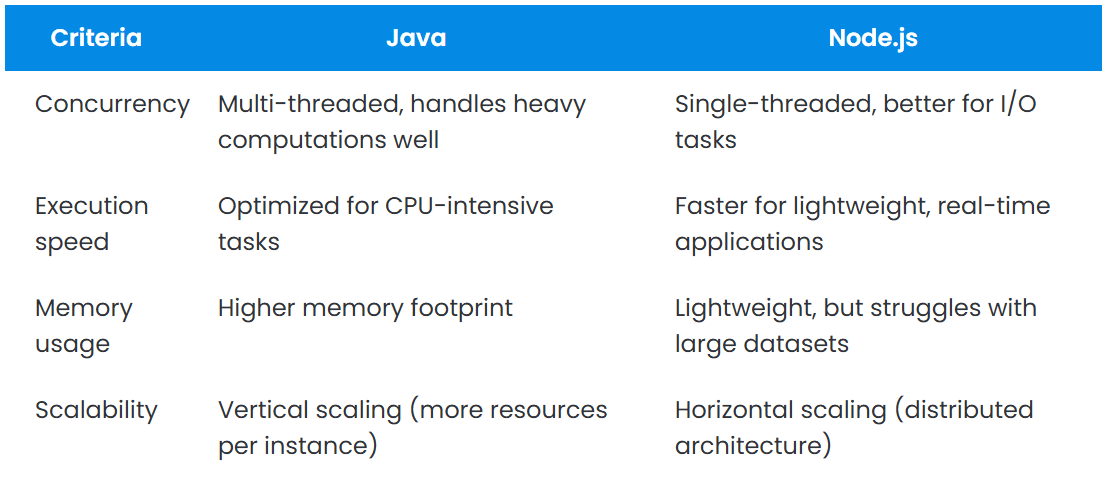
Performance is a critical factor when developing new applications or migrating legacy applications. Below is a benchmarking analysis that compares the performance of Node.js and Java-based applications across various workloads and scenarios.

2. Horizontal scaling (distributed architecture)

Modern enterprises are shifting towards cloud-native architectures with containers, serverless computing, and microservices. Java’s enterprise-ready features, robust ecosystem, and scalability make it a natural choice for building cloud-native applications, especially in large-scale, mission-critical deployments whereas, the asynchronous event-driven model and flexibility of Node.js align well with the demands of cloud-native application development, enabling rapid prototyping and deployment of scalable, distributed services.

Java for cloud-native applications

  • Strong support for Kubernetes, Docker, and Spring Boot microservices
  • Works well with serverless platforms (AWS Lambda, Azure Functions) but has a heavier runtime
  • Best for enterprises needing hybrid cloud and on-premises stability

Node.js for cloud-native applications

  • Lightweight and event-driven – ideal for serverless functions and microservices
  • Scales horizontally across distributed environments, making it a good fit for cloud-first startups
  • Works seamlessly with API-driven architectures and edge computing

3. Cost

The total cost of ownership (TCO) is a critical factor in migration or new development decision, encompassing infrastructure, licensing, and ongoing maintenance expenses.

Infrastructure

Node.js, with its lightweight, event-driven model, typically requires fewer server resources and lower infrastructure costs compared to Java-based applications, which often have higher memory and CPU requirements.

Licensing and tools

Node.js, being an open-source platform, avoids the licensing fees associated with commercial Java development tools and application servers.

Maintenance and support

While Java benefits from a mature, enterprise-grade ecosystem with extensive documentation and a large community of experienced developers, Node.js maintenance and support costs can be lower due to its simpler architecture and the prevalence of open-source libraries and community-driven solutions.

4. Security and reliability

As organizations migrate legacy applications or build new ones, ensuring robust security, reliability, and compliance is paramount, especially for mission-critical systems.

Security

Java’s strong typing, mature security libraries, and well-established best practices make it a preferred choice for building secure, enterprise-grade applications. Node.js, while offering a robust security ecosystem, requires more proactive management and vigilance to address potential vulnerabilities in its open-source dependencies.

Reliability

Java’s proven track record of reliability, scalability, and fault tolerance, combined with its enterprise-grade tooling and application containers, make it a compelling choice for mission-critical systems that demand high availability and resilience. Node.js, with its asynchronous, event-driven architecture, can also deliver reliable performance, particularly in WebSockets workloads, when properly configured and managed.

Compliance and governance

Organizations in highly regulated industries often require strict compliance and governance frameworks. Java’s maturity and enterprise-grade security features align well with such requirements, while Node.js may require additional attention to ensure the integrity and traceability of mission-critical applications.

Real-world success stories

This section outlines a series of real-world case studies that highlight the experiences and outcomes of organizations that have successfully transitioned from legacy platforms to Node.js or Java-based architectures or built new applications using any of these technologies.

E-commerce platform

A leading retail e-commerce company migrated its legacy .NET-based platform to a Node.js-powered architecture, resulting in a 40% improvement in response times, a 25% increase in developer productivity, and significant cost savings in infrastructure and hosting.

Healthcare data analytics

A healthcare technology provider transitioned its legacy Java-based data analytics platform to a modern, microservices-based architecture using Node.js. This migration enabled a 50% reduction in time-to-market for new features and a 30% improvement in system scalability.

Financial services integration

A global financial services firm migrated its complex integration layer from a monolithic Java application to a distributed, event-driven architecture powered by Node.js. This transformation resulted in a 35% increase in system throughput and a 20% decrease in maintenance overhead.

Open Access Fiber Network Platform

A leading digital infrastructure company built a new platform to manage an open-access fiber optic network. Using a hybrid architecture with Java microservices for network provisioning and Node.js services for real-time dashboards and portals, the platform enabled multi-tenant ISP management, customer onboarding, and network provisioning. This approach improved scalability, optimized performance by workload type, and supported domain-driven design.

Making the right choice

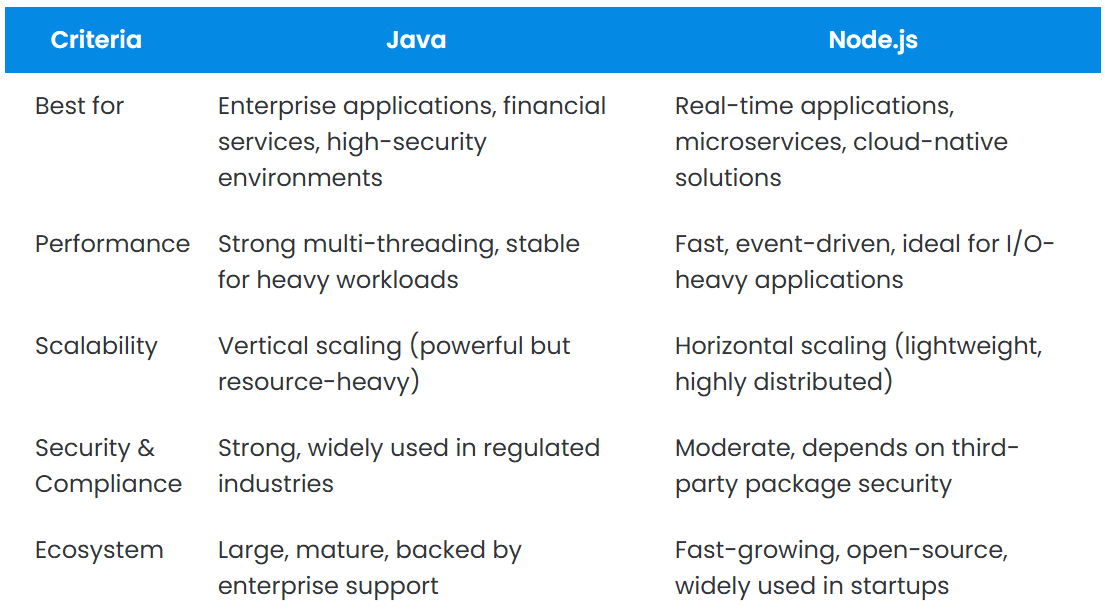
Java remains a robust and reliable choice for enterprise-grade applications, particularly in industries that demand high security, compliance, and scalability. Its mature ecosystem, extensive libraries, and strong typing make it suitable for large-scale, mission-critical systems. Java’s performance in CPU-intensive tasks and its proven track record in enterprise environments continue to make it a preferred choice for many organizations.

Node.js, on the other hand, excels in real-time, I/O-bound applications due to its non-blocking, event-driven architecture. It is particularly favored by startups and agile development teams for its rapid development cycle, lightweight runtime, and efficient resource utilization. Node.js is also highly suitable for microservices and serverless architectures, making it a popular choice for modern, cloud-native applications.

Both platforms have their strengths and are evolving to meet the demands of contemporary software development. Java’s advancements in cloud-native compatibility and Node.js’s growing ecosystem for enterprise applications highlight their adaptability and relevance in today’s technology landscape.

To help CTOs and IT leaders make an informed choice, here’s a decision matrix that can help:

Our perspective

For enterprise-scale applications, Java is often the preferred choice due to its maturity, extensive libraries, and strong concurrency support. However, for modern web applications that require real-time interactions and fast development cycles, Node.js is an excellent choice due to its lightweight, scalable architecture and the ability to use JavaScript throughout the full stack.

Best of both – A hybrid approach

Many enterprises are moving toward a hybrid tech stack where Java powers mission-critical backend systems, while Node.js handles APIs, microservices, and real-time interactions. For instance, a large financial institution may use Java for its core banking system while integrating Node.js for a customer-facing chatbot that responds in real-time. You could consider a hybrid approach for the best balance of stability and flexibility, if it aligns with your business needs.

Still unsure which approach suits your enterprise? Our experts at InfoVision specialize in Java and Node.js migrations, modernization, and cloud transformations. Connect with us at digital@infovision.com to explore the best-fit solution for your business.

How GenAI Is reshaping retail – And why we are on the cusp of a remarkable transformation

A customer browses your online store late at night, checking out the maroon and dark green jacket, adding it to the cart but leaving without buying. By morning, your AI-powered system has analyzed their behavior, identified them as a high-intent shopper, and triggered a personalized offer the moment they step into your store. No manual intervention, no guesswork – just seamless AI-driven engagement that converts interest into sales.

This isn’t a futuristic fantasy. It’s happening right now as retailers embrace Generative AI (GenAI) to optimize every aspect of the shopping experience – from hyper-personalized marketing and dynamic pricing to automated supply chains and cashier-less stores.

In our recent webinar on How GenAI is transforming retail innovation, industry leaders explored how GenAI is already making waves in retail, the challenges of AI adoption, and where the future is headed. Hosted by Nitin Naveen (VP – Innovation Strategy, AICorespot) and moderated by Jaydev Doshi (Director, Retail, InfoVision), the webinar panel featured:

From C-suite perspectives on AI implementation to how retailers are using AI to reduce costs, increase sales, and improve customer retention, the discussion made one thing clear: AI isn’t coming. It’s already here.

Let’s break down what they had to say – without the technical jargon, but with genuine insights and some additional real-world examples to boost understanding.

Retail’s two big goals: Cut costs & boost sales

Retails two big goals Cut costs & boost sales

If there’s one thing that never changes in retail, it’s the relentless push to lower costs while driving more revenue.

Aravind Kashyap explained how retailers work with razor-thin margins. Anything that helps them reduce costs or increase sales is a game-changer.
Retailers are leveraging AI to optimize supply chains, reduce waste, and predict demand more accurately – helping them keep shelves stocked without overloading warehouses. AI is also helping them streamline operations, reduce IT overhead, and automate routine processes, which adds up to significant cost savings over time.

On the sales side, AI is making customer engagement more intelligent and efficient. AI-powered personalization ensures that customers receive precisely what they are looking for, without having to search endlessly.

A good example of this is Walmart’s use of AI-driven inventory forecasting. Walmart’s AI analyzes historical sales data, weather patterns, and regional trends to ensure that the right products are in stock at the right time. During peak shopping seasons, AI helps prevent stockouts and overstock issues, ensuring customers always find what they need while reducing operational waste.

AI is also transforming retail marketing. GenAI can now create highly targeted campaigns by analyzing past purchases, browsing behaviors, and even sentiment from social media interactions. Instead of blasting generic promotions, AI helps retailers send the right offer to the right customer, at the right time.

The shift from personalization to hyper-personalization

For years, retailers have worked on personalizing experiences – things like “People who bought this also bought…” or sending birthday offers. But GenAI is taking this further, creating experiences that feel uniquely crafted for each customer.

Take chatbots, for example. A few years ago, they were just task-oriented virtual assistants, handling basic queries like “What’s my order status?” or “Where’s the nearest store?” Now, they understand context, sentiment, and intent. Instead of offering 20 similar products, they interpret what the customer really wants and deliver the most relevant choice.

Retailers are also using AI to analyze customer sentiment and behavior in real time. If someone searches for a white shirt with a blue stripe, AI can recognize not just the color preference but the style, fit, and even brand tendencies. This level of precision makes shopping frictionless and more engaging.

Aravind spoke about Domino’s being a great example of this shift. They let customers order pizza using just an emoji, because their AI already knows their usual order. No need for extra steps or manual selections. That’s hyper-personalization in action.

The beauty retailer, Sephora, utilizes AI-powered chatbots to deliver personalized product recommendations and makeup tips. By analyzing customer preferences, past purchases, and even skin tone data from Sephora’s Color IQ technology, these chatbots offer tailored advice that mimics the expertise of in-store beauty consultants. This level of hyper-personalization can help increase customer engagement and boost conversion rates.

Hyper-personalization also helps solve a critical challenge in retail – customer churn. As Hemanth Kumar pointed out, AI is now being used to predict when a customer is about to leave and take proactive steps to retain them. AI-powered churn prediction models analyze browsing habits, purchase frequency, and engagement levels to flag at-risk customers. Retailers can then offer personalized offers, exclusive early access, or targeted re-engagement campaigns before customers abandon the brand.

AI’s growing role in reducing product returns

AI’s growing role in reducing product returns

Returns are one of the biggest cost drivers in retail, and AI is now tackling this issue from both proactive and reactive angles.

On the proactive side, AI is improving product recommendations and sizing tools, reducing the chances of a customer buying the wrong item in the first place. Virtual try-ons and AI-generated fit assistants help customers make more informed choices, leading to fewer returns.

On the reactive side, AI is analyzing return patterns to identify which products are frequently sent back and why. Retailers can then decide whether to improve product descriptions, fix manufacturing defects, or even discontinue problematic items altogether.

Zalando, a European online fashion retailer, implemented an AI-powered size advice feature that combines machine learning and computer vision technologies. This system analyzes various data sets, including brand-provided item information, to inform customers if an item runs small or large, recommending size adjustments accordingly. As a result, Zalando has achieved a 10% reduction in size-related returns compared to items without size advice.

Another case in point is Amazon using AI to identify damaged items before they are shipped to customers, to reduce inevitable returns down the line.

Bridging the online-offline gap

Bridging the online-offline gap

One of retail’s big pain points has been the disconnect between online and in-store experiences. Customers want a seamless transition between both, retailers struggle to make that happen. AI is starting to bridge that gap.

Imagine browsing for shoes on a retailer’s website in the morning, then walking into the store in the afternoon. AI can recognize your online activity and offer personalized recommendations based on what you already viewed.

Some retailers are even using AI-powered cart handovers, where your mobile shopping cart syncs with in-store inventory in real time. If a product is unavailable in-store, AI can instantly suggest an alternative or offer a home delivery option, without any extra steps.

Luxury brand Burberry’s phygital store experiences through smart mirrors and digital screens allow seamless online-to-offline integration.

This kind of AI-driven unified commerce is quickly becoming the new standard.

AI Is no longer just a tool, it’s a business partner

AI Is no longer just a tool, it’s a business partner

Retailers are now embracing Agentic AI, which moves beyond just assisting with recommendations or transactions. AI is now taking action.

For example, many companies have already deployed AI-powered dynamic pricing models that adjust product prices in real-time based on demand, competitor pricing, and customer behavior. Instead of waiting for a team to manually review pricing trends, AI makes those decisions instantly.

Retailers are also using AI to automate back-end operations, such as supply chain management. AI is now predicting which products will run out of stock before it happens, rerouting shipments in real time, and ensuring inventory levels are optimized, without human intervention.

Ocado, a UK-based online grocery retailer, operates AI-powered fulfillment centers where intelligent robots autonomously manage inventory, retrieve products, and pack orders.

Cashier-less checkouts, another AI-driven innovation, have started appearing in major retail stores. AI doesn’t just scan products; it also monitors shopping behavior, detects fraud, and personalizes offers in real time.

Even finance departments are feeling AI’s impact. Companies are now deploying AI-driven credit collection agents, which manage invoices, payment reminders, and credit limits without human involvement.

As Aravind noted, AI is not just a tool, it’s a teammate making decisions alongside you.

Challenges and considerations

Challenges and considerations

While the promise of generative AI is immense, the journey isn’t without its obstacles.

Cutting through the AI hype

Every executive today is under pressure to jump into AI.

Sruti Patnaik shared a common dilemma: many retailers want to launch AI projects simply because everyone else is doing it. But not every problem requires GenAI.

Before investing in AI, retailers need to ask:

  • Is our data clean, organized, and structured – Is it ready to use?
    AI is only as good as the data it’s trained on. Messy data leads to unreliable results.
  • Is this solving a real business challenge?
    Just because AI can do something doesn’t mean it should.
  • What’s the actual ROI?
    AI projects can be expensive, and not all of them deliver the expected results.

The key takeaway? AI isn’t a magic fix for every problem. It’s a powerful tool, but only when used thoughtfully, and with the right data. Retailers that clean up, centralize, and structure their data will have a huge competitive advantage as AI continues to evolve.

Amazon has mastered this by using AI to clean and structure vast amounts of customer data. Its recommendation engine is powered by AI models that continuously refine product suggestions based on real-time shopping behavior.

Security & ethical concerns – The elephant in the room

Many companies, including big retailers like Target, have implemented AI-driven fraud detection systems that analyze real-time transaction data to identify unusual patterns. The AI models are trained to recognize potential fraud based on behavior anomalies, such as sudden large purchases or frequent returns.

However, as AI becomes more powerful, security risks grow even bigger. It’s a double-edged sword. Deepfake scams, misinformation, and data privacy concerns are already raising red flags across industries. AI-powered systems need vast amounts of customer data, and that opens up serious questions about how much data is too much.

Sruti emphasized that businesses are not spending enough time thinking about security. While companies rush to adopt AI, cybersecurity risks are often treated as an afterthought. And that’s a problem.

The speed at which AI is evolving means that ethical and security discussions need to catch up – very fast. Addressing this challenge necessitates continuous vigilance, innovative strategies, and a commitment to cybersecurity excellence.

What’s next for AI in retail?

What’s next for AI in retail

The future of AI in retail isn’t about whether companies will adopt AI, it’s about how they choose to use it.

Aravind believes that AI will soon be embedded into every business function, from HR and supply chain to marketing and finance. The challenge won’t be finding AI solutions, it will be figuring out how to use them effectively.

Sruti advised that businesses start small, focus on internal use cases first, and prioritize ROI.

Hemanth echoed this sentiment, emphasizing that the next three months matter more than the next three years. AI is evolving so rapidly that businesses must remain adaptable.

The AI revolution is here. Are you ready?

Retail is at an inflection point. The brands that succeed will be the ones that think strategically about AI, rather than just jumping on the bandwagon.

  • Hyper-personalization is no longer optional, it’s expected.
  • Agentic AI is turning AI from a passive tool into an active business partner.
  • Security and ethical concerns need to be tackled head-on.

The question isn’t whether AI will transform retail, it’s how well businesses can leverage it to their advantage. Because AI isn’t coming! It’s already here.

For more insights on the future of in-store shopping in the GenAI era, download our whitepaper.

Want to build your AI strategy for retail? Let’s talk. Connect with our experts at digital@infovision.com.

The future of digital health: Innovations reshaping healthcare

Picture this: a world where a smartwatch can alert a doctor about a potential health issue before someone even feels sick. That’s not sci-fi. It’s the power of digital health, and it’s already reshaping how we experience healthcare. Our recent webinar, hosted by Sandeep Punjani, Vice President – Healthcare, Life Sciences and Manufacturing at InfoVision on “The Future of Digital Health: Innovations in Healthcare Technology,” brought together some of the brightest minds in healthcare and technology to talk about where the healthcare industry is headed and what it means for healthcare providers and their surrounding landscape. Here’s a breakdown of what they had to say.

Empowering patients with AI and engagement tools

Empowering patients with AI and engagement tools

Engaging patients in their care journey is the cornerstone of modern healthcare. Technology is giving patients tools to take control of their health, providing access to information, and facilitating better communication with providers.

Shauna Zamarripa, Director of Business Analytics at Community First Health Plans, shared how her team used AI and predictive analytics for maternity health monitoring. This project improved outreach and care for high-risk pregnancies by partnering with local organizations, ensuring a holistic support system. She also highlighted how AI-driven insights are now being applied to behavioral health.

“Being able to do predictive analytics has been absolutely game changing and we’re now moving that into the behavioral health space,” Shauna highlighted.

But the applications of AI don’t stop there. Madhur Pande, Senior Vice President of Digital Product at Optum Health and former Executive Director of Digital Products at Kaiser Permanente, described how wearables are making proactive health management possible. She emphasized the importance of remote patient monitoring (RPM). Devices that track chronic conditions are transforming care by enabling continuous observation and early clinical intervention. Madhur described how wearable technologies help manage conditions like diabetes and heart failure, offering significant benefits for both patients and providers.

“Wearables keep people healthy and reduce the cost of care,” she explained.

Patient portals are another vital tool. They allow patients to access medical records, view test results, and receive reminders, fostering greater autonomy in managing their health. Pande noted that high adoption rates at Kaiser Permanente – exceeding 80%, demonstrate the potential for technology to enhance patient-provider relationships.

Telehealth: Increasing access and reducing barriers

“Availability, accessibility, affordability – all these things have really been supercharged with telehealth,” he shared.

Telehealth is also expanding beyond virtual consultations. Diagnostic services, such as radiology readings, can now be handled remotely, often reducing turnaround times from days to hours. To Ram’s points, Madhur cited how behavioral health services have particularly embraced telehealth, with virtual visits rising from 40% of appointments in 2021 to 67% in 2023.

Shauna pointed out how it is essential for providers to be cognizant of patient preferences and leave space to innovate and create new mechanisms instead of just continuing doing things the way they have always been done.

“The ultimate goal is giving the patient the ability to feel like they are in charge of their healthcare journey,” she remarks.

AI-powered clinical workflows: Efficiency without overload

Telehealth_ Increasing access and reducing barriers

AI offers immense potential to streamline clinical workflows, reduce administrative burdens, and combat provider burnout. However, thoughtful implementation is critical to prevent new inefficiencies. Clinicians are already stretched thin, and poorly deployed AI can add complexity instead of reducing it. Both Shauna and Madhur emphasized that AI must complement, not complicate, existing processes.

“You have to be cognizant of anything that is incorporating AI to not replace humans but support them.” Shauna believes.

One promising application is AI-driven triaging, where tools can sort patient messages and prioritize urgent cases. Madhur highlighted the importance of pilot testing and involving clinicians when rolling out new systems to ensure adoption and trust.

“When we are thinking about bringing AI to an environment like health care, it needs to be very thoughtful and purposeful,” she noted.

The concept of “human-in-the-loop” AI emerged as a best practice, ensuring clinicians retain control over AI-generated recommendations. Trust, transparency, and collaborative governance are essential to successfully integrate AI into healthcare systems.

Data privacy, bias, and ethical AI

Data privacy, bias, and ethical AI

With AI’s growing role comes increased responsibility to safeguard data privacy and mitigate bias. Shauna highlighted the importance of consistent data collection practices to ensure accuracy and integrity. She described how improper handling of sensitive information – such as emailing unprotected patient data, poses significant privacy risks.

“You need to make sure that the AI technology that you’re deploying or using within your organization is compliant with the relevant regulatory bodies,” Shauna highlighted.

Consent management is another critical area. Ram pointed out that machine learning algorithms do not inherently respect consent boundaries. Embedding consent rules into AI workflows is vital to prevent unauthorized data usage.

He remarked “We have to find a way to take the consent management restrictions and build them into the ML workflow.”

Bias in AI models remains a pressing issue. Without diverse and representative datasets, AI systems risk perpetuating healthcare disparities. Ethical review boards and rigorous data governance frameworks are necessary to address this challenge.

Shauna pointed out that data quality directly impacts the success of AI.

“It is really important to make sure that we unknowingly are not feeding our biases to the systems,” Madhur highlighted.

AI in drug discovery and personalized medicine

AI in drug discovery and personalized medicine

Drug discovery is a costly, time-consuming process, but AI is accelerating key stages. From predicting protein structures to identifying therapeutic targets, AI-driven simulations reduce reliance on lab testing.

Ram described how AI helps pharmaceutical companies speed up clinical trials by automating participant selection and analyzing trial data in real time. While no drugs have been fully developed using AI yet, platforms like DeepMind’s AlphaFold and IBM Watson are already making significant strides.

Personalized medicine, guided by genomic data, represents another frontier. AI enables rapid analysis of genetic mutations and their implications for individualized treatment plans.

“If you look back ten years, most of the genomic information was static, but the human genome is not static, it’s evolving. So, the AI tools have to be able to absorb real time data and be able to continually update your genome map,” Ram observed.

Cybersecurity for a digital future

Cybersecurity for a digital future

The rapid adoption of digital health technologies raises cybersecurity concerns. Healthcare data is a prime target for cyberattacks, and traditional security measures are insufficient against AI-enabled threats.

Ram stressed the need for dynamic, real-time cybersecurity solutions since static defences can’t handle threats evolving with AI.  He emphasized on adaptive architectures and comprehensive employee training.

“The current suite of cyber security platforms across the Globe were never designed with the proliferation of AI in mind”, he said.

Policy frameworks must also evolve. Regulations governing AI, telehealth, and genomic data require continuous refinement to balance innovation and patient safety.

Webinar

In summary, the webinar underscored several transformative trends shaping the future of healthcare:

AI-driven tools: From wearables to predictive analytics, AI is empowering patients and improving outcomes.

  • AI-driven tools: From wearables to predictive analytics, AI is empowering patients and improving outcomes.
  • Telehealth expansion: Virtual care is making healthcare more accessible, especially for underserved populations.
  • Ethical AI: Clean data, privacy safeguards, and diverse datasets are crucial to making AI reliable and equitable.
  • Pharmaceutical innovation: AI is reducing the time and cost of drug development while paving the way for personalized medicine.
  • Future technologies: Quantum computing and advanced cybersecurity solutions are poised to tackle healthcare’s critical challenges.

The road ahead

The future of digital health is filled with promise. Innovations in AI, telehealth, and personalized medicine are enhancing care delivery and improving outcomes. However, realizing this vision requires a holistic approach – combining technology with thoughtful policy, ethical governance, and human collaboration.

As healthcare embraces these changes, the goals remain clear: empowering patients, reducing disparities, and creating a more connected, efficient healthcare system. By pushing boundaries and staying vigilant about ethical considerations, we can shape a future where technology serves as a true catalyst for health and well-being. To know more about the technologies shaping healthcare, reach out to us at digital@infovision.com.

MSSP: The final piece of the Security puzzle for CISOs

CISOs (Chief Information Security Officers) are constantly putting out fires as they face increasing complexities daily with additional threats like AI-based attacks, ransomware, and supply chain vulnerabilities dotting the ever-evolving threat landscape. Even if new security tools are acquired, a lack of skilled staff to manage them exacerbates the problem. As if this is not enough, they face growing regulatory pressures, limited budgets, and resource constraints, often leaving companies vulnerable.

According to a Security Leaders Report, on average, enterprises use 76 security tools, many of which require manual intervention, leading to inefficiencies and errors. The shortage of cybersecurity professionals is severe, with over 500,000 positions unfilled in the U.S. alone, creating additional stress on already overstretched teams. Fatigue from manual tasks and alert overload contribute to human errors, driving high turnover rates in the field—33% of security professionals change careers due to burnout, it is said.

This pressure extends to CISOs themselves, with 32% considering leaving due to regulatory demands and 70% contemplating a change due to overall stress. Board conflicts, like the one that led Alex Stamos to leave Facebook, further strain the role, making the average CISO tenure just two years, compared to five for other C-suites.

This blog focuses on how CISOs, who are tasked to fight evil with their hands tied behind their back, can bolster their arsenal with the right Managed Security Services Provider (MSSP) partner. As they grapple with the challenges of limited resources and budgets causing burnout and attrition, can MSSPs be the silver lining? What immediate and strategic advantages do MSSPs bring? How can companies benefit from this partnership and how can CISOs ensure that their KPIs are met? Read on to uncover our perspective.

Going the MSSP way is a wise move by CISOs

Going the MSSP way is a wise move by CISOs

An MSSP offers security tools and services such as security management, monitoring, and response services. It acts like an extended arm, especially for businesses with small in-house security teams and limited expertise. An MSSP can therefore be the exact solution to the CISO’s predicament. Let’s find out ‘why’ and ‘how’.

Reduced costs

Having a full-scale in-house security team is expensive, especially when the security budget is tight. Most CISOs do not have a separate budget, as their budgets are carved out from the IT. On average, only 9% of this IT budget goes to security. In such a challenging scenario, partnering with an MSSP makes ample business sense.

For instance, any organization that’s considering running an in-house Security Operations Center (SOC), would have to spend more than USD 2.8 million a year.10 Running an advanced SOC can be as expensive as USD 5 million. In contrast, using SOC services from an MSSP costs around USD 1.4 million – around 50% cheaper than an in-house SOC. These numbers may further go down depending on what type of services are chosen. CISOs understand that in-house security teams mean full-time resources and tools – this needs up-front capital investment.

Skill availability

Apart from costs, the availability of the right experts in the market is a concern. As millions of security jobs are still open, recruiting the right talent continues to be a hurdle. It takes more than 7 months to recruit and train a security analyst. Attrition in the security department makes this even worse – it can be assumed that about 3 analysts will leave or be fired from the team.12

The lack of resources creates fatigue for the small in-house team, which is unable to cope with the tasks. According to Gartner, by 2025 more than 50% of security incidents will be attributed to a lack of security professionals or human errors.13

CISOs do not have to deal with either skill gaps or the availability of talent with an MSSP.  MSSPs employ experienced cybersecurity experts with specialized knowledge in various domains, such as threat detection, incident response, and compliance. MSSPs provide access to skilled professionals and advanced security tools like SIEMs, threat intelligence platforms, and automated detection systems.

Tools, technology & capabilities

Security Tools technology capabilities

As the threat landscape keeps changing with new threats looming around, newer tools are launched in the market. We already discussed that on average an enterprise maintains more than 76 security tools. Managing and adding so many tools can be unrealistic for many companies.

Additionally, organizations that have piled up security tools to avoid buyers’ regret end up not maintaining or patching previous software. This increases the attack surface and vulnerabilities. It can also create non-compliance issues due to software non-maintenance.

When outsourced to an MSSP, all these challenges are easily handled. Additionally, MSSPs provide 24/7 monitoring, threat detection, and immediate incident response capabilities to reduce the risk of undetected breaches. This constant vigilance reduces the average breach detection time.

Threat detection and incident response are critical parameters. For instance, if a company with limited in-house capabilities takes longer to detect and respond to a breach, then it’s likely to have a longer period of downtime. The longer the downtime, the more revenue losses. For most enterprises, the cost of hourly downtime is about USD 300,000, and these costs have been rising.14 This signifies the importance of faster detection and incident response which an MSSP can offer. Every hour means lower costs incurring out of downtime.

Even further, implementing advanced technologies like AI & ML in-house can be expensive as well as complicated, but these technologies are needed for advanced threat detection and remediation. Partnering with a service provider with the latest capabilities such as AI, ML, & Automation is much simpler.

Regulatory compliance

Regulatory compliance

Companies need to be compliant with many data security and privacy regulations, usually more than one. For example, a multinational financial company might have to deal with GDPR, PCI DSS, CCPA AML, and more.

The cost of non-compliance with each one of these regulations can be pretty steep. For instance, GDPR fines can go up to Euro 20 million or 4% of annual turnover (global), whereas PCI DSS ranges between USD 5000 to 100,000 per month until compliance is met.

In 2023, Meta was fined a staggering amount of USD 1.2 billion (under GDPR) relating to the unlawful transfer of customer data to the USA.15 Non-compliance costs bother CISOs much because of too many hassles, and they usually need external help staying compliant with multiple, ever-changing regulations is complex and resource intensive.

MSSPs provide expert teams with in-depth knowledge of regulatory frameworks. They also leverage advanced tools like automated compliance monitoring and real-time reporting. They ensure continuous compliance by managing audits, maintaining required controls, and swiftly addressing gaps, allowing businesses to avoid costly fines, reputational damage, and operational disruptions while staying focused on growth.

Scalability

With staff and skill shortages, it’s difficult for CISOs to take on additional projects. For instance, if a Zero Trust security architecture is to be implemented on top of existing solutions – more resources are needed. Resources are also needed to manage the operations after the implementation. Such business requirements cannot be met overnight – hence MSSP is a good alternative.

MSSPs offer scalable solutions that grow with the business. Whether a company needs to expand coverage, integrate new systems, or manage peak security demands, MSSPs adapt more easily than in-house teams. The additional advantage is not just scaling up but also scaling down – the number of resources can be reduced if there’s no requirement in the future.

Picking up the right partner

There is no doubt that picking an MSSP makes a compelling case. However, there are the following key considerations that businesses must oversee before zeroing in on anyone. Here is a checklist that we have designed to help you identify the right partner.

  • Do services and solutions offered by the MSSP integrate with current technology investments?
  • What are detection and response capabilities? What are the metrics used to measure the success? What are the SLAs?
  • What different regulatory compliances does the MSSP support?
  • What is the scope of the service offerings? Are the SLAs defined?
  • What is the level of reporting and visibility? Will there be real-time dashboards available? Will security operations be transparent enough? What will the frequency of different reports be?

The above questions help businesses align with the right MSSP that aligns with their security needs, technology requirements, and strategic goals.

How InfoVision can help

As one of the most trusted MSSP providers, we can help to improve your security posture and resilience. Right from endpoint protection solutions to the implementation of modern Zero Trust security solutions, we’ve got you covered.

Our customers trust us for our robust capabilities such as threat detection, incident response, intrusion detection, managed firewall, virtual private network (VPN), and various security assessments. For businesses that want to evaluate their current security posture, we offer different security assessments.

We enable businesses to access the latest technologies and security platforms like AI, ML, Automation, and more for enhanced detection capabilities. We also offer compliance assistance empowering CISOs and other C-suite leaders to focus on their core business objectives.

With security professionals having sound industry experience, businesses can easily onboard resources to scale up operations. Above all, our core strength is in security policy configurations, access management, 24/7 threat detection, and swift response to cyber risks. InfoVision also has experience in managing security operations of large organizations – and if you need advice on where to begin, talk to us today.

Need help in managing security or improving current security posture? Get in touch with us today for a discovery call.

You may also read:  MDR made simple to explore the emerging role of managed detection and response (MDR) in cybersecurity.